
Your complete guide to civil marriage process in the UAE

Updated: Jun 1

TL;DR:
Civil marriage in the UAE is a fully independent, secular process accessible to expats and non-citizen Muslims, without religious requirements. The process involves attesting documents through multiple official steps, with professional assistance simplifying navigation of complex certification chains. Couples can register in Abu Dhabi or Dubai, and their marriage certificates are recognized internationally after proper attestation, making civil marriage a flexible option for modern couples.
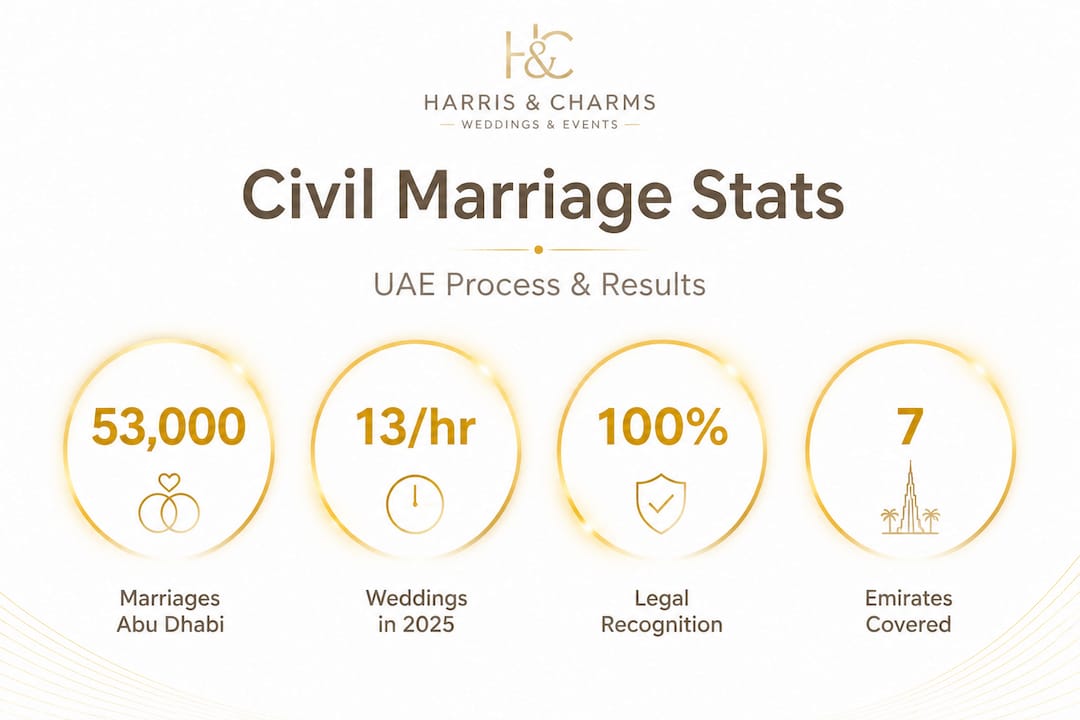
Many couples arriving in the UAE assume they only have two options: a religious ceremony or a long, confusing legal battle. That assumption is simply wrong. The UAE has quietly become one of the most welcoming destinations in the world for civil marriage, particularly for expats, interfaith couples, and even tourists who want a legally binding ceremony without religious requirements. Since 2021, Abu Dhabi’s Civil Family Court has registered roughly 53,000 civil marriages, a figure that reflects just how dramatically demand has grown. This guide will walk you through everything you need to know.
Table of Contents
Understanding civil marriage: What makes it unique in the UAE
Eligibility and legal requirements: Who can marry and what documents to prepare
After the ceremony: Attestation, personal status, and global recognition
Our perspective: The real secret to a smooth UAE civil marriage
Get personalized help to make your UAE civil marriage stress free
Key Takeaways
Point | Details |
Civil marriage is accessible | Expats and non-Muslims can legally marry under streamlined UAE civil law, especially in Abu Dhabi and Dubai. |
Essential documents required | You must prepare certified documents, such as a single status certificate and attested IDs, for a smooth application. |
Process is fast and digital | Abu Dhabi and Dubai offer rapid, often digital marriage registration with certificates valid throughout the UAE. |
Attestation needed for abroad | To use your marriage certificate internationally, proper attestation by MOFAIC and your embassy is required. |
Expert help prevents delays | Using authorized agents or legal advisors can help avoid common pitfalls and documentation setbacks. |
Understanding civil marriage: What makes it unique in the UAE
Civil marriage in the UAE is not simply a watered-down version of a religious ceremony. It is a fully independent, secular process governed by specific laws. The core distinction matters because it changes who can marry, where they can marry, and what legal protections apply afterward.
At the federal level, civil marriage under Federal Decree-Law No. 41 of 2022 is designed primarily for non-Muslims. However, Abu Dhabi took things further. Under its own local legislation, Law No. 14 of 2021, non-citizen Muslims can also access the civil marriage system. That single distinction makes Abu Dhabi far more accessible than most couples realize. You can read more about the civil vs Islamic marriage differences to get a clearer picture of how these two paths diverge in practice.
Here is a quick comparison to help frame the choice:
Feature | Civil marriage (UAE) | Islamic marriage (UAE) |
Religious officiant required | No | Yes (Qadi) |
Available to non-Muslims | Yes | No |
Available to non-citizen Muslims | Yes (Abu Dhabi) | No |
Governed by | Federal/local civil law | Sharia-based personal status law |
Interfaith couples eligible | Yes | Restricted |
Internationally recognized | Yes (with attestation) | Varies by country |
A few things make civil marriage in the UAE especially well-suited for the modern expat:
No religious conversion is required under any circumstance
Both partners do not need to share the same faith
The process is conducted in a court or official civil registry setting
The resulting certificate carries the same legal weight as any government-issued marriage document
“Civil marriage in the UAE gives couples the freedom to formalize their relationship on their own terms, without compromising their personal beliefs or nationality.”
For a full breakdown of what this process entails from start to finish, the civil marriage guide covers each stage in plain language.
Eligibility and legal requirements: Who can marry and what documents to prepare
Now that you understand what civil marriage is, the next question is whether you qualify. The rules differ somewhat between Abu Dhabi and Dubai, and the document list can feel overwhelming at first. Breaking it down by jurisdiction makes it much more manageable.
Abu Dhabi eligibility basics:
Minimum age is 18 years old for both parties
Non-Muslim expatriates and non-citizen Muslims are eligible
No UAE residency requirement (tourists and visitors can apply)
Both partners must appear in person at the Abu Dhabi Civil Family Court
Dubai eligibility basics:
Dubai civil marriage requires at least one UAE resident
Minimum age is 21 years old
Both partners must appear in person at Dubai Courts
A notary public officiates the ceremony, and processing can be as fast as 24 hours in some cases
The document requirements overlap significantly between the two emirates, but the attestation chain is where most couples run into trouble. Here is a general document table:
Document | Abu Dhabi | Dubai |
Valid passport copies | Required | Required |
UAE visa or entry stamp | Required | Required |
Single status certificate | Required (attested) | Required (attested) |
Birth certificate | Often required | Sometimes required |
Divorce/death certificate | If previously married | If previously married |
Certified Arabic translation | Required for non-Arabic docs | Required for non-Arabic docs |
Embassy attestation | Yes | Yes |
MOFAIC attestation | Yes | Yes |
The attestation chain means your home country documents must be officially verified by your own embassy in the UAE, then by the UAE’s Ministry of Foreign Affairs and International Cooperation (MOFAIC). Skipping a single step in this chain will result in rejected paperwork. Review the full civil marriage requirements before collecting any documents so you know exactly what level of attestation each item needs.

Pro Tip: Contact your home country embassy in the UAE before leaving your home country. Some embassies have long appointment backlogs for issuing single status certificates, and ordering that document early can save you weeks of waiting time.
Understanding your eligibility for civil marriage is the foundation. If either partner has a prior marriage on record, additional certified documents will be needed, and legal support becomes especially valuable. For a detailed look at what each document must include, visit the UAE legal documentation resource.
Step-by-step: Civil marriage process in Abu Dhabi and Dubai
Knowing the requirements is different from knowing the sequence. The actual process has a specific order, and timing each step correctly reduces both stress and cost.
Abu Dhabi process:
Gather and attest all required documents (this is typically the longest phase)
Book an appointment with the Abu Dhabi Civil Family Court online or in person
Submit documents for screening at the court’s dedicated non-Muslim affairs window
Attend the marriage ceremony with both partners present and two witnesses
Receive your civil marriage certificate, usually on the same day or within 48 hours
Apply for any optional services such as express processing or same-day certificate delivery
Abu Dhabi’s Civil Family Court has driven a surge in expat and tourist marriages specifically by leaning into digital-first systems. Online booking, digital document submission, and express civil marriage options have compressed what used to be a multi-week process into as little as two or three days for well-prepared couples.
Dubai process:
Confirm eligibility (at least one UAE resident, age 21+)
Prepare and attest all required documents
Visit Dubai Courts in person with both partners and your witnesses
Submit documents to the notary public section
Complete the ceremony with the notary officiating
Receive your certificate, often the same day if all documents are in order
Pro Tip: The civil marriage application process in Dubai tends to move faster once documents are approved because the notary can often finalize everything in a single visit. However, the document screening phase is strict. One missing attestation stamp equals a full restart.
A key insight for civil marriage for expats is that timing your appointment strategically matters. Early morning weekday slots typically move faster. Avoid scheduling your document submission the day before or after national holidays when court volumes spike.
The overall success rate across both emirates is high. With 53,000 marriages processed in Abu Dhabi alone since 2021, the system is clearly designed to handle large volumes efficiently. The bottlenecks almost always come from incomplete attestation, not from the courts themselves.
After the ceremony: Attestation, personal status, and global recognition
Receiving your marriage certificate is a milestone worth celebrating. But if you plan to use that certificate outside the UAE, whether for immigration purposes, name changes, or property rights in your home country, there are several more steps to complete.
Attestation process for international use:
Obtain the original UAE civil marriage certificate from the issuing court
Submit to MOFAIC for UAE-level attestation
Submit the MOFAIC-attested certificate to your home country’s embassy in the UAE
Some countries require an additional apostille stamp from your home country’s own authorities once you return
For a detailed walkthrough of each stage, the marriage attestation UAE process page breaks down country-specific requirements and typical timelines. For international certificate use, the full MOFAIC attestation followed by embassy verification is the accepted chain, and couples can choose either UAE civil law or their home country’s law for personal status matters such as inheritance and custody.
Pro Tip: Decide before the ceremony which country’s personal status law you want to govern your marriage. This choice is recorded when you register, and changing it later requires a separate legal process.
Post-ceremony checklist:
Collect original marriage certificate from the court
Make certified copies before submitting for attestation (originals can be delayed)
Confirm with your home country embassy exactly which attestation format they accept
Update your employer, bank, and insurance provider with your new marital status
If one partner is changing their name, start that process with their passport authority before any UAE documents are updated
A few practical notes: The UAE civil marriage certificate is valid and recognized across all seven emirates from the moment it is issued. You do not need to re-register in Dubai if you married in Abu Dhabi, or vice versa. The certificate functions as a single national document.
Our perspective: The real secret to a smooth UAE civil marriage
After watching hundreds of couples go through this process, there is one consistent pattern. The couples who sail through it in three to five days are not necessarily the most organized or the most legally sophisticated. They are the ones who respected the attestation chain early and asked for help before problems appeared.
The single biggest mistake we see is underestimating how many separate official stamps a single document needs before the UAE courts will accept it. A single status certificate from a European country, for example, needs to go through notarization in the home country, then the national foreign affairs ministry of that country, then the UAE embassy in that country, and finally MOFAIC in the UAE. That is four distinct steps for one piece of paper. Miss any one of them and your application is rejected at screening.
Abu Dhabi’s civil marriage boom of 13 weddings per hour in 2025 shows that the process works beautifully at scale. But that volume means court staff cannot guide you through individual document errors. They approve or reject, and you return when the issue is fixed.
Professional typing centers and authorized agents who specialize in UAE marriage documentation are not a luxury. For couples from countries with complex certification systems, or for anyone dealing with a prior foreign marriage, they are the difference between a five-day process and a five-week one. The cost of professional assistance is almost always less than the combined cost of rescheduled flights, repeated embassy visits, and the stress of doing it wrong.
For civil marriage for UAE expats, we genuinely believe that the best investment before your ceremony date is a single consultation with someone who has done this hundreds of times. Not because the process is impossibly complex, but because the gap between what you think you need and what you actually need can be surprisingly wide.
Get personalized help to make your UAE civil marriage stress free
Putting this plan into action for your own big day becomes much easier when you have a team that has already navigated every document, every attestation step, and every court protocol on your behalf.

At Harris & Charms, we offer fully personalized support for couples planning a civil wedding in the UAE. Whether you are looking at Dubai civil marriage packages or need hands-on guidance navigating the court requirements in Abu Dhabi, our team handles the paperwork so you can focus on the celebration. Our marriage services Dubai cover everything from document preparation and attestation coordination to venue and photography. Browse the full range of UAE wedding service options and reach out for a quick consultation. We make complicated feel simple.
Frequently asked questions
Can non-Muslim couples from outside the UAE have a civil marriage in Abu Dhabi?
Yes, Abu Dhabi allows non-Muslim non-residents, including tourists, to marry under its civil law without a residency requirement, thanks to Law No. 14 of 2021, which also extends eligibility to non-citizen Muslims.
How fast can Dubai process a civil marriage application?
In cases where all documents are correctly attested and in order, Dubai civil marriages can be finalized within 24 hours because a notary public officiates and the court review is handled in a single visit.
Is my UAE civil marriage certificate valid internationally?
Yes, your certificate is recognized in most countries worldwide, but you must first complete MOFAIC attestation and then have it certified by your home country’s embassy in the UAE before it is accepted abroad.
Can we choose which country’s laws apply to our marriage after the ceremony?
Yes, at the time of registration you can select either UAE civil law or your home country’s personal status law to govern matters such as inheritance, custody, and divorce, as outlined in the UAE attestation framework.
Do I need to use a marriage lawyer or typing center for the process?
It is not legally required, but authorized typing centers and agents significantly reduce the risk of rejected paperwork, particularly for multi-national couples or anyone with prior marriages in foreign jurisdictions.
Recommended
Comments