
Marriage Attestation UAE: Process of Marriage Attestation in UAE Explained


Every expat in the UAE planning a civil or Islamic marriage quickly realizes that a marriage certificate from your home country alone is not enough to access residency, spousal benefits, or legal rights. Marriage certificate attestation is what transforms your personal commitment into recognized legal status under UAE law. The verification process is multi-layered and enforced by the UAE Ministry of Foreign Affairs, Home Departments, and embassies, affecting everything from visa sponsorship to inheritance. This guide will help you understand how attestation protects your rights and supports your new life in the Emirates.
Table of Contents
Key Takeaways of the Process of Marriage Attestation UAE
Point | Details |
Importance of Marriage Attestation | Marriage attestation is essential in the UAE for legal recognition, impacting services such as visa sponsorships and inheritance rights. |
Detailed Attestation Process | The attestation involves multiple stages, starting from notarization in your home country to final verification by the UAE Ministry of Foreign Affairs. |
Preventing Errors | Common errors can result in severe consequences; it’s crucial to follow official requirements closely and keep meticulous records throughout the process. |
Start Early | Begin the attestation process as soon as planning relocations or legal transactions in the UAE to avoid delays and complications. |
Defining Marriage Attestation in the UAE
Marriage attestation in the UAE is the official process of verifying and legitimizing your marriage certificate so it holds legal weight within the country. Think of it as getting your marriage officially recognized by UAE authorities. This verification confirms that your marriage certificate is genuine and legally valid, which opens the door to accessing critical services like visa sponsorships, residency applications, inheritance rights, and spousal benefits. Without this attestation, your marriage certificate remains just a piece of paper with limited legal standing in the UAE.
The attestation process involves validation by several key authorities working together. The Home Department, Ministry of External Affairs, and UAE Ministry of Foreign Affairs all play a role in confirming that your marriage certificate is authentic and meets legal standards. These authorities cross-reference your documents and ensure they comply with UAE regulations. For expatriates and foreign nationals living in the Emirates, this step is non-negotiable. Whether you got married abroad or within the UAE, your marriage certificate needs this official stamp of approval before it can be used for any legal purpose within the country.
What makes marriage attestation particularly important for your situation as an expat is that it bridges the gap between where you got married and where you now live. Your marriage certificate from your home country might be perfectly valid there, but it carries no legal weight in the UAE without attestation. This is why understanding the specific requirements for marriage certificate attestation in Dubai and other Emirates is crucial before you start the process. The attestation essentially translates your marriage from a personal event into a legally recognized status that the UAE government acknowledges. Once complete, you can use your attested marriage certificate for employment sponsorships, opening joint bank accounts, registering children, claiming spousal health insurance, and countless other legal and administrative needs.
The practical reality is that many expats underestimate how early they need to handle attestation. If you’re planning to bring your spouse to the UAE on a visa, apply for family benefits, or take any action that requires proof of marital status, you’ll need this attestation in place. The process takes time, involves multiple government bodies, and sometimes requires documents to travel between countries. Starting early gives you breathing room and prevents delays when you actually need those documents.
Here’s a convenient summary comparing key authorities involved in the UAE marriage attestation process and their roles:
Authority Involved | Main Role in Attestation | Typical Location |
Notary Public | Certifies authenticity of marriage certificate | Home country |
Home/State Department | Verifies notary seal and credentials | Home country |
Ministry of Foreign Affairs | Checks national authenticity | Home country |
UAE Embassy/Consulate | Confirms prior attestations for UAE | Home country |
UAE Ministry of Foreign Affairs | Final legal recognition in UAE | UAE (Abu Dhabi) |
Pro tip: Begin your marriage attestation process as soon as you know you’re relocating to or planning a major legal transaction in the UAE, rather than waiting until you actually need it, as processing times can stretch from several weeks to a few months depending on where your marriage certificate originates.
Types of Marriage Attestation Required
Marriage attestation in the UAE isn’t a one-step process. Instead, it involves distinct stages where your marriage certificate passes through multiple authorities, each adding their own verification. Understanding these different types helps you know what to expect and why the process takes as long as it does. The stages are sequential, meaning you complete one before moving to the next, and skipping or rushing through any of them can derail your entire application.
The Four Main Stages of Attestation
The attestation journey typically follows this path:
Notary Public Attestation — This is your first step, happening in your home country. A notary public verifies the authenticity of your marriage certificate and adds their official seal. This confirms that the document you’re holding is a genuine certified copy from your local government records, not a fake or altered version.
Home Country Ministry or State Department Attestation — Once the notary approves your document, it moves to your home country’s Ministry of Foreign Affairs or State Department (the name varies by country). They verify that the notary’s seal is legitimate and that the document is authentic according to their records. This step proves the document is genuine at the national level of your country of origin.
UAE Embassy or Consulate Attestation — Your attested certificate then travels to the UAE Embassy or Consulate in your home country. They examine both previous attestations and confirm that everything is in order. This step essentially says the UAE recognizes the validity of your home country’s attestation process.
UAE Ministry of Foreign Affairs Attestation — Finally, the document arrives at the UAE Ministry of Foreign Affairs for the ultimate verification. This is the final stamp that makes your marriage certificate legally valid within the UAE. Without this last step, the previous attestations don’t carry legal weight in the Emirates.
Translation Requirements
There’s one more consideration that often catches people off guard. If your marriage certificate is not in English or Arabic, you’ll need professional translation services at specific points in the process. The translation must happen before certain stages of attestation, and the translation itself may need to be certified or notarized depending on the country. Getting this wrong means starting the entire process over, so clarity on translation requirements upfront saves massive headaches.
The specific type and order of attestation can vary based on where your marriage certificate was issued and whether you’re using it for legal marriage documents in the UAE. A marriage certificate from Canada follows a different path than one from India or the Philippines, as each country has unique government structures and attestation procedures. The UAE Embassy in your home country can tell you the exact sequence required for your specific situation, but it’s worth getting this information before you start collecting documents.
Many expats underestimate how these different types of attestation interconnect. Each stage builds on the previous one, so any error or omission early on creates problems downstream. A notary mistake means the Ministry of Foreign Affairs won’t accept it. A Ministry error means the UAE Embassy rejects it. This chain reaction is why having a clear understanding of each type is so valuable before you begin.
Pro tip: Request a specific attestation checklist from the UAE Ministry of Foreign Affairs or your country’s UAE Embassy before starting, as the exact sequence and any translation requirements can vary significantly based on your home country’s government structure.
Step-by-Step Marriage Certificate Authentication
Authentication is where your marriage certificate actually moves through the system. This is the practical work of getting your document verified at each stage. The process is methodical and follows a specific sequence. Miss a step or go out of order, and you’ll find yourself backtracking. The good news is that once you understand the progression, you can plan ahead and avoid costly delays.

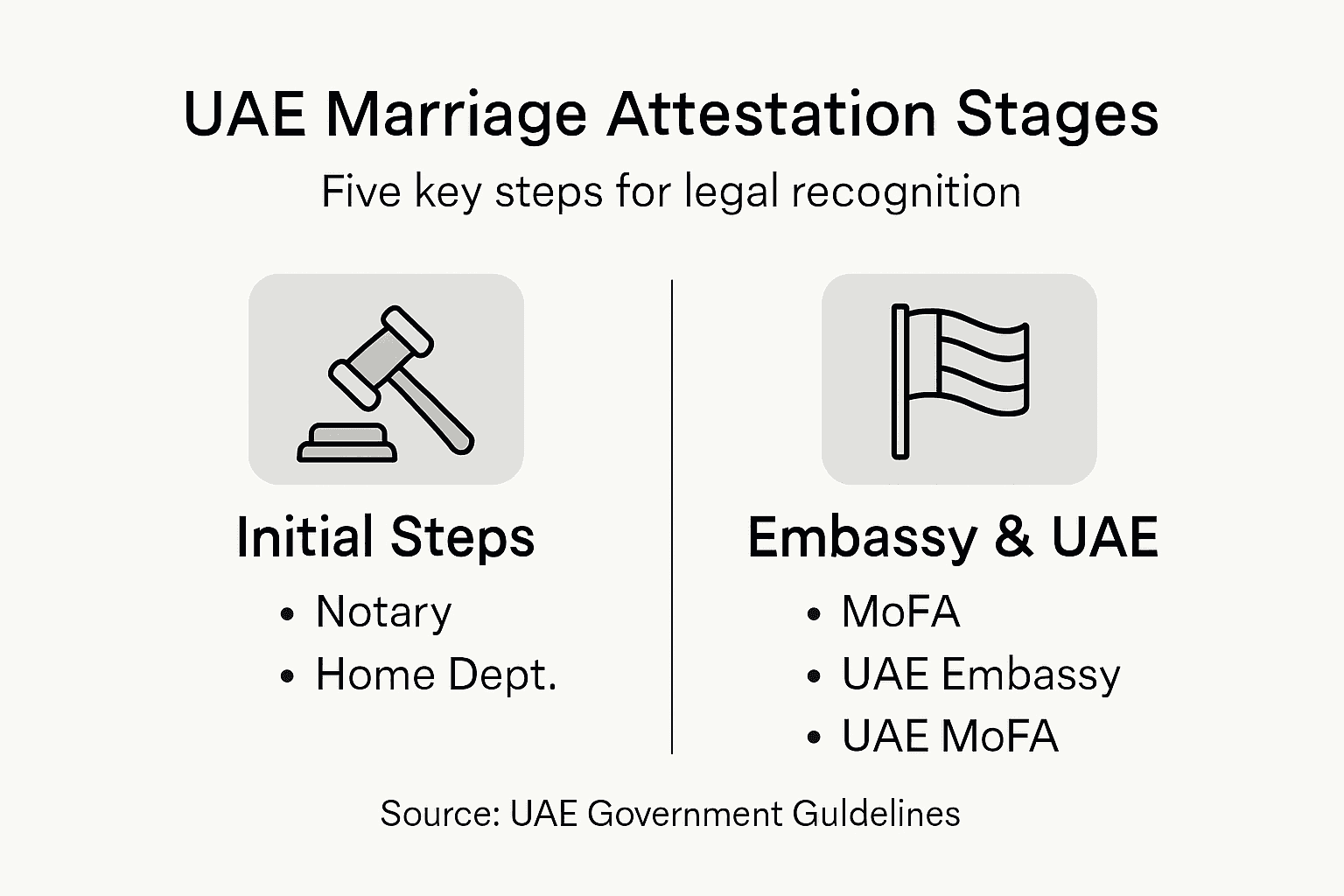
The Five-Stage Authentication Process
Here’s exactly how your marriage certificate gets authenticated, from beginning to end:
Step 1: Notarization in Your Home Country
Start by getting your original marriage certificate notarized by a notary public in your home country. The notary verifies that the certificate is genuine and hasn’t been altered or forged. They add their official seal and signature, which serves as proof that they’ve examined the document and confirmed its authenticity. You’ll need a certified copy of your marriage certificate for this step, not just any photocopy. The notary’s role is to prevent fraud from entering the system at the earliest stage.
Step 2: Home Department or State Department Attestation
Once notarized, your certificate moves to your home country’s Home Department or State Department (the name varies by country). This government body verifies that the notary’s seal is legitimate and that they’re actually authorized to notarize documents. They’re essentially vouching for the notary’s credentials. This step proves your document is genuine at the national level.
Step 3: Ministry of Foreign Affairs Attestation
Next, send your attested certificate to your home country’s Ministry of Foreign Affairs. They cross-check that the Home Department or State Department attestation is valid and that the document meets their standards. This stage bridges the gap between your home country’s verification and international recognition. At this point, your document is considered authentic within your home country’s legal system.
Step 4: UAE Embassy or Consulate Attestation
Your certificate then travels to the UAE Embassy or Consulate located in your home country. This is a critical stage because the UAE is directly examining all previous attestations. They verify that every seal and signature is authentic and that the sequence makes sense. They’re asking: Does this document actually come from where it claims to come from? The embassy’s attestation says the UAE recognizes your home country’s verification process.
Step 5: UAE Ministry of Foreign Affairs Final Attestation
Finally, your document arrives at the UAE Ministry of Foreign Affairs in Abu Dhabi. This is the final checkpoint and the one that actually makes your marriage certificate legally valid within the UAE. Without this last attestation, nothing before it matters. The Ministry reviews all previous attestations and confirms that your marriage certificate can now be used for any legal purpose in the Emirates.
Adding Translation to the Process
If your marriage certificate isn’t already in English or Arabic, certified translation becomes part of this process. The timing matters. Generally, you translate the document after notarization but before submitting it to your Home Department. Some countries require the translation to be notarized separately, which adds another layer. Get clarity on your specific country’s translation requirements before you start, as UAE marriage certificate translation rules vary considerably and can significantly extend your timeline if you get it wrong.
The entire process typically takes between 4 to 12 weeks, depending on how quickly each government body processes documents. Some countries work faster than others. The UAE government offices generally respond quickly once documents reach them, but delays often happen in your home country’s bureaucracy. Starting early gives you a buffer against these unpredictable delays.
One thing many expats miss is keeping detailed records at each stage. Take photos of your documents with all attestations and seals. Create a checklist and mark off each step as it’s completed. This documentation saves you if something gets lost in the mail or if a government office claims they never received your documents.
Pro tip: Create a tracking spreadsheet with submission dates, expected completion dates, and contact information for each government office handling your documents, and follow up proactively every two weeks rather than waiting passively for notification that each stage is complete.
Legal Prerequisites and Common Documentation
Before you even think about getting your marriage certificate attested, you need to understand what the UAE legally requires and what documentation proves you meet those requirements. Think of legal prerequisites as the foundation. They’re non-negotiable rules that must be satisfied before any attestation happens. Without meeting these prerequisites, you can’t legally marry in the UAE, and therefore you have nothing to attest. The UAE takes these requirements seriously, and there’s no workaround.
Age and Identification Requirements
First, both partners must meet age requirements. In the UAE, you must be at least 18 years old to marry, though in some cases a court can approve younger marriages with parental consent. This age verification happens through your passport or national identification document. You’ll need valid identification that clearly shows your date of birth and personal details. If your passport is expired but your national ID is current, the UAE typically accepts the national ID. However, having both documents current makes the process smoother.
Your passport is perhaps the most critical document you’ll submit. It must be valid for the entire duration of your marriage registration and attestation process. If your passport expires during this time, you’ll need to renew it and potentially restart certain steps. Many expats don’t realize this and find themselves in a bind when their passport nears expiration. The lesson here is simple: renew your passport before you start the attestation process if it has less than six months of validity remaining.
Pre-Marital Medical and Health Requirements
The UAE requires pre-marital medical fitness certificates for all couples getting married in the Emirates. This isn’t optional. You must undergo medical screening at an approved healthcare facility and receive a certificate confirming you’re fit to marry. The screening checks for certain communicable diseases and genetic conditions. You’ll get this certificate from your doctor or authorized clinic, and it must be dated within a specific timeframe (usually within three months of your marriage registration). Some couples overlook this requirement and discover they need it only after they’ve started the attestation process, forcing them to go back and obtain it.
If you’re getting married abroad and then attesting the certificate in the UAE, you may not need this medical certificate for the attestation itself. However, if you’re planning to register your marriage in the UAE afterward, you’ll need it. Planning ahead means getting this done early, even before you submit your marriage certificate for attestation.
Prior Marital Status Documentation
If either partner has been previously married, you must provide documentation proving the prior marriage ended. This means divorce decrees, separation agreements, or death certificates of previous spouses. The UAE requires these documents to be notarized, and sometimes they need to be attested by your home country’s authorities as well. This adds another layer of complexity if you’re bringing a divorce decree into the attestation process.
The UAE is particularly careful about verifying prior divorces because Islamic law has specific requirements about the waiting period between divorce and remarriage. If you’re getting married under Islamic law in the UAE, this becomes even more important. Civil marriages follow different rules, but both require proof of prior marital status.
Documents Required for Marriage Certificate Attestation
Once you have your marriage certificate and meet all prerequisites, you’ll need specific documents for the attestation process itself:
Original marriage certificate (certified copy from your local government)
Both spouses’ valid passports
UAE residence visa or entry stamp (if you already reside in the UAE)
Notarized documents from your home country’s authorities
Certified translation (if your marriage certificate isn’t in English or Arabic)
Home country attestation documents (from your Ministry of Foreign Affairs)
Each document must be an official certified copy. Photocopies won’t work, and even scanned copies won’t do for most stages. You need physical documents with official seals and signatures. This is why many expats use courier services or hire representatives to hand-carry documents between government offices.
Creating a Master Documentation Checklist
Before you submit anything, create a checklist of every single document you need based on your specific situation. Your situation depends on your home country, whether you’re married already, whether you’re marrying in the UAE or attesting a foreign marriage, and various other factors. What you need differs from what your friend needs, even if you’re from the same country. Get your specific checklist from the UAE Ministry of Foreign Affairs website or by contacting the UAE Embassy in your home country.
The difference between a smooth attestation and a nightmare is often whether you gathered all required documents before starting versus discovering halfway through that you’re missing something. Missing one document can add weeks to your timeline.
Pro tip: Request the complete documentation checklist specific to your home country from your UAE Embassy at least two months before you plan to start attestation, then gather everything at once rather than piecemeal, as missing documents discovered late in the process cause costly delays.
Risks of Errors and How to Avoid Them
One mistake in your marriage certificate attestation can unravel months of work. A single error doesn’t just delay things by a few days. It can trigger rejections, visa denials, legal complications, and loss of benefits you were counting on. The frustrating part is that most of these errors are preventable. They happen because people rush, assume they understand the requirements, or skip verification steps. Understanding what can go wrong puts you in a position to avoid it.
The Real Consequences of Errors
Let’s be specific about what happens when things go wrong. If your attestation contains errors or incomplete documentation, your visa sponsorship application gets rejected outright. You can’t bring your spouse to the UAE. Your employer’s HR department won’t approve your family benefits. You can’t access health insurance for your spouse. You can’t inherit property or claim spousal rights. You can’t open joint bank accounts. These aren’t minor inconveniences. They’re blockages that affect your entire life in the UAE.
Beyond the immediate practical problems, legal complications arise when documents are deemed invalid. The UAE government won’t recognize your marriage for any official purpose. This means if something happens to your spouse, you may not have legal standing as their next of kin. If you separate, custody and property division become legally murky. These scenarios are rare but catastrophic when they happen.
Common Errors That Cause Rejections
Submitting incomplete or incorrect documentation ranks as the biggest problem. People think photocopies are acceptable when the government clearly requires certified originals with official seals. They submit documents that expired months ago. They include certificates that aren’t notarized when notarization is mandatory. They skip entire stages of attestation thinking those stages don’t apply to them. Each of these is a rejection waiting to happen.
Skipping mandatory attestation steps is equally dangerous. You think you only need three attestations when your country of origin actually requires four. You assume the UAE Embassy attestation means you can skip the Ministry of Foreign Affairs step. You don’t get your document translated before submitting it, only to have it rejected because it’s in a language the UAE office won’t process. These mistakes happen because people cut corners or misunderstand the sequence.
Incorrect or poor quality translations cause enormous problems. You hire a translator who isn’t certified. The translation contains errors that change the meaning of key information. The translation wasn’t done by an officially recognized translator in the UAE. Any of these scenarios means your attested certificate gets rejected. You then have to redo the entire attestation with a corrected translation, losing weeks in the process.
Prevention Strategies That Actually Work
Start by verifying requirements from official sources directly. Contact your UAE Embassy in your home country and ask for their specific documentation checklist. Contact the UAE Ministry of Foreign Affairs website and read their guidelines yourself, not through a friend’s interpretation. Don’t rely on what someone on an expat Facebook group told you. Official sources exist for a reason.
Use only certified documents with original seals and signatures. Scanned copies don’t work, even if they look perfect on your screen. Digital images of notarized documents aren’t acceptable. You need the actual physical document with the actual seal. If you’re sending documents internationally, use courier services that provide tracking and proof of delivery, not regular mail.
Always get certified translations from officially recognized translators registered with the UAE. Don’t use online translation services or informal translators who know both languages. The certification matters. The translator’s registration matters. The official stamp matters. These aren’t formalities to ignore.
Follow the attestation sequence exactly as specified for your home country. Don’t try to submit documents in a different order thinking you’ll save time. Don’t skip steps thinking they don’t apply to you. If your country requires notarization, do it. If the sequence says your Home Department comes before the Ministry of Foreign Affairs, honor that order. If you’re unsure about any step, contact your embassy for confirmation before proceeding.
Keep meticulous records of everything you submit. Take clear photos of each document before it leaves your hands. Document the date you submitted it, the office you submitted it to, and the person who received it (if possible). Keep copies of all correspondence. When you receive attested documents back, verify that every seal and signature is present and clear. Don’t assume everything is correct just because the office returned it to you.
Below is a quick reference comparing typical errors during attestation with their potential consequences and prevention methods:
Common Error | Resulting Issue | Prevention Strategy |
Missing certified document | Application rejection | Use official checklists |
Incorrect attestation sequence | Legal document invalidation | Confirm country requirements |
Poor translation quality | Certificate gets rejected | Hire certified translators |
Expired identification | Delay or restart process | Renew documents in advance |
Building a Safety Net
Consider hiring a professional attestation service if the process feels overwhelming. Yes, it costs money. But the cost is minimal compared to the expense of starting over because of errors. Services like Harris and Charms specialize in exactly this kind of work and understand all the country-specific requirements. They know which translators are certified, which notaries are legitimate, and how to navigate each government office.
Before you submit your final documents to the UAE Ministry of Foreign Affairs, have someone else review them. A fresh set of eyes catches mistakes you’ve become blind to after staring at documents for weeks. That person should ideally understand UAE attestation requirements or work for an attestation service.
Pro tip: Have your complete attestation package reviewed by a professional service or legal advisor 48 hours before submission to the UAE Ministry of Foreign Affairs, as catching errors at this final stage prevents rejection and the need to restart the entire multi-week process.
Simplify Your Marriage Attestation Journey in the UAE
Navigating the complex steps of marriage attestation in the UAE can feel overwhelming with all the notarization, translations, and approvals required by multiple authorities. You want to ensure your marriage certificate gains legal recognition quickly and correctly without costly errors or delays. Whether dealing with the UAE Ministry of Foreign Affairs or coordinating translations and embassy attestations, every step counts toward securing your family’s future in the Emirates.

Take control of your attestation process today by partnering with experts who understand the detailed requirements and sequences specific to your home country and the UAE. At Harris & Charms, we provide personalized support covering all aspects from document verification to certified translations and final UAE Ministry attestation. Don’t let paperwork jeopardize your plans. Visit our website now to explore how our legal documentation services can save you time and eliminate stress. Start your marriage attestation with trusted assistance at Harris & Charms and ensure every signature and seal is flawlessly handled for your peace of mind.
Frequently Asked Questions
What is marriage attestation in the UAE?
Marriage attestation in the UAE is the official process of verifying and legitimizing your marriage certificate, ensuring it holds legal weight within the country. This verification is essential for accessing services like visa sponsorships and residency applications.
Why is marriage attestation important for expatriates?
Marriage attestation is crucial for expatriates as it validates their marriage certificate from their home country, allowing it to be recognized legally in the UAE for various legal and administrative purposes.
How long does the marriage attestation process typically take?
The entire marriage attestation process usually takes between 4 to 12 weeks, depending on the speed of document processing by each involved government body in your home country.
What are the common documentation requirements for marriage certificate attestation?
Common documentation required includes the original marriage certificate, both spouses’ valid passports, a UAE residence visa or entry stamp, notarized documents, and certified translations if the marriage certificate is not in English or Arabic.
Recommended
Comments