
Why Civil Marriage Is Required for UAE Expats

Updated: Jul 7
Most American expat couples in the United Arab Emirates are surprised to learn that over 80 percent of recent civil marriage registrations skipped traditional requirements entirely. For those hoping for a smooth, legally recognized wedding, understanding civil marriage and clearing up misconceptions is vital. This guide reveals exactly what documentation you need and how new UAE laws give expatriates a clear, fair pathway to marriage registration without complex barriers.
Table of Contents
Key Takeaways of why Civil Marriage is required
Point | Details |
Legal Framework | Civil marriage in the UAE provides a modern, secular framework for non-Muslim expatriates, simplifying the marriage process. |
Eligibility Criteria | Couples must meet specific legal requirements, including mutual consent, age of at least 18, and proof of single status. |
Documentation Requirements | Essential documents include authenticated passports, birth certificates, and proof of single status, requiring careful preparation. |
Legal Protections | Civil marriage confers significant rights, including asset protection, family residency facilitation, and clear child custody laws. |
Defining Civil Marriage and Misconceptions
Civil marriage in the United Arab Emirates represents a significant legal transformation for expatriate couples seeking a straightforward, secular union. Under the Federal Decree-Law No. 41 of 2022, civil marriage emerges as a distinct legal pathway that provides non-Muslim expatriates with a comprehensive, modern framework for marriage registration that transcends traditional religious constraints.
Unlike traditional marriage processes, civil marriage is a purely secular contract designed to offer equal rights and simplified legal procedures for men and women. This innovative approach removes several historical barriers by eliminating requirements such as mandatory guardian consent, religious ceremonies, and complex medical testing protocols. Civil marriage processes in UAE now prioritize individual autonomy and legal clarity for expatriate residents.
Common misconceptions about civil marriage often revolve around its perceived complexity or limited applicability. However, the new legal framework specifically addresses diverse expatriate needs by creating a flexible, inclusive mechanism for marriage registration. Key distinguishing features include:
Complete legal recognition across UAE jurisdictions
No mandatory religious prerequisites
Equal rights for both marriage partners
Simplified documentation requirements
Faster processing times compared to traditional marriage registration
Pro tip: Consult with official UAE marriage registration authorities and gather all required documentation before initiating your civil marriage process to ensure a smooth, efficient experience.
Legal Variations in UAE Civil Marriage
The United Arab Emirates has developed a complex and nuanced legal framework for civil marriages that varies significantly across different emirates. Legal implications of marriage in the UAE reveal a sophisticated dual-track system where marriage regulations differ substantially between jurisdictions, particularly for expatriate residents.
Abu Dhabi stands at the forefront of civil marriage reforms, pioneering a progressive approach through Law No. 14 of 2021. This groundbreaking legislation permits both Muslim and non-Muslim expatriates to register civil marriages under specific conditions, creating a more inclusive legal environment. In contrast, other emirates maintain more traditional approaches, with varying degrees of flexibility in their marriage registration processes.
The legal variations across UAE emirates are particularly significant for expatriates. Key distinctions include:
Residency requirements for marriage registration
Documentation needed for civil marriage
Procedural steps for marriage validation
Recognition of international marriage certificates
Specific eligibility criteria for different expatriate groups
These variations underscore the complexity of navigating marriage laws in the UAE, with each emirate maintaining unique interpretative frameworks. Non-Muslim expatriates, in particular, must carefully research the specific requirements of their intended emirate to ensure legal compliance.
Pro tip: Consult with local marriage registration authorities in your specific emirate and verify all documentation requirements well in advance of your planned marriage date.
Here’s a summary of how civil marriage requirements and legal processes vary across prominent UAE emirates:
Emirates Compared | Residency Requirement | Who May Marry | Recognition of Overseas Marriages |
Abu Dhabi | Not required | Muslim & Non-Muslim | Broad, including most international certificates |
Dubai | Often required | Primarily Non-Muslim | More limited, case-by-case basis |
Sharjah | Strict requirements | Non-Muslim only | Limited; favors local process |
Other Emirates | Varies | Usually Non-Muslim | May require additional attestation |
Key Requirements and Eligibility Criteria
Civil marriage in the UAE involves a comprehensive set of eligibility criteria designed to ensure legal clarity and compliance for expatriate couples. Requirements for civil marriage in the UAE demonstrate a nuanced approach that balances individual rights with legal protections across different emirates.
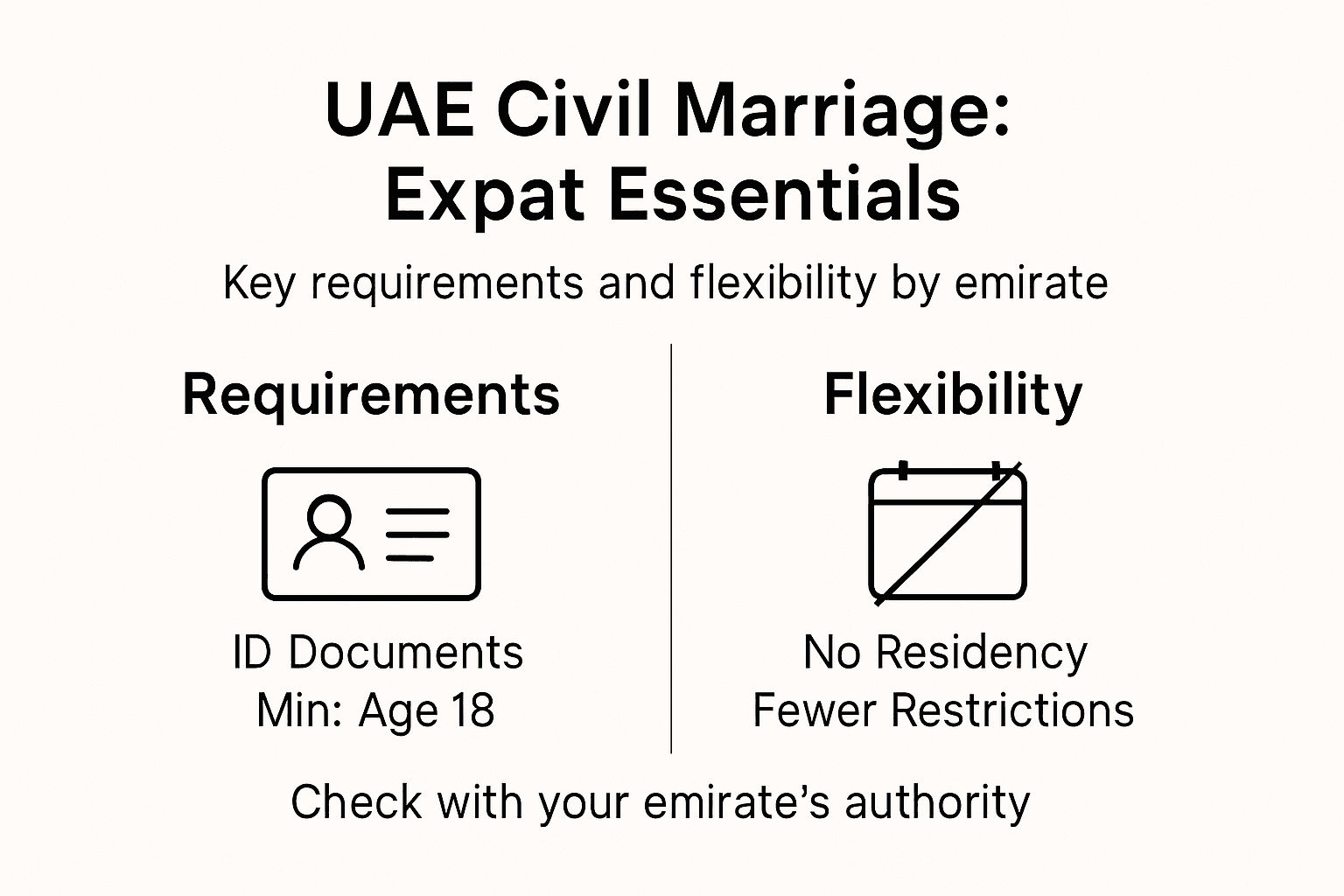
The fundamental eligibility requirements for civil marriage typically encompass several critical conditions. Prospective couples must be non-Muslim nationals, with both individuals being at least 18 years old, possessing free and mutual consent to marry. Additionally, participants must demonstrate legal freedom to marry, which means neither party can be currently married or have unresolved previous marriage obligations. Documentation plays a crucial role, requiring couples to provide authenticated passports, valid civil status documents, and proof of single status.
Key eligibility criteria for civil marriage in the UAE include:
Minimum age requirement of 18 years for both partners
Non-Muslim nationality status
Mutual and free consent to marriage
No existing marriage commitments
Valid international passports
Legalized civil status documentation
Proof of single status
No legal impediments to marriage
Unique to the UAE’s civil marriage framework, some emirates like Abu Dhabi offer more flexible provisions that do not mandate residency for marriage registration. This means tourists and temporary visitors can potentially complete their civil marriage process, provided they meet the fundamental legal requirements and possess appropriate documentation.
Pro tip: Prepare a comprehensive document portfolio including authenticated passport copies, birth certificates, and single status certificates well in advance of your marriage registration appointment.
Documentation, Attestation, and Application Steps
The civil marriage process for UAE expats demands meticulous preparation and understanding of complex documentation requirements. Examples of marriage documents for UAE expats highlight the critical nature of accurate and properly authenticated paperwork throughout the marriage registration journey.

The documentation process involves several crucial steps that require careful attention. Couples must compile a comprehensive portfolio of original documents, including valid international passports, birth certificates, and proof of single status. Each document typically requires official translation and legalization, a process that involves multiple governmental and diplomatic authentication stages. Emirate-specific variations mean that document requirements can differ slightly, necessitating precise research for the specific jurisdiction where marriage registration will occur.
Key documents and application steps include:
Original passports for both partners
Authenticated birth certificates
Proof of single status or divorce documents
Translated and legalized documents
Online pre-registration through civil family court portals
Payment of required marriage registration fees
Scheduling official marriage ceremony appointment
Signing marriage contract before authorized public officer
The attestation process represents a critical component of civil marriage documentation. This involves multiple verification stages where documents are authenticated by relevant authorities, including home country embassies, UAE Ministry of Foreign Affairs, and local emirates judicial departments. Each authentication step ensures the legal validity of marriage documents across international jurisdictions.
Pro tip: Begin document preparation at least three months before your planned marriage date, allowing sufficient time for translation, legalization, and potential administrative delays.
Rights, Protections, and Financial Implications
Civil marriage in the UAE establishes a comprehensive legal framework that provides expatriate couples with significant rights and financial protections. Legal implications of marriage in the UAE reveal a nuanced system designed to ensure equitable treatment and clear legal standing for both partners.
The legal rights afforded through civil marriage extend far beyond traditional marital recognition. Couples gain critical protections concerning asset management, inheritance rights, and financial responsibilities. The UAE’s civil marriage framework provides equal gender treatment in critical areas such as testimony, divorce proceedings, and child custody arrangements. This approach ensures that expatriate couples have clear legal mechanisms for resolving potential disputes and managing their shared financial interests.
Key rights and financial implications include:
Equal legal standing for both marriage partners
Clear inheritance and asset distribution protocols
Defined financial support and alimony provisions
Streamlined residency and family visa processes
Legal protections for child custody and support
Mechanisms for equitable property division
Access to social benefits and healthcare provisions
Protection against potential financial exploitation
From a practical perspective, civil marriage offers expatriates significant advantages beyond emotional commitment. The legal documentation provides a pathway to obtaining family residency visas, accessing shared healthcare benefits, and establishing clear financial and legal boundaries. These protections are particularly crucial for international couples navigating the complex legal landscape of the United Arab Emirates.
Pro tip: Consult with a legal professional specializing in UAE family law to fully understand the specific rights and financial implications of your civil marriage contract.
The following table summarizes key advantages civil marriage can provide for expatriate couples in the UAE:
Benefit Type | Civil Marriage Impact | Practical Example |
Asset Protection | Equal legal standing | Joint property rights |
Visa Facilitation | Streamlined process | Faster family residency |
Family Rights | Clear protocols | Shared child custody laws |
Social Benefits | Easier access | Health insurance options |
Risks of Non-Compliance and Legal Alternatives
Navigating the complex landscape of civil marriage in the UAE requires a thorough understanding of potential legal consequences. Requirements for civil marriage in the UAE highlight the critical importance of adhering to official registration procedures to avoid significant legal complications.
The risks of non-compliance with civil marriage regulations can be substantial and far-reaching. Couples who fail to properly register their marriage may encounter serious challenges, including difficulties proving marital status, challenges with inheritance rights, complications in obtaining family residency visas, and potential legal disputes regarding asset ownership and child custody. UAE courts strictly enforce marriage registration requirements, meaning unregistered marriages may not receive legal recognition.
Key risks and potential consequences include:
Invalidation of marital status
Loss of inheritance rights
Challenges in obtaining family visas
Complications in child custody proceedings
Limited legal protection for shared assets
Potential immigration and residency issues
Difficulties accessing social and healthcare benefits
Challenges in legal dispute resolution
Legal alternatives for expatriates exist, though they come with their own complexities. Options include registering marriages through home country embassies, obtaining international marriage certificates, or pursuing alternative legal frameworks. However, these approaches require careful navigation of both UAE and international legal requirements to ensure comprehensive legal protection.
Pro tip: Always maintain comprehensive documentation and seek professional legal consultation to understand the specific implications of your marriage registration strategy in the UAE.
Simplify Your Civil Marriage Journey in the UAE with Expert Support
Understanding why civil marriage is required for UAE expats can feel overwhelming given the varied legal requirements, complex documentation, and strict registration procedures highlighted in the article. Many couples face challenges such as gathering authenticated documents, navigating emirate-specific rules, and ensuring their union is legally recognized to access essential rights like family residency visas and financial protections.
You do not have to face these challenges alone. At Harris & Charms, we specialize in guiding expatriate couples through every step of their civil marriage process in the UAE. From handling document attestation and legal consultation to offering tailored event planning and official marriage registrations, our personalized service helps you avoid costly delays and legal complications. Discover how other couples trusted us to create a stress-free, memorable wedding experience while ensuring full legal compliance by visiting our landing page.
Ready to secure your future with confidence and celebrate your love without worry?

Take the first step now by connecting with our expert team at Harris & Charms. Benefit from our deep knowledge of UAE civil marriage laws and enjoy seamless coordination of all your marriage needs. Your peace of mind and a legally recognized union are just a click away.
Frequently Asked Questions
What is civil marriage, and why is it important for expatriates?
Civil marriage is a secular legal contract that allows non-Muslim expatriates to register their marriage in the UAE. It is essential as it provides a clear legal framework that offers equal rights and simplifies the marriage registration process.
What are the main requirements for expatriates to get a civil marriage in the UAE?
The primary requirements include being non-Muslim, both partners must be at least 18 years old, they must give mutual consent to marry, and provide valid documentation such as authenticated passports and proof of single status.
How does civil marriage protect the rights of expatriate couples?
Civil marriage offers legal rights including equal treatment in asset management, inheritance rights, child custody, and spousal support, ensuring comprehensive legal protections for both partners throughout their marriage.
What are the risks of not registering a civil marriage in the UAE?
Failing to register a civil marriage can lead to significant issues, such as challenges in proving marital status, complications with inheritance rights, difficulties obtaining family residency visas, and potential legal disputes regarding shared assets.
Recommended
Comments