
UAE law for marriage: Your complete guide for couples


TL;DR:
Getting married in the UAE offers three legal pathways: civil, Sharia, and recognition of foreign marriage certificates, each with distinct requirements. Civil marriage is secular and accessible to non-Muslims and tourists, while Sharia marriage involves guardian consent, witnesses, and medical screenings for Muslim citizens. Proper document attestation, early preparation, and expert guidance are crucial to avoiding delays and ensuring a smooth legal marriage process.
Most people assume getting married in the UAE means a religious ceremony under Sharia law, full stop. That assumption is wrong, and it costs couples months of wasted planning. UAE law for marriage actually offers three distinct legal pathways, including a fully secular civil option that does not require witnesses, a guardian’s consent, or any religious affiliation. Whether you are a tourist passing through Abu Dhabi, a Muslim expat wanting to skip the wali requirement, or a couple navigating two different nationalities, understanding which route fits your situation is the difference between a smooth registration and a bureaucratic standstill.
Table of Contents
Key Takeaways
Point | Details |
Multiple marriage pathways | The UAE offers civil and Islamic marriage options tailored to religion, nationality, and residency status. |
Civil marriage benefits | Civil marriages require no witnesses or medical tests and are favored by non-Muslims and some Muslim expats. |
Document attestation crucial | Properly attesting and translating documents early prevents most registration delays and rejections. |
Residency affects eligibility | Abu Dhabi allows tourists to marry civilly, while Dubai requires residency for civil marriage. |
Professional support is valuable | Using expert services ensures legal compliance and smooth wedding planning in the UAE. |
Understanding the legal frameworks for marriage in the UAE
The UAE offers three legal routes to register a marriage: civil under Federal Decree-Law No. 41 of 2022, Sharia under Federal Decree-Law No. 41 of 2024, or home-country certificate attestation for recognition of foreign marriages. Each pathway has its own eligibility rules, documentation demands, and officiating authority.
Civil marriage under Federal law applies primarily to non-Muslims. Couples can choose between applying UAE civil personal status law or the laws of their home country. This flexibility was designed with expatriates in mind, and it is one of the more underappreciated aspects of the civil vs Islamic marriage differences in the UAE system.
Abu Dhabi’s local civil marriage law goes even further. It allows non-Muslims and certain non-citizen Muslims to marry civilly, regardless of which emirate they reside in. This makes Abu Dhabi the most accessible marriage jurisdiction in the country for international couples.
Islamic marriage under Sharia is mandatory for UAE Muslim citizens. It follows distinct requirements including the presence of a wali (the bride’s male guardian), two adult Muslim male witnesses, a mahr (dowry), and a premarital medical screening.
Here is a quick comparison of the three pathways:
Feature | Federal civil marriage | Abu Dhabi civil marriage | Sharia marriage |
Who can use it | Non-Muslims | Non-Muslims, non-citizen Muslims | UAE Muslim citizens |
Witnesses required | No | No | 2 male Muslim witnesses |
Wali required | No | No | Yes (with exceptions) |
Medical screening | No | No | Yes |
Tourists eligible | No | Yes | No |
Approximate cost | AED 300 to 2,500 | AED 300 to 2,500 | AED 1,000 to 3,000 |
Key differences at a glance:
Civil marriage is contract-based and secular
Sharia marriage is governed by Islamic personal status law
Home-country certificates can be attested for UAE recognition where the couple married abroad
Now that we know the main legal routes, let’s break down civil marriage requirements specifically.
Detailed requirements for civil marriage in the UAE
Civil marriage minimum age is 18, with no witnesses or wali required, no premarital medical test, and a document attestation process for foreigners that must be completed before registration.
The required documents for civil marriage include:
Valid passports for both parties
Proof of single status (certificate of no impediment or equivalent), attested from the home country
Residency visa or entry stamp (for Abu Dhabi civil marriage, a tourist stamp is sufficient)
Divorce decree or death certificate if previously married, fully attested
Officially translated copies in Arabic or English
Completed application form from the relevant family court
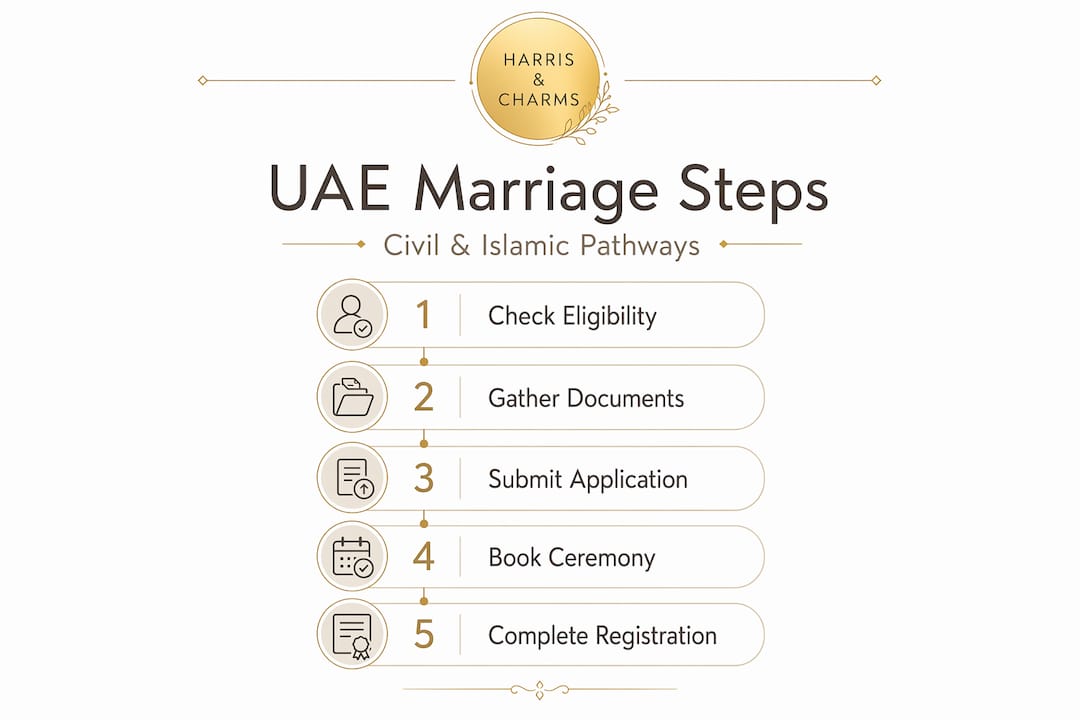
The registration process follows these steps:
Collect and notarize documents in your home country
Get UAE embassy attestation in your home country
Obtain the MOFAIC stamp in the UAE
Submit the application at Abu Dhabi Civil Family Court or Dubai Courts
Attend the ceremony in person (both parties must be present)
Incomplete paperwork causes 80% of rejections, so the attestation chain matters enormously. A missed embassy stamp can set you back weeks.
Fees you should know:
Regular service: AED 300, processed in approximately 10 working days
Express service: AED 2,500, processed within one working day
Prenuptial agreement notarization: additional fee varies by court
The express civil marriage process at Abu Dhabi Civil Family Court is genuinely impressive. The ceremony itself takes about 15 minutes, yet it produces a legally binding marriage certificate recognized across the UAE.
Pro Tip: If your home country issues single-status certificates through a government ministry rather than a notary, confirm with the UAE embassy which format they accept before you travel. Some nationalities face significant variation in how these certificates must be presented.
The Abu Dhabi civil marriage guide covers emirate-specific nuances worth reviewing if you are planning to register there as a non-resident.
Understanding civil marriage requirements sets the stage to compare these with Islamic marriage prerequisites and processes.
Islamic marriage requirements under UAE Sharia law
Sharia marriages require a minimum of 18 lunar years of age (roughly 17.5 Gregorian years), wali consent for the bride, two adult male Muslim witnesses, and premarital medical screening costing AED 200 to 300 per person. These are non-negotiable for UAE Muslim citizens.
The required documents for an Islamic marriage include:
Valid passports and Emirates IDs
Family book (for UAE nationals)
Single-status certificate attested per nationality
Premarital medical screening results from an approved UAE clinic
Wali’s identity documents
Mahr agreement (the agreed dowry amount becomes part of the contract)
The process typically follows this order:
Complete premarital medical screening at an approved health center (results valid for 3 to 5 days in most cases, so timing is critical)
Submit documentation to the Sharia court or Personal Status Court in your emirate
Wali and two male witnesses attend the ceremony
Marriage contract is signed and registered
The total process takes between 2 and 6 weeks, with fees ranging from AED 1,000 to AED 3,000 including medical screening costs. Courts in different emirates may have slight procedural variations, so checking with the relevant authority early saves significant time.
Pro Tip: Medical screening results expire quickly. Do not schedule your screening until your court appointment is confirmed, or you may need to repeat it at additional cost.
One frequently misunderstood point: a Muslim woman marrying a non-Muslim man cannot do so under Sharia without the man converting to Islam first. This is a firm requirement under the UAE’s personal status law, not a bureaucratic formality. The Muslim marriage rules UAE guide explains these scenarios in more detail.
With both civil and Islamic frameworks covered, let’s explore residency and nationality nuances affecting couple eligibility.
Residency, nationality, and procedural nuances affecting marriage options
Where you live in the UAE determines more than you might expect. Dubai civil marriage requires at least one party to hold Dubai residency. Abu Dhabi accepts tourists and residents from any emirate. This single difference makes Abu Dhabi the default destination for most expatriate and tourist couples.
Key scenarios to understand:
Non-Muslim tourists with no UAE residency: Abu Dhabi civil marriage is your only local option
Non-citizen Muslims who want to avoid wali or medical test requirements: Abu Dhabi civil marriage is available to you
UAE Muslim citizens: must use Sharia law for marriage; the civil route is not available
Mixed-religion couples where the man is Muslim and the woman is not: she must show conversion to Islam for a Sharia marriage
Expats residing in Dubai: can use Dubai Courts for civil marriage if residency conditions are met, or travel to Abu Dhabi for civil registration
Here is a comparison of the three main registration jurisdictions:
Criteria | Dubai civil marriage | Abu Dhabi civil marriage | Sharia marriage |
Residency required | Yes, Dubai residency | No | Yes, UAE residency typical |
Open to tourists | No | Yes | No |
Open to non-citizen Muslims | Limited | Yes | No (for UAE Muslims only) |
Processing time | 3 to 10 days | 1 to 10 days | 2 to 6 weeks |
Pro Tip: Check the legal age for marriage UAE rules for your specific nationality, since some embassies require parental consent documentation even if UAE law considers you an adult at 18.
Understanding your eligibility before you gather documents prevents wasted trips, unnecessary fees, and the frustration of arriving at a court that cannot legally process your application.
Practical tips for preparing legal documents and avoiding delays
Most registration problems are not legal problems. They are paperwork problems. The attestation chain requires documents to move from your home country to your UAE embassy, then on to the UAE Ministry of Foreign Affairs and International Cooperation (MOFAIC). Skipping or misordering any step means starting over.
Key preparation steps:
Start the attestation process at least 3 to 6 months before your intended marriage date
Obtain notarization in your home country first, then UAE embassy attestation, then the MOFAIC stamp
Single-status certificate processes vary by nationality, so verify early and request Arabic translations upfront
Bring all documents in officially translated Arabic or English versions; courts will reject untranslated paperwork without exception
If previously married, ensure divorce or death certificates are attested through the same chain
“Incomplete paperwork causes 80% of registration rejections, so preparation is key.” — UAE marriage registration data
Prenuptial agreements are a feature many couples overlook. When notarized during a civil marriage ceremony, they define asset division, custody terms, and financial arrangements before any dispute arises. They are legally recognized under UAE civil marriage law and significantly reduce the complexity of any future court proceedings.
For Sharia marriages, medical screening results expire fast. Book your appointment so results are fresh for your submission date. Using an approved clinic from the official UAE government list avoids having results rejected on technical grounds.
Pro Tip: Abu Dhabi’s online portal allows you to submit your civil marriage application and book your appointment digitally. Combine this with the express service option if you are working against a tight schedule. See the marriage certificate attestation guide for post-registration steps to ensure your certificate is recognized internationally.
Rethinking marriage in the UAE: Expert insights and practical wisdom
Here is the perspective most guides skip: the UAE’s civil marriage framework is not just a legal alternative. It is a genuine policy statement about how a multicultural country accommodates millions of residents who do not share a common religious framework. That context matters when you are making decisions about which pathway to choose.
The wali requirement catches many Muslim expat brides completely off guard. Women who have spent years in countries where marriage is purely a matter of personal consent suddenly discover that UAE Sharia law structures the bride’s consent through a male guardian. Abu Dhabi’s civil option did not appear by accident. It reflects a deliberate acknowledgment that customs and marriage in the UAE exist across very different cultural traditions, and that legal flexibility serves the population better than rigidity.
Prenuptial agreements are the most underused tool in the UAE civil marriage framework. Couples focused on the ceremony ignore them entirely, then face costly and emotional court battles over assets years later. In a country where many couples bring property, business interests, or children from previous relationships into a marriage, a notarized prenuptial agreement is genuinely valuable protection.
Another reality: the UAE legal marriage process rewards early starters dramatically. We have seen couples lose venue deposits and reschedule ceremonies because embassy queues took longer than expected or a MOFAIC stamp was delayed by a public holiday. Treating document preparation as something you can sort out “a few weeks before” is the single most common and most avoidable mistake.
The express service at Abu Dhabi Civil Family Court is a remarkable example of what legal innovation can look like. A full marriage ceremony, legally binding and court-certified, in 15 minutes, on the same day you apply. That is worth understanding even if you do not end up using it, because it illustrates how much flexibility the system actually offers when you know where to look.
We always recommend that couples consult a legal expert early to select the pathway that matches their nationality, religion, and residency status. There is no one-size-fits-all answer here. Review the civil vs Islamic marriage nuances carefully before committing to a pathway.
Personalized legal and wedding support services for your UAE marriage
Navigating UAE marriage law is genuinely complex, and most couples should not have to do it alone. Harris & Charms was built specifically for this: to take the legal complexity, documentation stress, and coordination burden off your plate so you can focus on the experience of getting married.

Our team guides couples through civil and Islamic marriage registration, from the very first document checklist to the final court certificate. We handle attestation coordination, translation requirements, and application submissions, ensuring your paperwork clears every step of the chain without delays. Beyond the legal side, our comprehensive marriage services UAE cover venue management, photography, makeup, and full event planning, so your day reflects exactly who you are as a couple. Whether you need the express one-day registration or a full celebration package, we tailor every detail. Contact Harris & Charms early to build the package that fits your timeline, culture, and vision.
Frequently asked questions
Can non-Muslim tourists get married civilly in the UAE without residency?
Yes, Abu Dhabi accepts tourists for civil marriage without residency requirements, unlike Dubai, which requires at least one partner to hold a valid Dubai residency visa.
Is a premarital medical test required for civil marriages in the UAE?
No. Civil marriage does not require premarital medical testing; that requirement applies exclusively to Islamic marriages conducted under Sharia law.
What documents must be attested for UAE marriage registration?
Foreign documents including single-status certificates, divorce decrees, and passports must follow the full attestation chain: home country notarization, UAE embassy attestation, then MOFAIC stamp.
Can Muslim expats opt for the civil marriage route in Abu Dhabi?
Yes, non-citizen Muslims may contract a civil marriage in Abu Dhabi, allowing them to bypass Sharia requirements such as wali consent and premarital medical screening.
How long does the express civil marriage process take in Abu Dhabi?
The Abu Dhabi express civil marriage service completes the entire process, including the ceremony, within one working day for a fee of AED 2,500, with the ceremony itself lasting approximately 15 minutes.
Recommended
Comments