
How to validate your marriage certificate in the UAE


UAE requires official attestation for foreign marriage certificates to be legally recognized.
The attestation process involves authentication by the issuing country, UAE embassy, and MOFA.
Proper preparation, accurate workflow selection, and certified translations are essential to avoid delays.
You got married. Congratulations. But when you walked into a UAE government office, bank, or immigration department with your foreign marriage certificate, you hit a wall. Without official validation, that certificate is legally invisible in the UAE. This guide gives you the full picture, from understanding what “attestation” actually means to completing every step of the Ministry of Foreign Affairs (MOFA) process, so your marriage is recognized the way it should be, and you can move forward with your life together without unnecessary setbacks.
Table of Contents
Key Takeaways
Point | Details |
MOFA attestation required | Validation through the Ministry of Foreign Affairs is essential for legal use of marriage certificates in the UAE. |
Check prior attestations | Your certificate must be attested by authorities in its country of issue and the UAE embassy or consulate before MOFA can process it. |
Consider certified translation | Non-Arabic certificates often need an official Arabic translation to be legally recognized in the UAE. |
Choose correct workflow | Selecting ‘inside’ or ‘outside’ UAE on the platform must match your current location to avoid delays. |
Professional help available | Specialist services can manage validation and translation, reducing stress and errors for couples. |
Understanding marriage certificate validation in the UAE
The word “validation” often gets used loosely, but in the UAE context it means one specific thing: attestation. Attestation is the official government confirmation that your foreign-issued marriage certificate is genuine, legally issued, and acceptable for use inside the UAE.
Many couples assume that a marriage certificate issued by a certified authority abroad automatically carries legal weight here. It doesn’t. UAE authorities, including government departments, banks, hospitals, and schools, need proof that the document is real and that it has been verified at every level of the chain.
That chain works like this:
Your certificate is authenticated by the issuing country’s relevant ministry
Then it is verified by the UAE embassy or consulate in that country
Finally, MOFA (the UAE Ministry of Foreign Affairs) attests it inside the UAE
The MOFA attestation process distinguishes between two primary routes: “attestation inside the UAE” and “attestation outside the UAE.” Choosing the wrong one is one of the most common mistakes expats make, and it causes immediate delays.
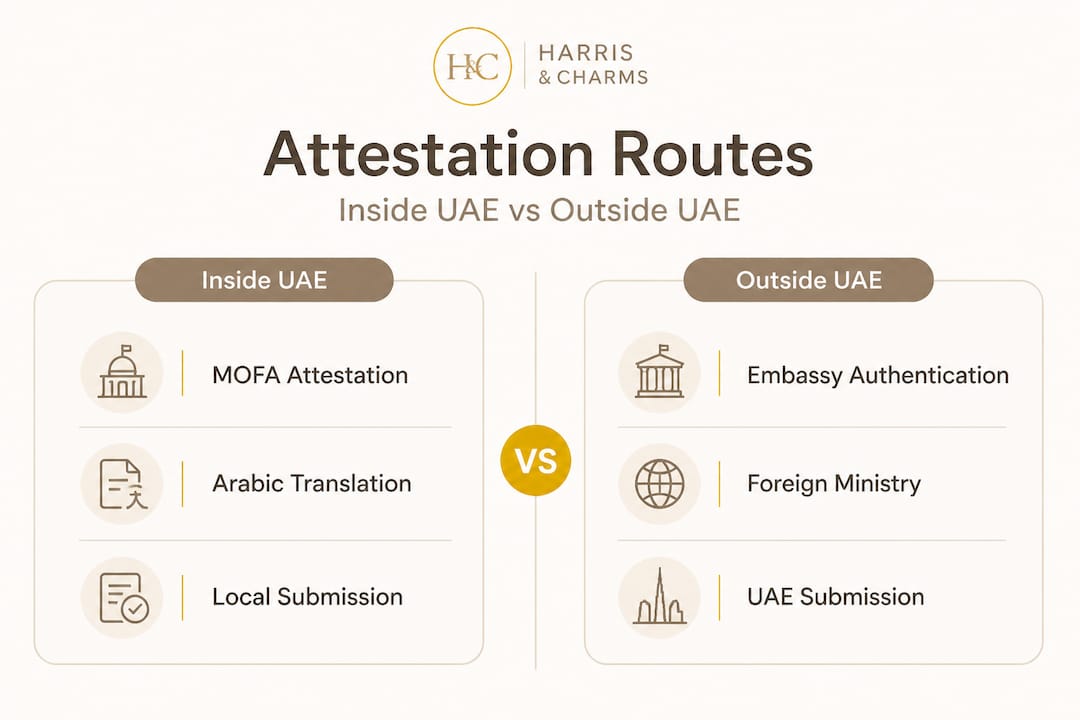
Here’s a quick reference to the key terms you need to know:
Term | What it means |
Attestation | Official government confirmation of a document’s authenticity |
MOFA | UAE Ministry of Foreign Affairs, final attestation authority |
Issuing country ministry | Government body that authenticates your certificate in the country it was issued |
UAE embassy/consulate | Verifies your document before MOFA submission |
Courier delivery | MOFA’s service to return your attested document |
Understanding the legal steps for validation before you start saves you from submitting documents that get rejected before they’re even reviewed. You can also read a broader certificate validation process overview if you’re just starting to research your options.
What you need: Required documents and prerequisites
Once you understand the importance of attestation, ensuring you have all necessary documents and prerequisites saves time and money. Missing even one item from this checklist can put your entire application on hold for weeks.
Here’s what you typically need before you begin the MOFA process:
Original marriage certificate issued by the foreign authority (court, registry, religious body, etc.)
Attestation by the issuing country’s ministry (this varies by country, but it is always step one)
UAE embassy or consulate verification from the issuing country
Certified Arabic translation if your certificate is not already in Arabic
Passport copies of both spouses
Completed MOFA online application with the correct workflow selected
On the translation requirement specifically: even a fully attested certificate may be rejected by UAE departments without an Arabic version if the original is in another language. This is a step many couples skip, assuming their attested English certificate is enough. Plan for certified translation before you arrive at any UAE government counter, not after.
Regarding workflow selection, MOFA’s platform requires you to choose whether you’re applying from inside or outside the UAE. If you’re currently residing in the UAE and your certificate was issued abroad, you select “attestation inside the UAE.” If you’re completing the process from your home country, you select “attestation outside the UAE.” This isn’t optional or flexible; it directly affects which options appear in your application.
Here’s a side-by-side comparison to help you choose:
Factor | Attestation inside UAE | Attestation outside UAE |
Your location when applying | Inside UAE | Outside UAE |
Where certificate was issued | Abroad | Abroad |
Embassy/consulate step | Must be completed before MOFA | Handled through home country UAE embassy |
Courier delivery available | Yes | Depends on location |
Recommended for expats already in UAE | Yes | No |
Pro Tip: Before submitting anything to MOFA, call or email your issuing country’s ministry to confirm their current authentication process. Some countries have introduced apostille systems that simplify this step, while others still require a multi-stage local attestation.

Get clarity on your certificate translation tips early in the process, and follow a step-by-step translation guide to ensure your Arabic version meets UAE standards.
Step-by-step process: Validating your marriage certificate with MOFA
With all your documents ready, here’s the exact step-by-step process to follow, plus potential pitfalls to watch out for along the way.
Authenticate your certificate in the issuing country. Contact the relevant ministry or government authority in the country where your certificate was issued. In the UK, this might be the Foreign, Commonwealth and Development Office. In India, it’s the Ministry of External Affairs. Each country has its own process, so research this first.
Get your certificate verified by the UAE embassy or consulate abroad. Once your home country ministry stamps the document, take it to the UAE embassy or consulate in that country for their verification stamp. This is a non-negotiable prerequisite for MOFA.
Obtain a certified Arabic translation if needed. If your certificate isn’t in Arabic, get a certified translation done by an accredited UAE translator. Keep both the original and the translated version together at all times.
Log in to the MOFA online portal. Visit the official MOFA website and create or log in to your account. Select the correct attestation type based on your location and document origin.
Select “Attestation inside the UAE” if you’re currently in the UAE. As outlined in MOFA’s documented workflow, you’ll then specify the document type (marriage certificate), confirm that prior attestations (issuing country ministry and UAE embassy/consulate) have been completed, and enter your delivery details.
Upload clear scans of all documents. Blurry or cropped scans are one of the top rejection triggers. Scan in color at high resolution and make sure every stamp and seal is visible.
Pay the applicable fees. MOFA charges vary by document type and service speed. Fees are paid online during the application process.
Choose your courier delivery option. MOFA returns your attested document via courier. Enter accurate delivery details to avoid delays.
Track your application status. Log back into the MOFA portal to check progress. Processing is relatively quick when all documents are correct.
Here’s a summary of the process timeline:
Stage | Estimated time |
Country ministry authentication | 1 to 4 weeks (varies by country) |
UAE embassy/consulate verification | 3 to 10 business days |
Arabic translation | 1 to 3 business days |
MOFA attestation (inside UAE) | A few business days if complete |
Courier return | 1 to 3 business days |
“The most important thing is to complete every prior step before approaching MOFA. A missing stamp from a previous level causes a full rejection, not just a hold.”
Pro Tip: Keep photocopies of every stamped version of your certificate throughout this process. If any document gets lost in transit or during review, you’ll have a clear paper trail showing what was completed.
Read the full attestation guide for Dubai if you’re based in Dubai specifically, or check out the complete UAE attestation process for an updated 2026 overview. You can also download a marriage document checklist to track your progress step by step.
Troubleshooting and common mistakes
Even with clear instructions, some common errors trip up even experienced expats. Here’s how to avoid them, and what to do if you’re already dealing with a delay.
The most frequent mistakes include:
Selecting the wrong MOFA workflow. Choosing “attestation outside UAE” when you’re physically inside the UAE, or vice versa, causes immediate processing issues. Match your selection to your actual location at the time of application.
Missing the embassy/consulate attestation. MOFA will not process your certificate without confirmation that the UAE embassy abroad has already verified it. This step cannot be skipped.
Submitting non-Arabic certificates without translation. This is a top rejection trigger for many UAE government services. Get certified translation done before, not after, submission.
Uploading low-quality scans. Stamps and seals must be legible in every uploaded image. Redo any scan that looks unclear.
Assuming your certificate doesn’t need prior attestations. Some couples believe that because their marriage was legally registered in a reputable country, no further verification is needed. That assumption is wrong.
“Every rejected application resets your timeline. One missing stamp can add weeks or months to the process.”
If your application is held or rejected, log back into the MOFA portal for a status explanation, correct the identified issue, and resubmit. For complex situations, including prior rejections or certificates from countries with unusual authentication processes, professional guidance makes a real difference. Review the key marriage documentation rules that apply specifically to expats so you go in fully prepared.
What happens after validation: Using your certificate in the UAE
Once your certificate is validated, here’s how it helps you unlock the next steps in your UAE life. A MOFA-attested marriage certificate is the starting point for almost every joint legal action you’ll take as a couple in the UAE.
Here are the main uses for your validated certificate:
Family visa sponsorship. Spouses can sponsor each other for UAE residency, and this requires a validated certificate as proof of the marital relationship.
Joint bank accounts. Most UAE banks require attested marriage proof before linking accounts or granting spousal financial access.
Health insurance as a dependent. Employers and insurers require official marriage proof to add a spouse to a health plan.
School enrollment. Many UAE schools require parental marriage documentation for student registration, especially for custody-related cases.
Property and legal matters. Joint property purchase or inheritance-related legal steps may also require a validated certificate.
Always keep both your original attested certificate and your certified Arabic translation in a secure location. Make digital copies stored in a cloud service you can access from anywhere. When presenting to officials, bring both the original and attested copies together, never just one or the other.
One important note: your validation doesn’t technically expire, but if you ever lose the original and need to request a replacement from your home country, you’ll need to restart the full attestation process from the beginning. Treat this document as you would your passport.
Refer to the official certificate guide for additional context on getting and managing your certificate inside the UAE.
Our perspective: What most guides miss about marriage certificate validation in the UAE
Most articles on this topic give you the basic steps and call it done. But having worked with hundreds of couples navigating this process in the UAE, we’ve noticed some consistent gaps that even well-researched guides miss.
The single most overlooked issue is the relationship between your physical location and your MOFA workflow selection. Couples who researched this process from home and then moved to the UAE before completing it often select the wrong MOFA route because their research was based on being abroad. The platform looks the same either way, so it’s easy to choose incorrectly without realizing the consequences.
Another reality: official requirements shift without public announcements. MOFA updates its processes periodically, and a guide written even six months ago may reflect outdated steps. We always recommend checking MOFA’s platform directly before starting, even if you’ve read five guides already. The attestation validity insights we’ve gathered from real submissions show just how frequently small procedural details change.
There’s also a human cost to getting this wrong. Couples waiting on delayed attestations sometimes miss visa renewal windows, lose job offer deadlines tied to dependent visa processing, or face gaps in health coverage. These aren’t minor inconveniences. They’re real disruptions to your life and your finances.
Our honest advice: if your situation involves a country with a complex or unusual authentication process, certificates from religious or customary marriages, or if you’ve already received one rejection, don’t try to figure it out alone. The cost of professional help is almost always lower than the cost of repeated delays and resubmissions.
Get expert help validating your marriage certificate in the UAE
Navigating the MOFA attestation process on your own is possible, but it’s easy to lose weeks to avoidable mistakes. If you’d rather have it done right the first time, we can help.

At Harris & Charms, we handle the full marriage documentation journey for couples in the UAE, including translation, attestation coordination, and complete civil marriage support. Our civil marriage packages include document preparation and legal guidance so nothing gets missed. If you’re based in Dubai, explore our dedicated Dubai marriage services for location-specific support. For a full picture of everything we offer, visit our comprehensive marriage services page. We’re here to make sure your paperwork matches the commitment you’ve already made.
Frequently asked questions
How long does it take to validate a marriage certificate in the UAE?
MOFA attestation typically takes a few business days when all documents are in order, but delays are common when prior attestations or translations are incomplete.
Can I validate my marriage certificate if I’m not in the UAE?
Yes, but you must select the outside-UAE workflow and ensure your home country ministry and UAE embassy attestations are complete before submitting.
Is a translation into Arabic always required for marriage certificate validation?
If your certificate is not in Arabic, a certified Arabic translation is required for acceptance by most UAE authorities, including banks, schools, and government offices.
What happens if I submit a certificate missing an official attestation?
MOFA will reject or halt your application, requiring you to complete missing attestations at the country or embassy level before the submission can proceed.
Where can I get help if my marriage certificate was rejected for validation?
Specialized marriage service providers like Harris & Charms can review your case, identify what went wrong, and guide you through a corrected resubmission to get your certificate validated without further delays.
Recommended
Comments