
Why Register Marriage in UAE – Legal and Life Impact


Every year, thousands of American couples living or working in the United Arab Emirates face the complex reality of marriage registration. The difference between a registered and unregistered marriage carries lasting legal and financial consequences. More than 40 percent of expatriates report confusion about official marriage requirements in the Emirates. Understanding how registered marriage works in the UAE is essential for anyone seeking genuine legal protection, secure residency, and peace of mind for their family.
Table of Contents
Key Takeaways
Point | Details |
Registered Marriage in the UAE | Represents a legally recognized union, providing legal protections and benefits. |
Civil vs. Islamic Marriage | Couples must choose between civil or Islamic marriage registration based on their religious affiliations and legal requirements. |
Documentation Requirements | Proper legal documentation is essential, including identification and marital status verification for successful registration. |
Risks of Unregistered Marriages | Couples in unregistered marriages face significant legal and financial vulnerabilities, affecting residency, inheritance, and spousal rights. |
Defining Registered Marriage in the UAE
In the United Arab Emirates, a registered marriage represents a legally recognized civil contract between two individuals that formally establishes their marital status through official government documentation. Unlike traditional religious ceremonies, this process focuses on creating a legally binding union that is recognized by state authorities and provides comprehensive legal protections for both partners.
According to the Civil Marriage Law No. 14 of 2021, a civil marriage in the UAE is specifically defined as the lawful union between a man and a woman, solemnized through a non-religious civil contract. The key distinguishing feature of a registered marriage is its adherence to standardized legal protocols, ensuring that the marriage is formally documented and recognized by legal implications of marriage in the UAE.
The registration process involves several critical components that differentiate it from informal or traditional marriage arrangements:
Official Documentation: Complete and submit required legal paperwork
Government Verification: Validation of individual identities and legal eligibility
Certificate Issuance: Formal marriage certificate from authorized government entities
Legal Recognition: Comprehensive legal status and rights for both spouses
For expatriates and UAE nationals alike, registering a marriage provides substantial legal and practical benefits. The civil registration ensures that the marriage is officially recognized, which becomes crucial for various life events such as visa applications, property ownership, inheritance rights, and establishing family relationships under UAE law.
Civil vs. Islamic Marriage Registration
The United Arab Emirates offers two distinct pathways for marriage registration: civil marriage and Islamic marriage, each with unique legal frameworks and requirements designed to accommodate the diverse population of the country. These registration methods serve different demographic groups while ensuring comprehensive legal recognition of marital unions.
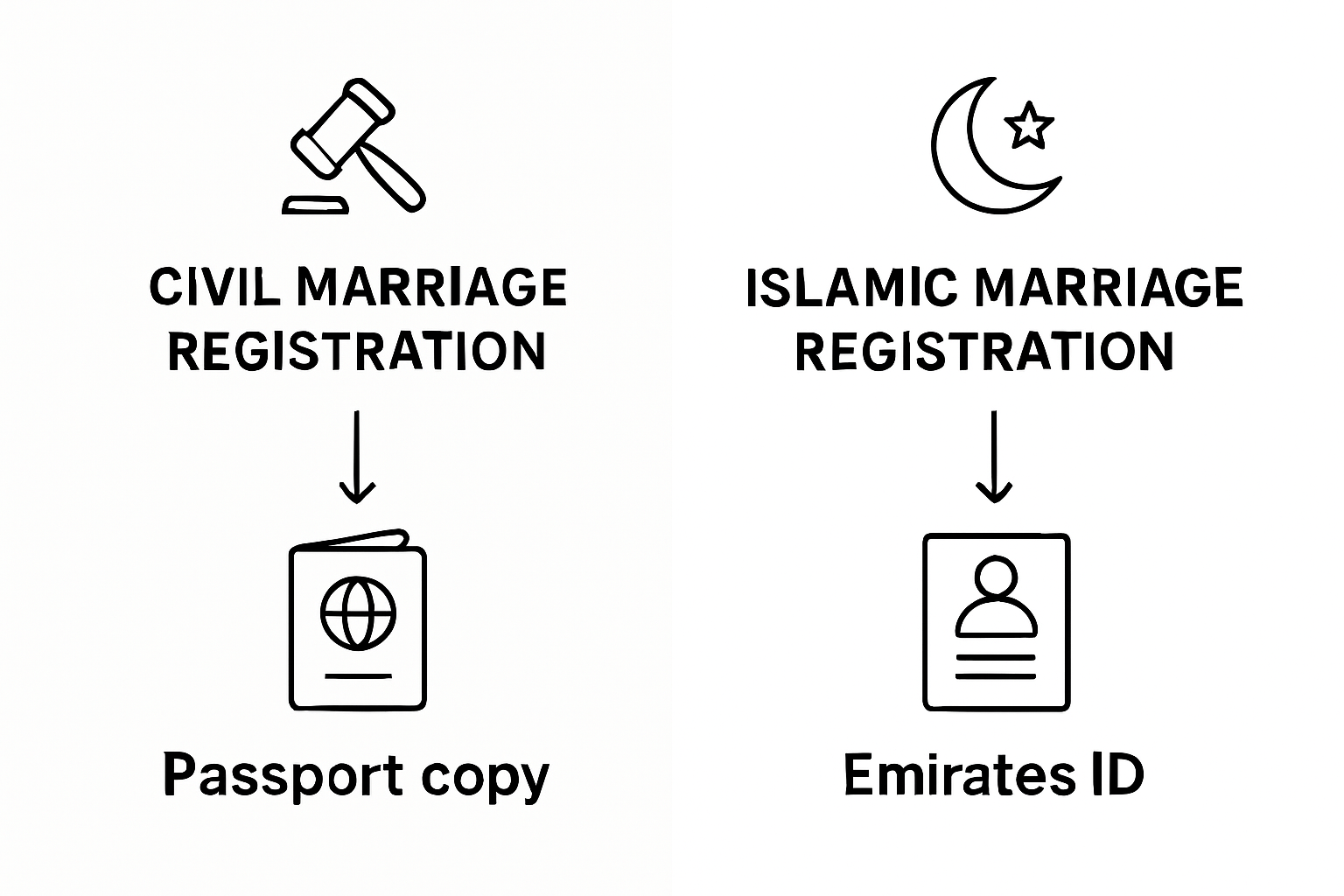
In the UAE, civil marriages are primarily available for non-Muslim couples and are characterized by a secular legal process that does not require religious intervention. These marriages are governed by non-religious protocols and focus on establishing a legal contract between partners. By contrast, Islamic marriages follow Sharia law principles and involve specific religious requirements, such as the presence of a Sharia judge, two Muslim male witnesses, and the bride’s guardian, as outlined in civil marriage in Dubai explained.
Key differences between civil and Islamic marriage registration include:
Eligibility
Civil Marriage: Open to non-Muslims and couples seeking a secular union
Islamic Marriage: Typically for Muslim couples following religious protocols
Procedural Requirements
Civil Marriage: Standard legal documentation and government verification
Islamic Marriage: Religious ceremonial elements and witness requirements
Legal Framework
Civil Marriage: Governed by UAE civil laws
Islamic Marriage: Guided by Islamic jurisprudence and Sharia principles
Understanding these distinctions is crucial for couples navigating marriage registration in the UAE, as the chosen path significantly impacts legal rights, documentation, and future administrative processes related to family status and personal documentation.
Legal Requirements and Documentation Needed
Registering a marriage in the United Arab Emirates requires meticulous preparation and a comprehensive understanding of the legal documentation process. Each marriage registration type demands specific paperwork, with variations depending on the couple’s nationality, religious background, and personal circumstances.
For civil marriages, applicants must meet several critical prerequisites. Couples must be at least 18 years old and provide mutual consent for the union. The documentation checklist typically includes key steps for marriage requirements in the UAE such as valid passports, birth certificates, proof of marital status, and potentially a prenuptial agreement. Non-Muslim expatriates will need additional documents like residence visas, employment contracts, and no-objection certificates from their respective embassies.
The essential documentation for marriage registration in the UAE generally includes:
Personal Identification Documents
Valid passports for both partners
Original birth certificates
Passport-sized photographs
Emirates ID or residence permit
Marital Status Verification
Certificate of no-impediment
Divorce or death certificates (if previously married)
Single status declaration
Additional Supporting Documents
Medical fitness certificates
Proof of address
Translated and attested documents (if originally in a foreign language)
Embassy authentication for expatriate couples
Navigating the documentation process requires careful attention to detail. Each document must be original, recently issued, and properly translated and attested by authorized entities. Couples should anticipate potential processing times and ensure all paperwork is complete and accurate to avoid unnecessary delays in their marriage registration.
Benefits of Official Marriage Registration
Official marriage registration in the United Arab Emirates represents more than a simple bureaucratic process. It provides couples with a comprehensive legal framework that protects individual rights, establishes familial relationships, and ensures comprehensive social and legal recognition of their union.
The legal advantages of official marriage registration extend far beyond a ceremonial document. Couples gain critical protections in areas such as property rights, inheritance, child custody, and spousal support. Role of Marriage Certificate in UAE demonstrates how this official documentation becomes a crucial instrument in navigating complex legal and administrative landscapes, particularly for expatriates and multicultural couples residing in the Emirates.
Key benefits of official marriage registration include:
Legal Protection
Comprehensive rights for both spouses
Legal recognition of marital status
Ability to make medical and financial decisions
Protection under UAE family laws
Administrative Advantages
Simplified visa and residency processes
Easier access to healthcare and insurance
Smoother property ownership transfers
Streamlined banking and financial interactions
Social and Personal Benefits
Establishes clear familial relationships
Provides legal framework for potential future children
Ensures equal rights and responsibilities
Creates a foundation for long-term financial planning
Beyond the immediate legal implications, official marriage registration offers couples peace of mind. It transforms a personal commitment into a recognized social contract, providing a robust legal infrastructure that supports and protects the relationship through various life stages and potential challenges.
Risks of Unregistered Marriages in the UAE
Unregistered marriages in the United Arab Emirates expose couples to significant legal and financial vulnerabilities that can have long-lasting and potentially devastating consequences. Without official documentation, spouses essentially exist in a legal gray zone that offers minimal protection and recognition under UAE law.
The most critical risks emerge in areas of personal and financial rights. Unregistered marriages create substantial challenges in proving marital status, which impacts critical life processes such as obtaining residency, securing healthcare benefits, and establishing inheritance claims. Marriage Under UAE Law: Legal Paths and Pitfalls highlights the complex legal landscape that can leave unregistered couples vulnerable to significant legal complications.
Key risks of unregistered marriages include:
Legal Vulnerabilities
No legal recognition of marital status
Inability to prove spousal rights
Challenges in child custody disputes
Limited protection under UAE family laws
Financial Complications
Difficulties claiming financial rights
No legal recourse for spousal support
Challenges in property ownership transfer
Inability to access joint financial accounts
Administrative Barriers
Obstacles in obtaining residency permits
Problems with visa sponsorship
Challenges in healthcare and insurance coverage
Complications in employment and work authorizations
Ultimately, an unregistered marriage in the UAE represents a significant risk that can compromise personal security, financial stability, and legal standing. Couples choosing to remain unregistered essentially forfeit crucial legal protections and rights that are fundamental to establishing a secure and recognized marital relationship in the Emirates.
Secure Your Future With Official Marriage Registration in the UAE
Navigating the legal requirements and documentation for your marriage in the United Arab Emirates can feel overwhelming. The risks of an unregistered marriage include lack of legal protection, difficulties with residency, and challenges in securing financial and family rights. At Harris & Charms, we understand these concerns and provide personalized support to help you complete your marriage registration seamlessly. Our expert team guides you through every step, from documentation to legal attestations, making your journey to a legally recognized union simple and stress-free.
Why risk your peace of mind and future security? Choosing official marriage registration means gaining comprehensive legal rights and smoother administrative processes. Our services cover civil and Islamic marriages, venue management, document processing, and more. Trust the team behind an inspiring love story that highlights the power of commitment and reliability in the UAE.
Elevate your wedding experience with professional assistance tailored to your needs. Visit Harris & Charms today and discover how we can secure your legal and personal happiness.

Start your journey now. Contact us to simplify your marriage registration and enjoy the legal benefits you deserve. Learn more about our legal document processing and explore the essential marriage requirements in the UAE with support you can trust.
Frequently Asked Questions
Why is it important to register a marriage in the UAE?
Registering a marriage in the UAE provides legal recognition of the marital status, which is crucial for protection under family laws, rights in property ownership, inheritance, and other administrative processes.
What are the benefits of official marriage registration in the UAE?
The benefits include legal protection for both spouses, simplified administrative processes for residency and visas, access to healthcare benefits, and a clear legal framework for future children.
What are the risks of not registering a marriage in the UAE?
Unregistered marriages expose couples to legal vulnerabilities, such as lack of recognition of marital status, challenges in claiming financial rights, and difficulties with residency, healthcare, and child custody matters.
What documents are typically required to register a marriage in the UAE?
Typically required documents include valid passports, birth certificates, marital status verification (such as a certificate of no impediment), medical fitness certificates, and, for expatriates, additional embassy-authenticated documents.
Recommended
Comments