
What Is Marriage According to Islam: A 2026 Guide

TL;DR:
Marriage in Islam is a sacred contract called Nikah that establishes a spiritual and legal partnership. It requires four essential pillars: offer and acceptance, two witnesses, a Mahr, and a wali in most schools. Its purpose is to create a peaceful home rooted in tranquility, affection, and mercy while emphasizing character over appearance.
Marriage in Islam is defined as a sacred, binding contract called Nikah, which represents an act of obedience to Allah and a comprehensive framework for love, mercy, and spiritual partnership. The Nikah is not simply a social arrangement. It is a religious covenant recognized across all major schools of Islamic jurisprudence, including the Hanafi, Maliki, Shafi’i, and Hanbali traditions. Understanding what is marriage according to Islam means grasping both its legal structure and its deeper spiritual purpose. Harrisandcharms has guided many couples through this process in the UAE, and this guide covers everything you need to know.
What is marriage according to Islam, and what makes it valid?
Marriage in Islam is the Nikah contract, highly recommended for capable adults and obligatory for those who fear falling into sin without it. That distinction matters. Islam does not treat marriage as optional decoration on a spiritual life. It treats it as a foundational act of worship with real legal weight.
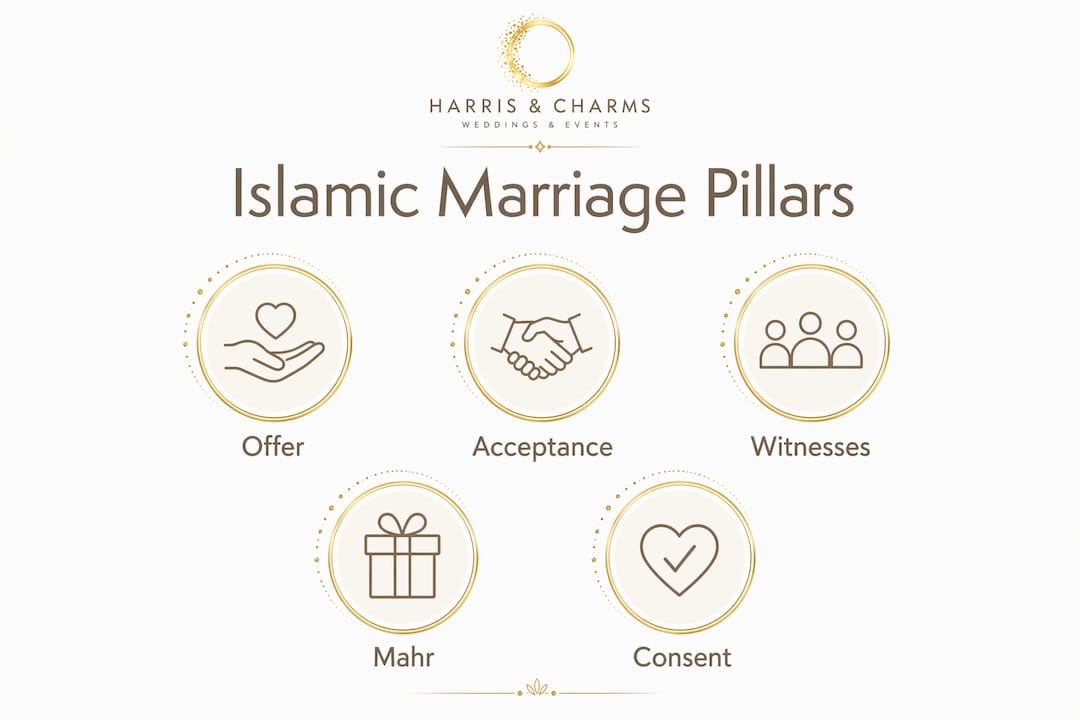
A valid Nikah rests on four essential pillars. Miss any one of them, and the contract is not recognized under classical Islamic law. The four pillars of a valid Nikah are consistent across Sunni schools, even where minor procedural differences exist.
Offer and acceptance (Ijab and Qabul). The proposal and acceptance must occur in the same gathering. Both parties must be legally eligible to marry, meaning they are adults of sound mind and not prohibited from marrying each other.
Two Muslim witnesses. The witnesses must be trustworthy, adult Muslims present at the time of the contract. Their presence makes the marriage a public act, not a private arrangement.
Mahr (nuptial gift). The Mahr is a mandatory gift from groom to bride. No classical fiqh school considers a Nikah valid without it. The amount is agreed upon by both parties and becomes the wife’s exclusive property.
Wali (guardian). Most Sunni schools require a male guardian to represent the bride. The Hanafi school, however, permits an adult woman to contract her own marriage with witnesses present. Shia schools recommend a wali but do not strictly require one.
Pro Tip: Agree on the Mahr amount before the ceremony, not during it. A rushed Mahr discussion can create tension at the worst possible moment. Treat it as a serious negotiation that reflects mutual respect.
Prohibited marriages under Islamic law include unions between close relatives (mahram relationships), marriages where one party is already in a prohibited number of simultaneous marriages, and marriages across certain religious boundaries as defined by classical fiqh.
What is the spiritual and social purpose of marriage in Islam?
The Quran frames the purpose of marriage in three words: Sakinah, Mawadda, and Rahma. These translate as tranquility, affection, and mercy. Together, they describe a home that is peaceful, emotionally warm, and morally grounded.
“And of His signs is that He created for you from yourselves mates that you may find tranquility in them; and He placed between you affection and mercy. Indeed in that are signs for a people who give thought.” (Quran 30:21)
This verse is the theological anchor for Islamic views on marriage. It tells you that the goal is not just legal compliance. The goal is a living, breathing partnership that produces peace and compassion.
The Prophet Muhammad (peace be upon him) described marriage as completing half of one’s faith. That framing is striking. It positions marriage not as a personal preference but as a spiritual milestone. A person who marries with the right intention is performing an act of worship, not just fulfilling a social norm.
Marriage also serves as a moral safeguard. Islamic teaching holds that marriage channels human desire within a lawful, dignified framework. This protects individuals, families, and communities from the social harms that come from unstructured relationships. The family unit built through Nikah becomes the foundation of a stable society in Islamic thought.
Prophetic teachings reinforce this. The Prophet encouraged marriage, described it as part of his Sunnah, and warned against unnecessary delay for those who are ready. The importance of marriage in Islam is therefore both personal and communal.
What roles and responsibilities do spouses have in an Islamic marriage?
Islamic marriage assigns complementary roles to husband and wife. These roles are not about superiority. They are about function, accountability, and mutual support within a shared life.
The husband’s primary responsibilities include:
Financial provision (Nafaqah). The husband is obligated to provide food, clothing, and shelter for his wife and children according to his means.
Protection and leadership. He carries the role of Qawwam, meaning a responsible guardian who leads the family with consultation and care.
Emotional availability. Islamic teaching requires the husband to treat his wife with kindness, not just fulfill material duties.
The wife’s primary responsibilities include:
Nurturing the home. She manages the household and raises children in an environment of faith and stability.
Mutual fidelity and respect. She upholds the sanctity of the marriage and supports her husband’s role as provider and leader.
Spiritual partnership. Both spouses are expected to support each other’s religious practice and moral growth.
Marriage requires active commitment to ethical behavior beyond legal formalities. Islamic ethics describe this as treating one another “bil-ma’ruf,” meaning with recognized social kindness that exceeds the minimum legal requirement. Forbearance, trust, and mercy are not optional virtues. They are the daily practice that keeps a marriage alive.
Pro Tip: The Quran instructs husbands to consult their wives (Shura) in family decisions. Couples who practice regular, honest consultation report stronger bonds and fewer unresolved conflicts. Build it into your weekly rhythm from day one.
The goals of Nikah center on creating a peaceful home where both spouses fulfill complementary roles. This goes far beyond a legal checklist. It is a daily practice of character.
How do contemporary understandings of Islamic marriage align with classical teachings?
Several common misconceptions cloud the modern understanding of Islamic marriage. Addressing them directly helps couples enter Nikah with accurate expectations.
Common misconception | What classical teaching actually says |
An Imam must conduct the Nikah | Any competent adult Muslim who understands the requirements can solemnize the contract. An Imam’s presence is a custom and often a civil registration requirement, not a religious obligation. |
Wealth and beauty are the top criteria for a spouse | Islamic teaching prioritizes faith and character (deen and khuluq) over outer attributes. Experts in Islamic family counseling consistently find that character predicts long-term marital success far better than wealth or appearance. |
Marriage is mainly about legal rights and duties | Marriage is a living partnership. The Quran and Hadith both describe it as a source of tranquility and spiritual growth, not just a contract to be enforced. |
Cultural wedding customs are Islamic requirements | Many elaborate customs, such as specific dress codes, feast formats, or ceremony rituals, are cultural traditions. The core Islamic requirements are the four pillars of Nikah, nothing more. |
One insight that surprises many people: knowing a potential spouse’s character, including how they handle anger, their honesty, and their relationship with their parents, predicts long-term success better than any superficial criterion. Classical scholars emphasized this. Modern Islamic family counselors confirm it.
The Hanafi school’s position on the wali also surprises many. An adult Hanafi woman can legally contract her own marriage without a guardian, provided two witnesses are present. This is not a modern liberal reinterpretation. It is a classical ruling that has existed for over a thousand years. Understanding these key Islamic marriage requirements helps couples separate religious obligation from cultural expectation.
Key Takeaways
A valid Islamic marriage requires the Nikah contract, built on four pillars: offer and acceptance, two witnesses, a mandatory Mahr, and in most schools, a wali, all held together by the spiritual goals of tranquility, affection, and mercy.
Point | Details |
Nikah is a binding contract | Marriage in Islam is a formal legal covenant, not a casual arrangement, and requires four specific pillars to be valid. |
Mahr is non-negotiable | Every classical fiqh school requires the Mahr; a Nikah without it is not recognized under Islamic law. |
Spiritual goals define success | Sakinah, Mawadda, and Rahma are the Quranic benchmarks for a successful marriage, not just legal compliance. |
Character over appearance | Islamic teaching prioritizes faith and character in a spouse over wealth, beauty, or social status. |
An Imam is not required | Any competent adult Muslim can conduct a valid Nikah; the Imam’s role is customary, not religiously mandatory. |
What I have learned from helping couples navigate Islamic marriage
The couples I have worked with through Harrisandcharms often arrive with two very different problems. Some know every legal detail of the Nikah but have never seriously discussed what kind of home they want to build together. Others are deeply in love but have no idea what the contract actually requires. Both groups need the same thing: a clear, honest conversation that connects the legal to the personal.
What strikes me most about the Islamic marriage framework is how practical it is. The Mahr is not symbolic. It is the wife’s financial security. The witness requirement is not ceremonial. It creates accountability. The Quranic goals of Sakinah, Mawadda, and Rahma are not poetic ideals. They are daily targets that a couple can actually measure against their own behavior.
The misconception I see most often is that a beautiful ceremony equals a strong marriage. I have seen couples spend months planning a reception and thirty minutes discussing their expectations of each other. The Nikah itself takes minutes. The marriage takes a lifetime of intentional effort.
My honest advice: treat the Mahr discussion as your first real negotiation as a couple. Treat the witness selection as a statement about who you trust. And treat the ceremony, however simple or elaborate, as the beginning of a practice, not the peak of an experience. The Islamic marriage process is designed to set you up for that practice from day one.
— Harris
Planning your Islamic marriage in the UAE with Harrisandcharms

Harrisandcharms offers comprehensive marriage services covering both Islamic Nikah arrangements and civil registration in the UAE. The team handles documentation, legal attestation, and ceremony coordination so couples can focus on what matters most. Whether you need support with Mahr documentation, witness arrangements, or navigating UAE-specific registration requirements for expats and Golden Visa holders, Harrisandcharms provides end-to-end guidance. Every package is built around the real legal and religious requirements of a valid Islamic marriage, not generic wedding planning. Reach out to Harrisandcharms to start your Nikah process with clarity and confidence.
FAQ
What is the marriage definition in Islam?
Marriage in Islam is a binding contract called Nikah, which is a religious and legal covenant between two eligible adults. It is considered a Sunnah act and, for those who fear sin without it, an obligation.
What are the requirements for marriage in Islam?
A valid Nikah requires a clear offer and acceptance in one gathering, two trustworthy Muslim witnesses, a mandatory Mahr from the groom to the bride, and in most Sunni schools, a wali for the bride.
Does an Imam have to perform the Nikah?
No. Any competent adult Muslim who understands the requirements can conduct a valid Nikah. An Imam’s presence is a cultural custom and sometimes a civil registration requirement, but it is not a religious obligation.
What does Islam say about marriage and faith?
The Prophet Muhammad described marriage as completing half of one’s faith. The Quran identifies tranquility, affection, and mercy as the three foundational goals of a successful Islamic marriage.
Can a Muslim woman contract her own marriage?
Under the Hanafi school, an adult Muslim woman can contract her own marriage without a guardian, provided two witnesses are present. Other Sunni schools require a wali, while Shia schools recommend one but do not strictly mandate it.
Recommended
Comments