
Marriage Customs in Islam: A Complete 2026 Guide

TL;DR:
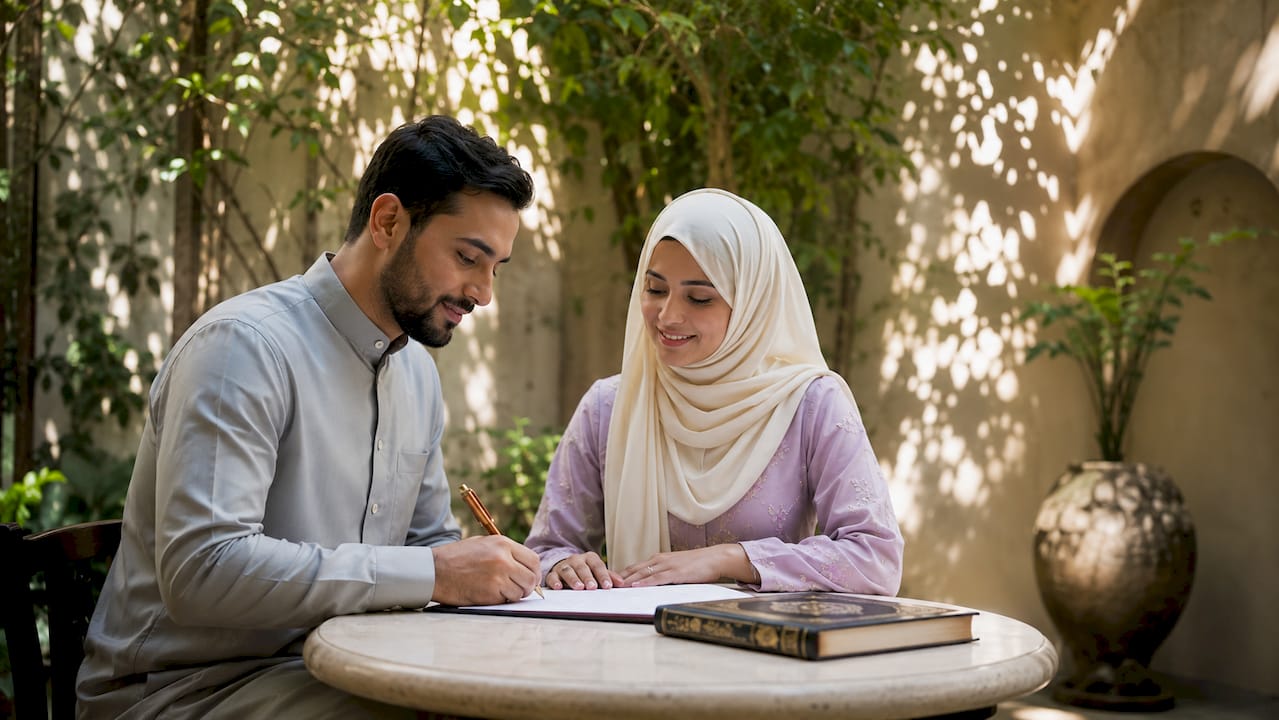
Islamic marriage customs center on the Nikah, a religious contract requiring mutual consent, mahr, and witnesses. Cultural traditions like Mehndi and Baraat are optional and do not affect the validity of the marriage. The Walima is a Sunnah celebration that publicly announces the marriage, but is not obligatory.
Marriage customs in Islam are defined by the Nikah, a religious contract that legally and spiritually unites two people under Islamic law. The Nikah establishes mutual rights, responsibilities, and a framework for family life rooted in faith. Understanding these customs matters whether you are planning a wedding, attending one, or simply learning about Islamic traditions. This guide separates the religious requirements from the cultural celebrations, so you know exactly what is obligatory, what is recommended, and what is simply tradition.
What are the essential marriage customs in islam?
The Nikah is the core of every valid Islamic marriage. All other festivities are cultural and optional. That distinction is the most important thing to understand before planning any Islamic wedding.
A valid Nikah requires five elements recognized across mainstream Islamic jurisprudence:
Mutual, free consent (Ijab wal Qabul): Both parties must agree voluntarily. A Nikah without the bride’s consent is invalid under Islamic law. This is not a formality. It is a legal and spiritual requirement.
Mahr: The groom must give the bride a gift of agreed value, whether money, property, or another form. The mahr belongs exclusively to the bride. It is not a payment to her family.
Two adult Muslim witnesses: The contract must be witnessed by at least two competent adult Muslims. This requirement is what makes the marriage a public, verifiable act.
A wali (guardian) for the bride: In most Sunni schools of thought, the bride’s guardian, typically her father or a male relative, must be present to represent her interests. The wali’s role is protective, not controlling. He acts to safeguard her rights, not to override her agency.
Prohibition of mahram marriages: Islam prohibits marriage between close relatives. This rule is non-negotiable across all schools.
One fact surprises many people: the Nikah can take as little as 10 minutes and requires no specific location or religious official. A mosque is not required. An imam is not required. Any competent Muslim adult who understands the contract procedure can conduct it.
Pro Tip: If you are planning a Nikah, write down the agreed mahr amount clearly before the ceremony. Disputes over mahr terms are one of the most common sources of post-wedding conflict.
How do islamic marriage customs differ from cultural traditions?
The single biggest source of confusion in Islamic wedding planning is the blurring of religious requirements and cultural customs. The two are not the same, and treating cultural traditions as religious obligations creates unnecessary pressure on couples.
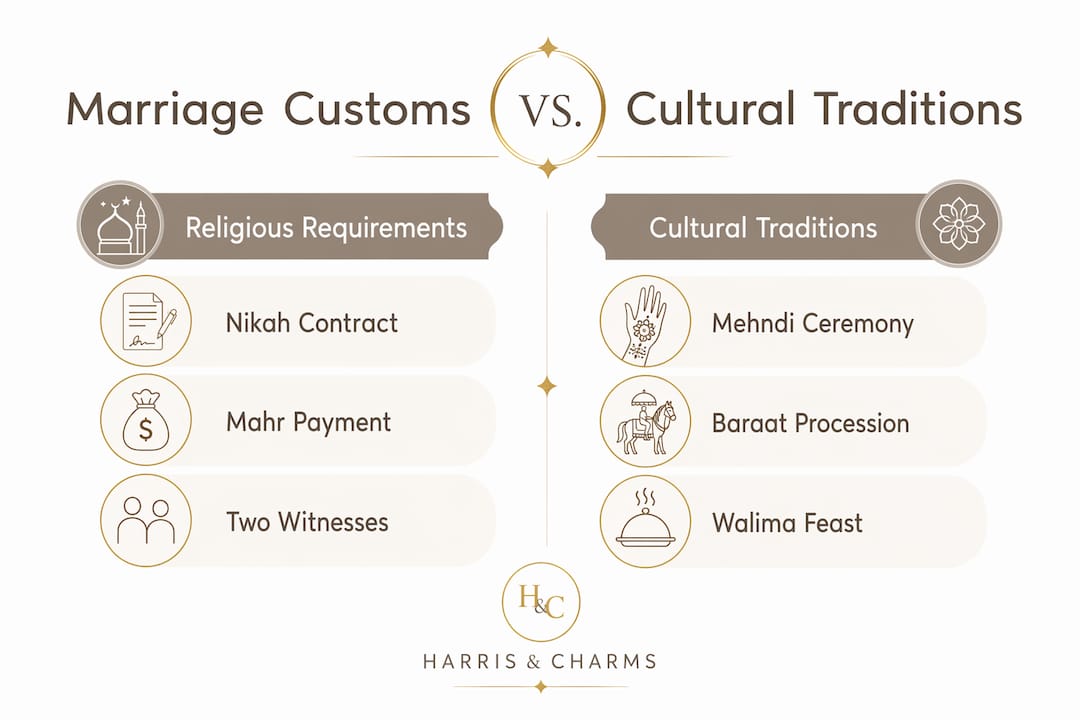
Practice | Religious Requirement? | Notes |
Nikah contract | Yes | Obligatory for a valid Islamic marriage |
Mahr | Yes | Amount is negotiable; must be given to the bride |
Two witnesses | Yes | Required by all major schools |
Mehndi (henna night) | No | South Asian and Middle Eastern cultural tradition |
Baraat (groom’s procession) | No | South Asian cultural custom |
Elaborate reception | No | Optional; scale depends on family means |
Specific dress code | No | Modesty is required; specific styles are cultural |
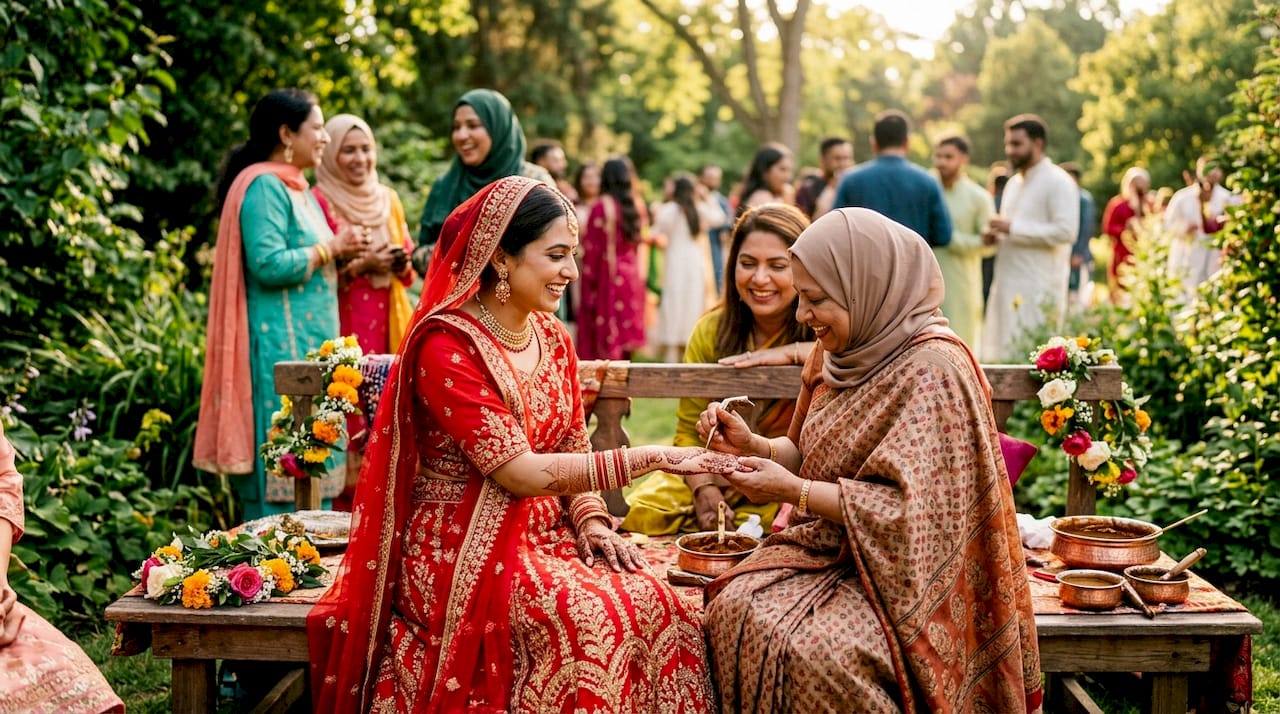
Cultural customs like Mehndi and Baraat vary by geography and are respected when they do not contradict Islamic principles. An Islamic legal maxim states that custom carries legal weight only when it does not conflict with Islamic law. That principle gives cultural traditions room to exist without becoming religious obligations.
South Asian Muslim weddings often include multi-day events: the Mehndi, the Nikah, the Walima, and sometimes a reception. Middle Eastern weddings may separate men and women entirely. West African Muslim weddings often feature specific fabrics and community feasts. None of these regional customs are required by Islam. They are expressions of culture layered onto the religious core.
The practical takeaway is clear. A simple Nikah conducted in a living room with two witnesses, a mahr, and genuine consent is fully valid. A couple who cannot afford an elaborate ceremony should never feel their marriage is less legitimate. Prioritizing faith and character over social status and wealth correlates directly with marital success and tranquility.
What is the role of the walima in islamic weddings?
The Walima is the celebratory feast that follows the Nikah. It is one of the most recognized Muslim marriage rituals across cultures, and its purpose is specific: to publicly announce the marriage and share joy with the community.
Key facts about the Walima:
It is a Sunnah practice, meaning it follows the example of the Prophet Muhammad. It is strongly recommended but not religiously obligatory.
The groom or his family hosts it, typically within seven days of the Nikah.
Scale should match the family’s financial means. Prophetic tradition encourages holding a Walima even with modest means, such as a single sheep. Extravagance is discouraged.
Attendance is considered a social and religious courtesy. Declining a Walima invitation without a valid reason is generally frowned upon in Islamic tradition.
The Walima is distinct from the Nikah contract. Skipping it does not invalidate the marriage. However, announcing the marriage publicly through the Walima serves a social function: it removes ambiguity and signals the couple’s new status to their community.
Pro Tip: If budget is a concern, a simple Walima dinner at home with close family and friends satisfies the Sunnah completely. You do not need a banquet hall or catered event.
What modern factors shape islamic marriage practices today?
Traditional Islamic weddings are adapting to modern legal systems, diverse communities, and the realities of Muslim life outside majority-Muslim countries. Several practical considerations now shape how couples approach their wedding planning.
Civil registration is not optional in most countries. Civil registration alongside the Nikah ensures legal recognition in countries where the Nikah alone is not legally binding. In the UAE, Western countries, and Australia, many couples conduct the Nikah first and then complete civil registration separately. Skipping civil registration can leave spouses without legal protections for property, inheritance, and custody.
An imam is not required by Islamic law. Any competent Muslim adult can conduct the Nikah. Imams are customary and may be required by civil registration laws in some jurisdictions, but Islamic law itself does not mandate their presence. This matters for couples in areas with limited access to Islamic clergy.
The wali situation is solvable. If the bride’s father is absent, deceased, or non-Muslim, Islamic law permits a trustworthy community member or imam to act as wali. Navigating this process typically involves connecting with a local mosque or Islamic center to identify a suitable representative.
Converts and intercultural couples face unique pressures. Cultural pressures can overwhelm converts and couples without a Muslim family network, particularly around expectations for language, dress, or ceremony style. Knowing which elements are religious requirements and which are cultural customs gives these couples the confidence to make their own choices without guilt.
The Nikah must remain the center of planning. Couples who treat the Nikah as a formality and invest all their energy in the reception often report feeling disconnected from the spiritual significance of their marriage. Centering the contract, the consent, and the mahr as the meaningful core of the day produces a more grounded experience.
For couples in the UAE specifically, understanding the Islamic marriage requirements for documentation and registration is a practical first step before booking any venue or vendor.
Key takeaways
A valid Islamic marriage requires the Nikah contract with mutual consent, mahr, and witnesses; all other celebrations are cultural additions, not religious obligations.
Point | Details |
Nikah is the legal core | The contract requires consent, mahr, and witnesses; no imam or mosque is needed. |
Mahr belongs to the bride | It is a gift exclusively for her, not a payment to her family. |
Cultural customs are optional | Mehndi, Baraat, and elaborate receptions are traditions, not religious requirements. |
Walima is Sunnah, not obligatory | A simple post-Nikah feast satisfies the recommendation without requiring extravagance. |
Civil registration protects both spouses | In the UAE and most Western countries, Nikah alone does not provide legal protections. |
What i’ve learned advising couples on islamic weddings
Most of the stress I see couples carry into wedding planning comes from one source: they cannot tell the difference between what Islam actually requires and what their family or community expects. Those two things are not always the same.
I have worked with couples who spent months agonizing over whether to include a Baraat, whether the venue needed to be gender-separated, or whether skipping a Mehndi night would offend someone. The answer in every case was the same. None of those decisions affect the validity of the marriage. The Nikah, the mahr, the witnesses, and genuine consent are what matter. Everything else is negotiable.
What I find genuinely encouraging is the growing number of couples who are choosing to make the Nikah itself the most intentional part of their day. They write their own mahr agreements thoughtfully. They choose their witnesses carefully. They take time before the ceremony to understand what they are consenting to. That shift produces marriages that start with clarity and purpose rather than exhaustion.
The couples who struggle most are often those who have never had an honest conversation about which customs are religious and which are cultural. Opening that conversation early, ideally before engagement, removes a significant amount of pressure. It also tends to reveal a lot about how a couple will handle disagreement in marriage itself.
— Harris
Plan your islamic wedding in the UAE with Harrisandcharms
Planning an Islamic wedding in the UAE involves more than booking a venue. Documentation, civil registration, and legal attestation all require careful coordination, especially for expat couples or those navigating intercultural requirements.

Harrisandcharms offers tailored marriage packages in Dubai that cover both Islamic Nikah support and civil registration in one place. From venue coordination and photoshoots to legal document processing and attestation, the team handles the details so you can focus on the day itself. Whether you need a simple Nikah ceremony or a full-service wedding experience, Harrisandcharms provides expert guidance built around your specific situation. Explore the full range of marriage services in the UAE and take the first step toward a stress-free wedding.
FAQ
What makes a nikah legally valid in islam?
A valid Nikah requires mutual free consent from both parties, a mahr given to the bride, and at least two adult Muslim witnesses. In most Sunni schools, a wali for the bride is also required.
Is an imam required to perform a nikah?
No. Any competent Muslim adult who understands the contract procedure can conduct a Nikah. An imam is customary but not mandated by Islamic law.
What is the difference between a nikah and a walima?
The Nikah is the marriage contract itself. The Walima is the celebratory feast that follows, typically within seven days. The Walima is a recommended Sunnah practice, not a religious requirement.
Do muslim couples need civil registration in addition to a nikah?
Yes, in most countries including the UAE and Western nations. Civil registration provides legal protections for property, inheritance, and custody that the Nikah alone does not guarantee under civil law.
What happens if the bride’s father is not available to act as wali?
Islamic law allows a trustworthy community member or imam to serve as wali when the father is absent, deceased, or non-Muslim. Connecting with a local mosque is the standard way to arrange this.
Recommended
Comments