
Islamic Marriage Contract (Nikah): What Muslims in the US Need to Know

Updated: Jul 24
TL;DR:
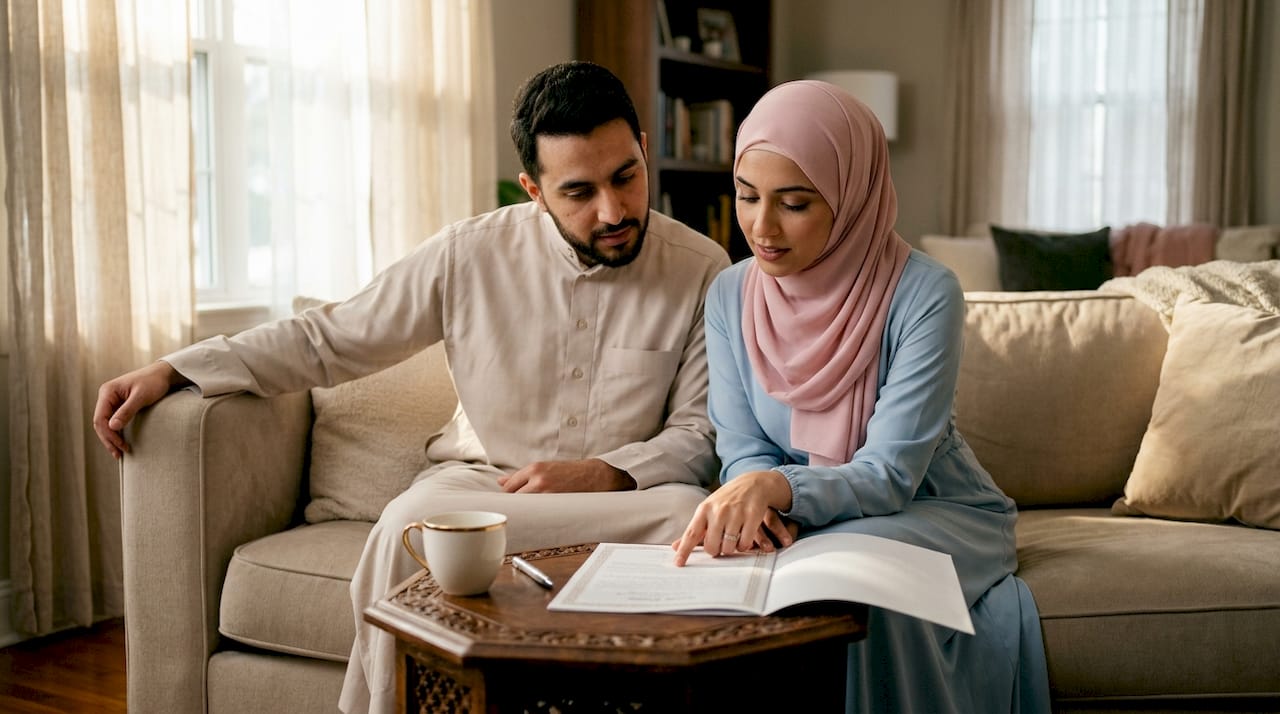
A Nikah is a legal and religious marriage contract in Islam that legitimizes the relationship and outlines rights and duties.
In the US, couples often need both a Nikah and a civil marriage to ensure legal protections and enforceability.
What is a marriage contract in Islam?
A Nikah is a civil and religious contract that makes a marriage lawful under Islamic law. It is not a sacrament in the way Christian marriage is understood. It is a binding legal agreement, and that distinction matters more than most couples realize when they are standing at the altar.
The core purpose of the Nikah is to legalize the marital relationship and legitimize any children born from it. Beyond that, it establishes a formal structure of rights and duties for both spouses, enforceable under Islamic jurisprudence. Think of it as a contract in the fullest legal sense, one that happens to carry deep religious weight.
Three elements are non-negotiable for a valid Nikah:
Mutual consent (Ijab and Qabul): Both parties must freely agree. The bride makes the offer, the groom accepts. No coercion, no proxy agreement without explicit authorization.
Mahr (mandatory dower): A gift from the groom to the bride, specified before the ceremony. It belongs exclusively to her, not her family.
Witnesses: At least two competent adult witnesses must be present. In Sunni Islam, two male witnesses are required; in Shia Islam, witnesses are strongly recommended.
The contract also typically involves a Wali, a male guardian for the bride, usually her father. His role varies by legal school and cultural context, but his presence is standard in most communities across the United States.
Key components and conditions of a valid Nikah
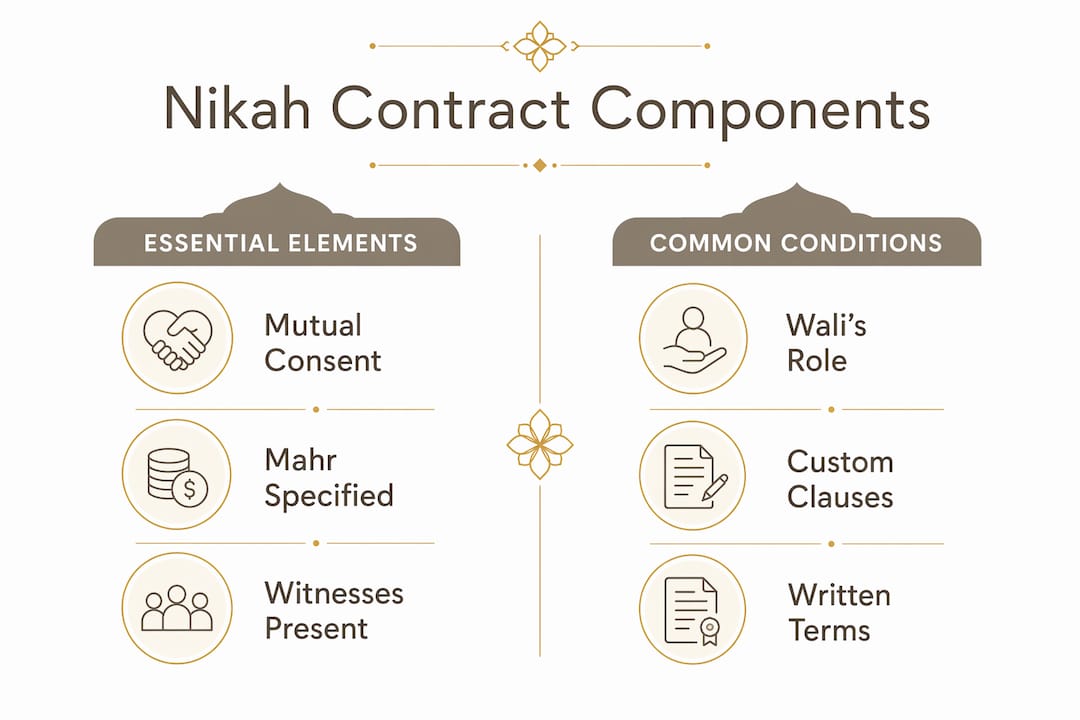
The Nikah rests on a specific set of conditions. Miss one, and the contract’s validity comes into question under Islamic jurisprudence.
Essential components:
Mahr: The Assembly of Muslim Jurists of America specifies that Mahr must be explicitly stated at the time of marriage. It can be cash, property, or any material value the couple agrees on. If no amount is specified, a judicially determined sum still becomes due.
Offer and acceptance (Ijab/Qabul): All five major schools of Islamic jurisprudence agree that a marriage requires a verbal offer and acceptance. A mere agreement or intention, without the spoken formula, does not constitute a valid Nikah.
Witnesses: Required in Sunni Islam; the Shafi’i and Hanbali schools specifically require two male Muslim witnesses of good character.
Freedom from legal obstacles: The groom must be Muslim; the bride must not be in an existing marriage; neither party can be in a prohibited degree of kinship.
The role of the Wali:
The four Sunni schools generally require a Wali for the bride’s marriage to be valid. The Hanbali and Shafi’i schools are strict on this point. The Hanafi school, by contrast, permits a woman of sound mind and legal age to contract her own marriage without a guardian, though a Wali is still strongly preferred. Shia jurisprudence holds a similar position to the Hanafi school for adult women.
Jurisprudential variances:
Hanbali school: Grants the most flexibility for contractual stipulations, including the wife’s right to dissolve the marriage if the husband violates agreed conditions.
Hanafi school: Accepts a broader range of words for the contract formula and does not require witnesses of a specific gender ratio.
Shafi’i school: Requires the Arabic roots al-zawaj or al-nikah in the contract formula and mandates two male Muslim witnesses.
Maliki school: Does not require witnesses at the time of the contract itself, only before consummation.
Shia (Imamiyyah) school: Requires the offer in the past tense using ankahtu or zawwajtu, and considers the presence of a cleric customary but not legally required.
What rights and duties does the Nikah establish?
The Nikah creates a specific, interdependent structure of rights and obligations. Under Islamic jurisprudence, a spouse’s failure to perform a duty can affect their claim to a corresponding right. That interdependence is built into the contract’s logic.
Husband’s duties:
Pay the agreed Mahr to the wife. This is her exclusive property. She may save, spend, or invest it as she chooses.
Provide lodging, clothing, and financial support.
Treat the wife with fairness and respect, described in Islamic sources as “mutual good treatment.”
If he takes additional wives, he must divide his time equally among them.
Wife’s rights:
Full ownership of her Mahr. Islamic scholars emphasize that poorly defined Mahr terms are one of the most common sources of dispute, particularly in divorce proceedings.
Financial security and maintenance, independent of her own income or assets.
The right to seek divorce through khul’ (by returning the Mahr) or through judicial divorce if she has valid grounds.
The right to have divorce initiation delegated to her by the husband, a provision called talaq al-tafwid, which can be written directly into the Nikah contract.
Sexual rights and exclusivity:
The contract establishes the husband’s right to sexual intimacy and his exclusive relationship with the wife. A wife who refuses intimacy without a valid religious excuse, or who leaves the marital home without permission, may forfeit her right to financial support under classical jurisprudence. This is one of the more contested aspects of traditional Islamic marriage law, and many modern Muslim couples address it explicitly through contractual stipulations.
How can you customize an Islamic marriage contract in the US?
The Nikah is legally a civil contract, not a sacrament, and that means its terms are negotiable within the limits of Sharia. Couples can and should use that flexibility, especially in the United States, where the legal landscape adds another layer of complexity.
Common customizations:
Residence: Specifying where the couple will live, or requiring the husband’s consent before relocating.
Polygamy restrictions: The wife can include a clause making a second marriage grounds for divorce. The Hanbali school enforces this; other schools vary.
Divorce initiation rights: The husband can delegate his right of talaq to the wife, giving her the ability to initiate divorce under specified conditions. The Council of Shia Muslim Scholars of North America has formalized a list of twelve conditions under which this delegation becomes active, including the husband’s failure to provide basic necessities, abuse, addiction, or taking another wife without consent.
Financial terms: Deferred Mahr amounts, conditions for when deferred portions become due, and financial support obligations can all be specified.
Dispute resolution: Couples can designate a mediator or Islamic arbitration body for resolving disagreements.
The US legal reality:
Islamic marriage contracts are private religious agreements and are not automatically recognized by US civil courts. A Nikah clause requiring the husband to pay deferred Mahr, for example, may not be enforceable in a state court without a separate civil prenuptial agreement that mirrors those terms. The strategy most Islamic legal organizations in the US recommend is pairing the Nikah with a civil prenuptial agreement that incorporates the same financial conditions, making them enforceable under state law.

Pro Tip: Have an attorney familiar with both Islamic family law and your state’s contract law review any prenuptial agreement before signing. A clause that is valid under Sharia may still be unenforceable in a US court if it violates public policy or lacks proper consideration.
Detailed written Nikah contracts, sometimes called Nikah namas, are increasingly advocated by Islamic institutions in the West precisely because verbal agreements leave too much room for dispute. The Muslim Institute’s model marriage certificate, developed in consultation with Islamic scholars and women’s organizations, is one example of a document designed to protect both parties’ rights in writing.
How does a Nikah compare to civil marriage in the US?
A Nikah and a civil marriage serve overlapping but distinct purposes. Understanding where they diverge is critical for Muslim couples in the United States.
A Nikah alone does not constitute a legally recognized marriage under US law. Without civil registration, couples lack federal and state legal protections, including inheritance rights, hospital visitation rights, health insurance coverage, and property claims in divorce.
Feature | Islamic Nikah | US Civil Marriage |
Legal recognition | Religious only; not recognized by US courts | Fully recognized by federal and state law |
Required elements | Mutual consent, Mahr, witnesses | Marriage license, officiant, registration |
Mahr / financial gift | Mandatory | Not required |
Divorce process | Talaq, khul’, or judicial divorce under Islamic law | Civil court proceedings |
Inheritance rights | Governed by Islamic law (Sharia) | Governed by state intestacy laws |
Healthcare decisions | No automatic legal authority | Automatic spousal rights |
Customizable terms | Yes, within Sharia limits | Yes, via prenuptial agreement |
Documentation | Nikah nama (marriage certificate) | State-issued marriage certificate |
The practical solution for most Muslim couples in the US is to perform both: a civil marriage registration to secure legal protections, and a Nikah ceremony to fulfill religious obligations. Many imams in the US will not officiate a Nikah until the couple has already obtained a civil marriage license, precisely to avoid leaving the wife without legal recourse.
For couples navigating the civil and Islamic marriage frameworks simultaneously, understanding how each system handles property and inheritance is especially important before the ceremony.
How is the Nikah ceremony actually conducted?
The ceremony itself is simpler than most people expect. There is no required elaborate ritual. What matters is the spoken formula.
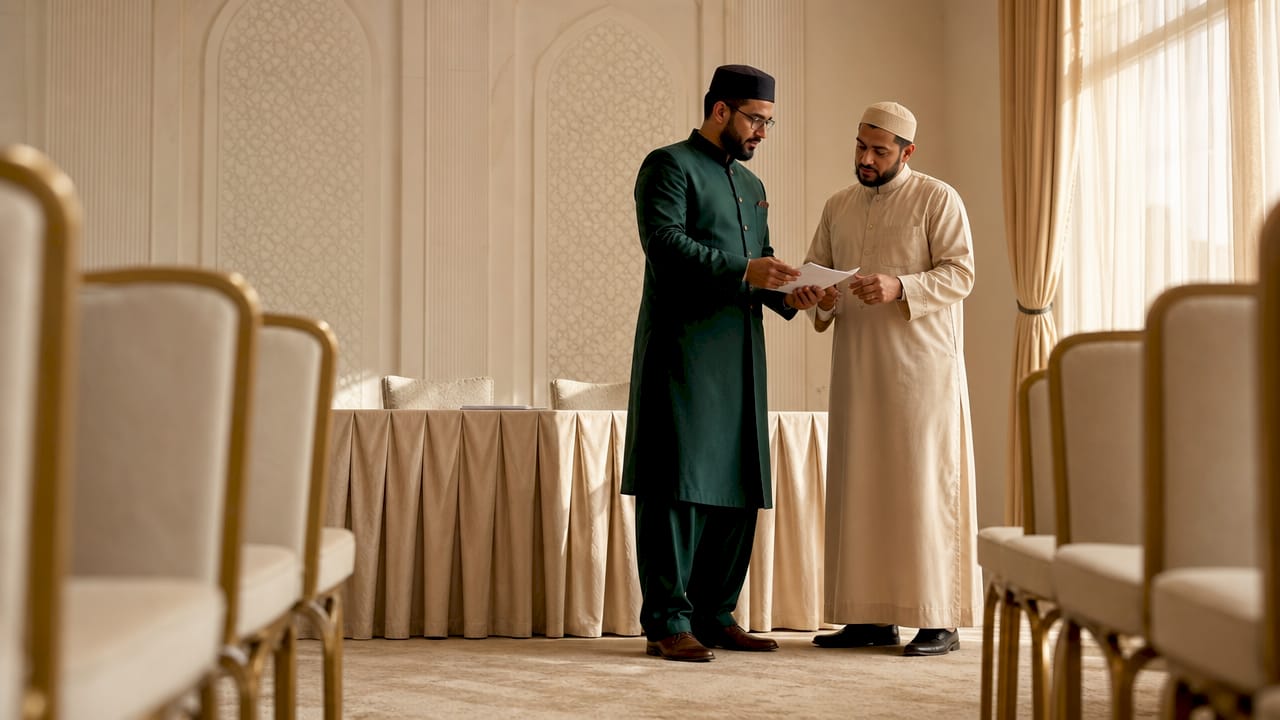
The bride (or her Wali) makes the offer using the words zawwajtu or ankahtu, meaning “I give in marriage.” The groom immediately accepts with qabiltu, meaning “I have accepted.” This exchange, known as Ijab and Qabul, is the legal heart of the Nikah. All five major schools of Islamic jurisprudence agree that a marriage is concluded by this recital, and that a mere agreement without the spoken words does not constitute a valid contract.
The ceremony is typically preceded by a Khutbah, a short sermon that opens with praise of Allah and blessings upon the Prophet Muhammad. Three Quranic verses (4:1, 3:102, and 33:70) are commonly recited, followed by a du’a asking for blessings on the marriage. Once the Khutbah is complete, the contract formula is recited.
If either party cannot recite the Arabic formula correctly, they may appoint a representative (a wakil) to speak on their behalf. According to Ayatollah Sistani’s guidance for Muslims in the West, if Arabic is genuinely not possible, the contract may be recited in another language as long as the meaning is preserved. The formula is typically repeated two or three times for certainty.
After the exchange, the marriage is concluded under Islamic law. A Walimah, a wedding feast, is strongly recommended as a Sunnah practice, but it is not a legal requirement for the Nikah’s validity.
What qualifications does a Nikah officiant need?
The short answer: fewer than most people assume. The presence of an imam or religious scholar is customary but not strictly required for a Nikah to be valid. What the contract actually requires is a proper offer, acceptance, and witnesses. The officiant facilitates the process; he does not make it valid.
That said, having a qualified imam or qazi (Islamic judge) officiate carries real practical advantages. A knowledgeable officiant can verify that all conditions are met, guide the couple through the formula correctly, and ensure the contract documentation is complete. In the US context, this matters because an imam who is also a licensed civil officiant can solemnize both the religious and civil marriage in a single ceremony, which simplifies the registration process considerably.
Qualifications to look for in an officiant:
Islamic knowledge: Familiarity with the marriage contract requirements across the relevant legal school (Hanafi, Shafi’i, Hanbali, Maliki, or Shia).
Civil licensing: In most US states, an officiant must be registered or ordained to legally solemnize a civil marriage. Check your state’s specific requirements.
Experience with documentation: The officiant should be comfortable completing the marriage license paperwork and ensuring it is filed with the county clerk.
Familiarity with contractual stipulations: If the couple is including custom clauses, the officiant should understand their religious validity and limitations.
Some Islamic officiants in the US will only perform a Nikah after the couple has already obtained a civil marriage license. This protects both parties and ensures the religious ceremony has immediate legal backing.
Common disputes in Islamic marriage contracts and how they get resolved
The most frequent source of conflict is a poorly defined Mahr. When the amount is vague, when deferred payment conditions are not written down, or when the contract is entirely verbal, disputes become almost inevitable, especially in divorce. Islamic legal scholars consistently flag this as the area where couples are most underprepared.
Common disputes:
Mahr disputes: Whether the full amount was paid, whether deferred portions are due, and what triggers payment of a deferred Mahr.
Divorce initiation: Husbands who refuse to grant a religious divorce (talaq) after a civil divorce has already been granted. This leaves the wife in a state of religious limbo, still married under Islamic law even though the civil marriage is dissolved.
Polygamy: A husband who takes a second wife in violation of a contractual clause, with the wife then seeking to enforce her right to dissolve the marriage.
Financial support: Disputes over the husband’s obligation to provide maintenance, particularly when the wife is also employed.
Custody and children: The Nikah contract rarely addresses custody explicitly, which creates gaps when the marriage ends.
Resolution pathways:
Islamic arbitration bodies, such as those affiliated with the Assembly of Muslim Jurists of America (AMJA), offer mediation and adjudication for disputes within an Islamic framework. Many mosques also provide informal mediation through their imams. For disputes with financial or property dimensions, US civil courts apply state law, which is why pairing the Nikah with a civil prenuptial agreement is so valuable. A clause that is only in the Nikah may be morally binding but legally unenforceable without that civil backing.
The Islamic marriage contract process works best when both parties treat the drafting stage as seriously as the ceremony itself.
How does the Nikah affect inheritance rights?
This is where the gap between Islamic law and US law creates the most serious practical consequences for Muslim couples.
Under Islamic inheritance law (the rules of mirath), a surviving spouse receives a fixed share of the deceased’s estate. A wife receives one-eighth of her husband’s estate if they have children, and one-quarter if they do not. A husband receives one-quarter of his wife’s estate if they have children, and one-half if they do not. These shares are set by the Quran and are not negotiable within Islamic law.
US state law operates entirely differently. Without a valid civil marriage, a surviving partner has no automatic inheritance rights under state intestacy laws. If the couple had only a Nikah and no civil marriage, the surviving spouse could be legally excluded from the estate entirely, regardless of how long they were together.
Even with a civil marriage, US intestacy laws do not follow Islamic inheritance shares. A Muslim couple who wants their estate distributed according to Islamic principles must create a will or trust that explicitly specifies those shares. Without that document, state law applies, and the distribution may contradict what Islamic law prescribes.
The practical steps for Muslim couples in the US:
Register a civil marriage to establish baseline legal inheritance rights.
Draft a will that specifies Islamic inheritance shares for each beneficiary.
Name beneficiaries explicitly on retirement accounts, life insurance policies, and bank accounts, since these assets pass outside the will entirely.
Consult an attorney familiar with both estate planning and Islamic inheritance principles.
The Islamic marriage requirements that govern the contract’s formation are only the beginning. What happens to the estate when the marriage ends, whether by death or divorce, requires equal attention.
Key Takeaways
A valid Nikah requires mutual consent, a specified Mahr, and competent witnesses, but without civil registration, it carries no legal force under US law.
Point | Details |
Nikah is a civil contract | It is a binding legal agreement under Islamic law, not a religious sacrament, and its terms are customizable within Sharia limits. |
Three non-negotiable elements | Mutual consent (Ijab/Qabul), a specified Mahr, and competent witnesses are required for validity across all major legal schools. |
US legal gap | A Nikah alone is not recognized by US courts; civil marriage registration is required for inheritance, healthcare, and property rights. |
Written contracts prevent disputes | Poorly defined Mahr terms and verbal-only agreements are the leading cause of conflict in Islamic divorce proceedings in the West. |
Harrisandcharms | Harrisandcharms provides comprehensive Islamic and civil marriage services, including contract facilitation and legal documentation support. |
Why the verbal Nikah tradition needs a written upgrade in the West
The Nikah’s flexibility is one of its genuine strengths. It was designed as a civil contract, not a ritual, and that means it can adapt to the realities of any legal environment. The problem is that many Muslim communities in the United States still treat the verbal ceremony as sufficient, and that assumption causes real harm, almost always to the wife.
When a marriage ends in the US without a written Nikah contract and without civil registration, the wife often has no legal recourse for unpaid Mahr, no claim to shared property, and no standing in a US court. She may also face the additional burden of a husband who grants a civil divorce but refuses a religious one, leaving her in an impossible position under Islamic law. This is not a hypothetical. It is a pattern that Islamic family law organizations across the US encounter regularly.
The conventional wisdom in many communities is that a good Muslim husband will honor his obligations without needing them written down. That may be true in many marriages. But a contract exists precisely for the cases where it is not. Writing down the terms is not a sign of distrust. It is the responsible thing to do, and it is what Islamic jurisprudence itself recommends when it describes the Nikah as a formal, binding agreement.
Modern Muslim couples in the US are navigating two legal systems simultaneously. The Nikah handles the religious dimension; the civil marriage and prenuptial agreement handle the legal one. Neither replaces the other. Both are necessary.
Harrisandcharms makes Islamic and civil marriage documentation straightforward
Getting the Nikah right, religiously and legally, takes more than a ceremony. It takes the right documentation, the right guidance, and someone who understands both the Islamic contract framework and the civil requirements that make it enforceable.
[Image removed due to lack of supporting facts]
Harrisandcharms specializes in exactly this. From tailored civil marriage packages to full Islamic marriage facilitation, the team handles contract documentation, legal attestation, and event coordination so couples can focus on the marriage itself rather than the paperwork. Whether you need help structuring your Nikah contract, registering a civil marriage, or navigating the documentation process as an expat, Harrisandcharms offers comprehensive marriage services built around your specific situation. Reach out directly to discuss your needs and get a personalized plan.
Recommended
Comments