
What Court Do You Get Married in? A 2026 US Guide

Updated: Jul 27
TL;DR:
Marriage licenses in the US are issued at local offices, such as county clerk's offices or probate courts, depending on the state. Applicants must fulfill jurisdiction-specific rules, including obtaining their marriage license in the same county or court to get married in, where the ceremony will take place, with a legally authorized officiant performing the binding marriage ceremony. Harrisandcharms provides comprehensive civil and Islamic marriage services in the UAE, managing legal documentation and logistics for couples.
Which courts and offices handle marriage licenses in the US?
In the United States, marriage licenses are issued and ceremonies are performed at specific local offices, not a single national court. The exact venue depends entirely on where you live.
County clerk’s office: The most common option across most states. You apply here, pay the fee, and walk out with a license.
Probate court: Georgia couples, for example, apply directly at their county’s probate court rather than a clerk’s office.
Marriage bureau: Washington, DC uses the Moultrie Courthouse’s Marriage Bureau for both license issuance and ceremony scheduling.
Local courthouse: Cook County, Illinois residents obtain licenses from the County Clerk and can have the ceremony performed at Chicago or suburban courthouses by a judge.
Fees vary by location. Cook County generally charges a small administrative fee for courthouse ceremonies. Appointments are typically required, and walk-in ceremonies are rarely available. Judges and court officials perform the ceremony at these venues, so the process is civil and legally binding from the moment you sign.
Table of Contents of What court do you get married in
How to get a marriage license and complete the court marriage process
The court marriage process in the US has two distinct steps: getting the license, then having the ceremony. Confusing them as a single same-day event is the most common mistake couples make.
Step 1: Apply for the marriage license
Both parties must appear in person at the issuing office. Georgia explicitly requires both individuals present at the probate court.
Bring valid government-issued photo ID, proof of age, and, if either party was previously married, divorce documentation or a death certificate.
Some jurisdictions, like Cook County, allow part of the application to be completed online, but the final signature still requires an in-person visit.
Step 2: Wait out any required period
Some jurisdictions require marriage licenses to be obtained at least one day before the ceremony, with licenses expiring after a set period, so timing matters on both ends. Check your specific county’s rules, since validity windows vary by state.
Step 3: Schedule the courthouse ceremony
Book your appointment at the courthouse or marriage bureau in advance. Walk-in ceremonies are rarely accommodated. Pay any applicable administrative fees at this stage.
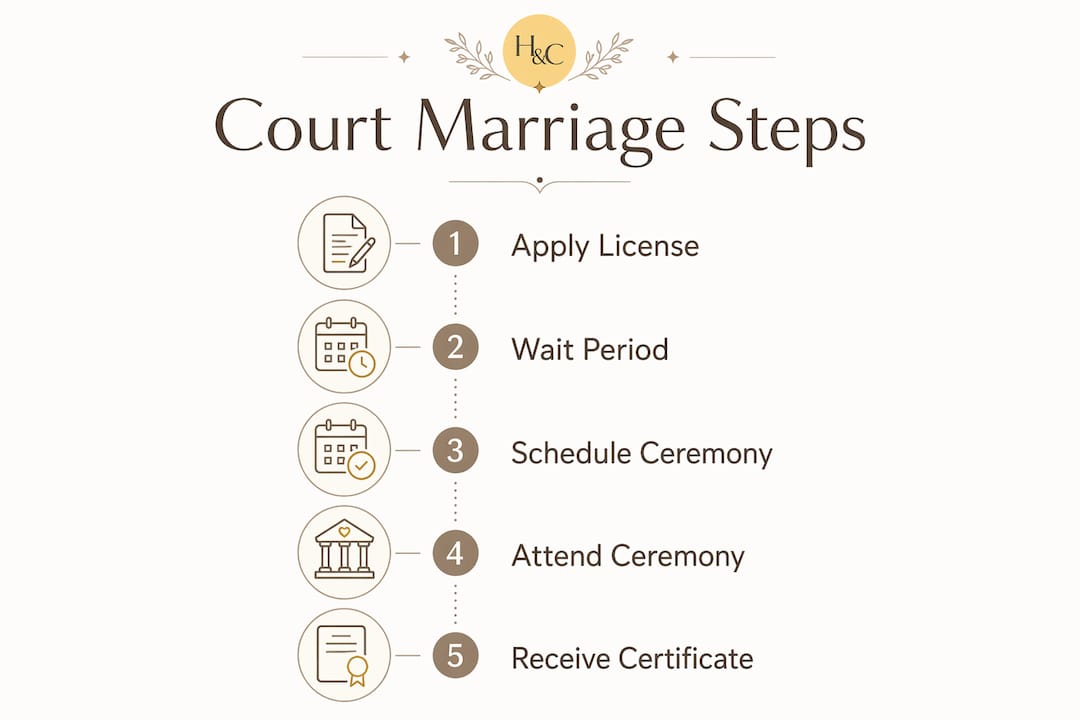
Step 4: Attend the ceremony
A judge or authorized court official performs the ceremony. Both parties sign the license, witnesses sign where required, and the officiant files the completed document with the appropriate office.
Pro Tip: Secure your marriage license before you finalize any ceremony date. License processing times and appointment availability can push your timeline by days or even weeks, especially in busy urban courthouses.
If you need to correct information on a marriage license after issuance, contact the issuing office directly. Most counties have an amendment process, but it requires documentation and sometimes a court order depending on the error.
Who can legally perform a marriage ceremony in the US?
Court marriage is a civil ceremony, and the officiant must be legally authorized by the state or local jurisdiction. The list of eligible officiants is broader than most couples expect.
Judges and magistrates: Perform ceremonies at courthouses as part of their official duties.
Court clerks: In some jurisdictions, clerks are authorized to solemnize marriages.
Religious celebrants: Ministers, rabbis, imams, and other religious leaders authorized under state law can perform legally valid marriages.
Civil celebrants: DC’s Marriage Bureau, for example, authorizes registered civil celebrants who are not affiliated with any religious institution.
Justices of the peace: Common in many Southern and Midwestern states.
A court or civil marriage is legally recognized independently of any religious ceremony. If you have a religious ceremony without a civil registration, the marriage may not be legally valid in the eyes of the state. The reverse is also true: a courthouse ceremony with a valid license is fully legal even without any religious component. Couples planning Islamic court marriages in the UAE context should note that the civil and religious tracks often run in parallel there, unlike the unified US system.
Legal considerations for court marriages in the US in 2026
The single most important legal rule: your marriage license is jurisdiction-specific. A license issued in Georgia cannot be used for a ceremony in New York, even if the officiant is authorized in both states. The license and the ceremony must happen within the same issuing jurisdiction.
This rule catches couples off guard more often than any other aspect of the court marriage process. If you plan to marry in a different county or state from where you applied, you need a new license from the jurisdiction where the ceremony takes place.
Legal trends in 2026 are moving toward greater flexibility. Governments globally are easing restrictions on ceremony locations and expanding the categories of authorized officiants, giving couples more options beyond traditional courthouse settings. The US reflects this shift, with several states now permitting ceremonies at parks, private venues, and other non-courthouse locations, provided the officiant is properly registered and the license is valid.
One practical implication: early license acquisition protects your plans. Courthouse appointment slots fill quickly in spring and summer, and processing delays can derail a carefully planned date. Treat the license as the first item on your wedding checklist, not the last.
How Harrisandcharms supports couples with civil and Islamic marriage services
Harrisandcharms specializes in guiding couples through civil and Islamic marriages in the UAE, handling the legal and logistical complexity that most couples find time-consuming.
Civil marriage packages: End-to-end support for legally recognized civil ceremonies in Dubai, including documentation and venue coordination.
Islamic marriage legal assistance: Guidance through the specific requirements for Islamic marriage registration under UAE law.
Document preparation and attestation: Harrisandcharms works with sister companies to handle legal translation, attestation, and visa-related paperwork.
Court application support: The team manages court submissions and follows up on approvals, so couples avoid the back-and-forth that typically delays the process.
Event services: Venue management, event photography, and prenuptial photoshoots are available as part of broader wedding packages.
For couples navigating UAE marriage requirements from abroad, Harrisandcharms provides the kind of on-the-ground guidance that makes the difference between a smooth process and a stressful one.
Harrisandcharms: civil and Islamic marriage services in the UAE, done for you
If you are planning a civil or Islamic marriage in the UAE and want someone to handle the court paperwork, documentation, and ceremony logistics without the back-and-forth, Harrisandcharms is built exactly for that.
The team manages everything from license applications and legal attestation to venue coordination and photography, all under one roof. Couples who come from countries with straightforward courthouse systems often underestimate how document-heavy UAE marriage registration can be. Harrisandcharms removes that friction entirely. Reach out through civil marriage packages to get started, or browse the full range of marriage services to find the package that fits your situation.
Key Takeaways
Court marriages in the US require a jurisdiction-specific license obtained before the ceremony, with both steps handled at designated local offices such as county clerk offices, probate courts, or marriage bureaus.
Point | Details |
Where to get married legally | County clerk offices, probate courts, and marriage bureaus handle licenses; courthouses host ceremonies. |
License jurisdiction rule | A license from one state or county cannot be used for a ceremony in a different jurisdiction. |
Cook County timing | Cook County requires the license at least one day before the ceremony; licenses expire after 60 days. |
Who performs the ceremony | Judges, court clerks, religious celebrants, and registered civil celebrants are all authorized officiants. |
Harrisandcharms | Handles civil and Islamic marriage documentation, court applications, and event services in the UAE. |
Recommended
Comments