
Documents Required for Court Marriage: 2026 UAE Guide


TL;DR:
Court marriage depends on submitting comprehensive legal documents, including identity, age, and address proofs, along with notarized affidavits and photographs. Proper preparation, especially for witnesses and foreign nationals, ensures a smooth process within the mandatory timelines, avoiding delays or refusals. Early and thorough document organization is crucial to successfully completing the legal union without procedural setbacks.
Court marriage is defined as a legally binding civil union solemnized before a Marriage Officer, requiring submission of specific legal documents including identity proofs, age proofs, address proofs, affidavits, photographs, and witness documentation. For couples in the UAE, whether Indian expats or foreign nationals, understanding what are the documents required for court marriage is the single most important step before filing any application. Missing even one document from the checklist can delay your entire process by weeks.
What are the documents required for court marriage?
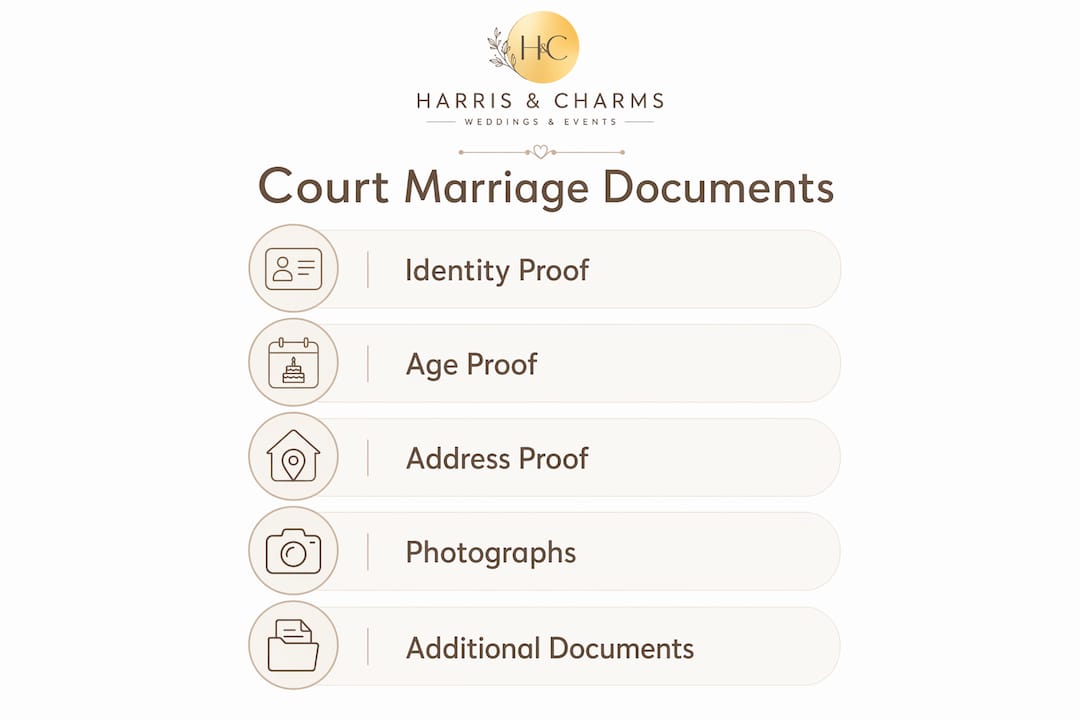
The core court marriage requirements fall into three categories: identity proof, age proof, and address proof. Each party must submit documents from all three categories, and originals must accompany every photocopy you submit.
Accepted identity proofs:
Aadhaar card
Passport (valid and current)
Voter ID card
PAN card
Emirates ID (for UAE residents)
Accepted age proofs:
Birth certificate
Passport (doubles as both identity and age proof)
Class 10 school certificate
Hospital birth record
Accepted address proofs:
Utility bills (electricity, water, gas) not older than three months
Rent agreement
Aadhaar card showing current address
Bank statement with local address
Voter ID or Passport with address
Both parties must submit identity, age, and address proofs including 4 to 6 passport-size photographs each. This means you need to prepare two complete document sets, one per applicant, before you even approach the Marriage Officer’s office.
The residency requirement is one that catches many couples off guard. At least one party must have resided in the Marriage Officer’s district for a minimum of 30 days before filing the Notice of Intended Marriage. Utility bills, rent agreements, or bank statements all serve as acceptable proof of local residence. For Indian expats based in the UAE, this means planning your India visit with enough lead time to satisfy this requirement.

Pro Tip: Carry three sets of photocopies for every document. Marriage Officer offices rarely have photocopying facilities on-site, and showing up with only originals will send you back out the door.
What additional documents support court marriage eligibility?
Beyond identity and address, the court marriage procedure requires a second layer of legal papers that confirm your eligibility to marry. These are the documents most couples forget to prepare.
Affidavit of marital status. Both parties must submit separate affidavits declaring their current marital status (single, divorced, or widowed). The affidavit must declare marital status, age, and confirm no prohibited relationship, and it must be notarized on proper stamp paper. A prohibited relationship includes close blood relatives, and the declaration protects both parties legally.
Affidavit of date of birth. If your birth certificate and passport show different dates, a notarized affidavit reconciling the discrepancy is required. This is more common than you think among Indian expats whose documents were issued across different decades and jurisdictions.
Passport-size photographs. You need 4 to 6 photographs per person, taken against a white background, not older than three months. Some Marriage Officer offices require joint photographs of both parties as well.
Notice of Intended Marriage (Form I). This is the official application form submitted to the Marriage Officer. It triggers the mandatory notice period and must be filled out accurately. Any error on this form restarts the clock.
Marital status supporting documents. If either party is divorced, a certified copy of the divorce decree is required. If widowed, an original or certified copy of the spouse’s death certificate must be submitted.
Official payment receipt. After submitting your Notice, you pay a prescribed fee and receive a receipt. Keep this receipt. It is proof of your filing date and is required at every subsequent step.
The marriage solemnization must occur within three months of the Notice being filed, or the Notice lapses entirely. This procedural timeline is non-negotiable. If your documents are incomplete at the time of filing, you lose days from that three-month window while you gather what is missing.
Pro Tip: Get your affidavits notarized at least one week before your filing date. Notary offices in India can have queues, and a rushed affidavit with errors will be rejected.
What documents do witnesses need to provide for court marriage?
Witness documentation is the most overlooked part of the court marriage checklist, and it is the most common reason applications stall on solemnization day. Three adult witnesses aged 18 or older must be present at the solemnization, and each witness must bring their own complete document set.
Each witness must provide:
Original government-issued photo ID (Aadhaar, Passport, or Voter ID)
Address proof matching the ID (utility bill, bank statement, or rent agreement)
Two to four passport-size photographs
Biometric verification in some jurisdictions (fingerprint or thumb impression at the Marriage Officer’s office)
Witness documents require original IDs and biometric authentication, a step that is frequently overlooked and leads directly to delays. The Marriage Officer will not proceed with solemnization if even one witness arrives without proper documentation. This means you are responsible for briefing your witnesses thoroughly, not just asking them to show up.
For UAE-based couples, choosing witnesses who are physically present in India on the solemnization date is a logistical challenge. Many couples make the mistake of selecting witnesses who are also traveling from abroad and underestimate the document preparation required on the witness’s end. Review the legal witness requirements well in advance to avoid last-minute complications.
Witness readiness is a critical factor for smooth solemnization. Treat your witnesses as co-applicants in terms of document preparation, not as guests who simply need to attend.
What special documents are needed for foreign nationals and special cases?
Foreign nationals and applicants in special circumstances face additional legal papers for court marriage beyond the standard checklist. The table below outlines the key differences.
Applicant type | Additional documents required |
Foreign national | Valid passport, current visa, proof of 30+ days India residence, No Objection Certificate (NOC) or Single Status Certificate from home country embassy or consulate |
Divorcee | Certified copy of divorce decree from the issuing court, translated into English or Hindi if in another language |
Widowed applicant | Original or certified death certificate of deceased spouse, translated if not in English or Hindi |
Non-English documents | Certified translation by a sworn translator; some jurisdictions require apostille on translated documents |
NRI or UAE resident | Proof of UAE residence (Emirates ID, UAE utility bill), valid Indian passport, and proof of 30-day India stay before filing |
Foreign nationals need a valid passport, visa, No Objection Certificate from their embassy, and proof of Indian stay for 30 or more days. The NOC, also called a Single Status Certificate, confirms that the applicant is legally free to marry under their home country’s laws. Without it, the Marriage Officer cannot verify that the marriage would be recognized internationally.
For Indian expats in the UAE, the civil court wedding guide for Indian expats covers jurisdiction-specific requirements that differ from standard domestic applications. Certified translations must be prepared by a recognized translator, and some states require an apostille stamp on foreign documents before they are accepted.
How does document preparation affect the court marriage process?
Proper document preparation is not just administrative. It directly determines whether your application moves forward or stalls. Failure to register marriages on time carries serious legal implications, which makes thorough documentation the foundation of the entire process.
The 30-day notice period is mandatory and designed to allow objections, preventing fraudulent unions. The notice is publicly displayed on state digital portals so that any person with a legal objection can raise it. Attempting to shortcut this period is illegal. This transparency mechanism is built into the Special Marriage Act 1954 and cannot be bypassed regardless of circumstances.
Common document preparation errors that cause delays:
Submitting photocopies without originals
Affidavits notarized on incorrect stamp paper denomination
Photographs older than three months or not meeting size specifications
Witness IDs with addresses that do not match their address proof documents
Divorce decrees without court seal or certification
Pro Tip: Create a shared digital folder with your partner and each witness containing scanned copies of every required document. If the Marriage Officer requests a replacement copy on the day of filing, you can print it immediately rather than scrambling.
Understanding the difference between court marriage and marriage registration is also critical. Court marriage is the solemnization of a new union before a Marriage Officer. Marriage registration is the legal recording of a marriage that may have already taken place. Confusing the two leads couples to prepare the wrong document set entirely.
Key takeaways
Preparing the correct legal papers for court marriage from the start is the only way to avoid delays, rejections, and a lapsed Notice of Intended Marriage.
Point | Details |
Core document categories | Both parties need identity, age, and address proof plus 4 to 6 passport-size photographs each. |
Affidavit requirements | Separate notarized affidavits from both parties declaring marital status, age, and no prohibited relationship. |
Witness documentation | Three adult witnesses (18+) must bring original government-issued ID, address proof, photographs, and biometric verification. |
30-day residency rule | At least one party must prove 30 days of residence in the Marriage Officer’s district before filing the Notice. |
Foreign national extras | NOC from embassy, certified translations, and proof of 30+ days India stay are required beyond the standard checklist. |
Why I think most couples underestimate the document side of court marriage
Most couples I speak with at Harrisandcharms treat document preparation as a formality. They focus on the ceremony, the date, the venue. The paperwork feels like a box to check. That mindset is exactly what causes the majority of delays I see.
The distinction between court marriage and marriage registration trips people up more than anything else. Couples arrive having prepared documents for one process when they actually need the other. The marriage registration process is a separate legal procedure with its own document requirements, and conflating the two wastes weeks.
The 30-day residency requirement is the second biggest blind spot. Couples plan a two-week India trip thinking that is enough time to complete everything. It is not. The notice period alone is 30 days, and that clock does not start until your documents are accepted. If your paperwork has errors, you lose days before the clock even starts.
Witness documentation is where I have seen the most last-minute chaos. Witnesses treat their role as informal. They show up without address proof, or with an ID whose address does not match their current residence. The Marriage Officer turns them away, and the entire solemnization is postponed. Brief your witnesses like co-applicants. Give them a checklist. Follow up.
My honest advice: start gathering documents at least 60 days before your intended filing date. That buffer absorbs notary delays, translation timelines, embassy certificate processing, and any corrections the Marriage Officer requests. Couples who prepare early have a genuinely stress-free experience. Couples who prepare at the last minute do not.
— Harris
Let Harrisandcharms handle your court marriage documentation

Harrisandcharms specializes in taking the complexity out of civil marriage procedures for couples in the UAE. From document checklists tailored to your specific situation to full-service coordination with Marriage Officers, the team handles the paperwork so you can focus on the moment that matters. Whether you are an Indian expat, a foreign national, or a UAE resident navigating the court marriage process for the first time, Harrisandcharms has a package designed for you. Explore the civil marriage packages in Dubai or browse the full range of marriage services in the UAE to find the right fit for your needs.
FAQ
What are the main documents required for court marriage?
Both parties must submit identity proof (Aadhaar, Passport, or Voter ID), age proof (birth certificate or Class 10 certificate), address proof (utility bill or rent agreement), notarized affidavits, and 4 to 6 passport-size photographs each.
How many witnesses are needed for court marriage?
Three adult witnesses aged 18 or older are required, and each must bring original government-issued ID, address proof, passport-size photographs, and may need to provide biometric verification at the Marriage Officer’s office.
What is the 30-day notice period in court marriage?
The Notice of Intended Marriage must be filed at least 30 days before solemnization, and at least one party must prove 30 days of residence in the Marriage Officer’s district. This period is legally mandatory under the Special Marriage Act 1954 and cannot be shortened.
What extra documents do foreign nationals need for court marriage?
Foreign nationals must provide a valid passport, current visa, proof of 30 or more days of India residence, and a No Objection Certificate or Single Status Certificate from their home country’s embassy or consulate.
Is court marriage the same as marriage registration?
No. Court marriage is the solemnization of a new union before a Marriage Officer. Marriage registration is the legal recording of a marriage that has already taken place. Each process has its own document requirements and procedural steps.
Recommended
Comments