
How Non-Muslims Can Get Married in the UAE


Planning a wedding as an expat in the UAE brings real questions about legal steps and which marriage process fits your needs. The introduction of a dedicated civil marriage law for non-Muslims means you can marry under a system that reflects your values rather than religious rules. With the UAE’s modern personal status law, non-Muslims now access civil marriage without guardian approval or premarital screening, streamlining your path to an internationally recognized marriage certificate and giving you control over your family’s future.
Table of Contents
Key Takeaways of How Non-Muslims Can Get Married in the UAE
Point | Details |
Civil Marriage Framework | Non-Muslim marriages in the UAE are governed by Federal Decree Law No. 41 of 2022, allowing couples to marry under civil law instead of Islamic Sharia law. |
No Religious Requirements | Non-Muslim couples are exempt from Islamic pre-marital requirements, such as guardian approval and medical screenings. |
Legal Equality | The civil marriage framework offers legal parity for non-Muslim residents, ensuring equal rights in property division, child custody, and inheritance matters. |
International Recognition | Civil marriage certificates issued in the UAE are recognized internationally, facilitating the validation of marital status in other countries. |
What Non-Muslim Marriage Means in the UAE
Non-Muslim marriage in the UAE represents a fundamental shift in how family law operates for expat residents. Instead of being bound by Islamic Sharia law, non-Muslims now have the legal right to marry under civil law frameworks that reflect their home country standards or other secular legal systems recognized by the Emirates. This distinction matters immensely because it affects everything from how you sign your marriage contract to what happens to your property, custody of children, and financial obligations if the marriage ends.
The Federal Decree Law No. 41 of 2022 created this legal pathway by establishing a separate personal status system for non-Muslim residents. What this means in practical terms is that you can enter into a marriage contract based on secular rules rather than religious requirements. You won’t need premarital medical screenings mandated by Islamic law, you don’t require a guardian’s approval to marry, and your marriage certificate carries the same legal weight as any civil marriage in Western countries. The law applies to family matters across the board: marriage registration, divorce procedures, inheritance rights, and child custody arrangements all follow the civil law framework you choose. Understanding legal marriage eligibility in the UAE helps clarify which specific laws apply to your situation.
For expats planning a wedding in the UAE, this legal structure offers significant advantages. You can choose to follow the laws of your nationality, which provides continuity with how your home country views your marital status and property rights. Alternatively, you can opt for another civil law system available under UAE regulations. The marriage becomes recognized not just locally but internationally because it’s documented through official UAE channels. This becomes critical if you’re eventually relocating back home or to another country—your marriage certificate proves legitimate, registered status without requiring any complex religious interpretation. The process itself is also more streamlined than Islamic marriage procedures; you submit documentation, meet residency requirements, have the contract signed before an official, and receive your certificate. There’s no ambiguity about whether your marriage is legally binding.
What often surprises expats is how this law specifically removed barriers that Islamic law imposes. Muslim couples in the UAE must follow Sharia provisions, but non-Muslims gained explicit exemption from these requirements. If you’re a non-Muslim couple marrying in the UAE, you’re stepping into a genuinely secular legal space. Your rights regarding property division during divorce, your ability to have guardianship of children without gendered restrictions, and your freedom to marry without parental consent all operate under civil law principles. This doesn’t mean the UAE became a Western country overnight—Islamic law still governs Muslims and remains foundational to Emirates society—but it does mean that non-Muslim residents received genuine legal parity with how they would marry in their home countries.
Pro tip: Verify which legal system you want to elect during your initial marriage registration meeting, as this choice determines how all future family law matters get handled; waiting until after marriage complications arise makes changing your elected legal system significantly more difficult.
Civil vs. Religious Marriages: Key Differences
The choice between a civil marriage and a religious marriage fundamentally shapes your legal rights, obligations, and how your relationship is recognized in the UAE. Civil marriages operate under secular law frameworks, while religious marriages follow the customs, rituals, and legal provisions of a specific faith tradition. For non-Muslims in the UAE, understanding this distinction is critical because it determines which legal system governs your marriage, what happens during divorce, how property gets divided, and who has custody of children. The two systems produce vastly different outcomes, even though both are legally recognized.
Civil marriages in the UAE are governed by Federal Decree Law No. 41 of 2022 and are designed specifically for non-Muslims and foreigners. The process is straightforward and focuses purely on legal consent between two adults. You don’t need premarital medical screening, a guardian’s permission, or religious officiants. The marriage contract is a legal document that both parties sign before an authorized official, and it grants equal rights to both spouses regardless of gender. Civil marriage eliminates the religious rituals and requirements entirely, replacing them with secular procedures that mirror what you’d experience in most Western countries. When you register a civil marriage, the UAE government issues an official certificate that holds legal weight internationally. Property rights, inheritance, custody arrangements, and divorce procedures all follow secular law principles, which typically favor equal treatment and individual property ownership. Civil marriage in Dubai operates under the same framework as other Emirates, providing consistency across the country.
Religious marriages, by contrast, are deeply rooted in faith traditions and their associated legal codes. Islamic marriages, the most common religious marriage type in the UAE, follow Sharia law and involve formal religious elements. These marriages include premarital screening requirements, may require guardian consent depending on circumstances, and incorporate religious rites and verses from Islamic texts. The marriage ceremony itself has spiritual significance beyond the legal contract. Religious marriages can be ceremonial in nature, performed at religious institutions or even embassies, without necessarily following the state’s civil registration protocols. Some couples opt for ceremonial religious marriages without official state registration, which creates legal complications if the marriage needs to be dissolved or if property disputes arise. The key difference is that religious marriages blend spiritual commitment with legal obligation, whereas civil marriages separate these entirely and focus only on the legal contract.
How These Systems Differ in Practice
Several concrete differences emerge when you compare the two systems side by side:
Consent and Permissions
Civil marriages require only mutual consent from both parties. You sign a contract, and you’re legally married. Religious marriages may involve additional requirements. Islamic marriage, for example, traditionally requires a guardian’s consent for certain parties and includes premarital obligations that aren’t present in secular civil contracts.
Property Rights and Inheritance
Civil marriages typically grant both spouses equal property ownership and inheritance rights, following secular legal principles. If you own property before marriage, it remains your separate property unless you formally combine assets. Religious marriages under Sharia may allocate property differently based on Islamic inheritance principles, where male and female heirs receive different proportions.
Divorce Procedures
Civil divorce is handled through courts and follows secular family law procedures. Both parties have relatively equal standing, and property division typically aims for fairness. Religious divorce, particularly Islamic divorce, involves different procedures. A husband may unilaterally pronounce divorce, while a wife must often petition the court for divorce grounds. Financial settlements follow religious inheritance principles rather than equal division.
Child Custody
Civil law prioritizes the best interests of the child and doesn’t automatically favor one parent over the other based on gender. Religious law, specifically Sharia, traditionally grants mothers custody for young children, but paternal rights become more significant as children age.
These differences explain why your choice matters enormously. Expats marrying in the UAE should recognize that selecting civil marriage provides legal predictability and equality. You know exactly how property works, what happens if you divorce, and how custody is determined. Religious marriage offers spiritual fulfillment but introduces legal complexity, especially if you later need to relocate or dissolve the marriage.
Here’s a side-by-side comparison of civil and religious marriage procedures in the UAE:
Aspect | Civil Marriage (Non-Muslim) | Religious Marriage (Islamic) |
Governing Law | Federal Decree Law No. 41 | Sharia-based family law |
Parental Consent | Not required for adults | Usually required for brides |
Medical Screening | Not mandated | Mandatory screening needed |
Officiant | Government official | Religious leader or Imam |
Ceremony Type | Legal only, secular | Includes religious rites |
Gender Rights | Equal for both spouses | Different per Sharia guidelines |
Certificate Validity | Recognized internationally | May need civil registration for recognition |
Pro tip: If you’re marrying as a non-Muslim couple, verify at your initial consultation with your marriage registration authority whether you want to formally register your marriage as civil even if you have a separate religious ceremony, as this creates legal protection that ceremonial-only marriages do not provide.
Legal Requirements and Required Documents
Marrying in the UAE as a non-Muslim requires specific documentation and eligibility criteria that differ from traditional Islamic marriage requirements. The good news is that the process is considerably simpler than many expats expect. You won’t need premarital medical screenings, guardian approvals, or religious endorsements. Instead, the UAE focuses on verifying your identity, proving you have no legal impediments to marriage, and confirming mutual consent. Understanding exactly what you need to bring and what eligibility criteria apply prevents delays and rejected applications.
Age and Basic Eligibility
The fundamental requirement is that both parties must be at least 21 years old at the time of marriage. This is a hard minimum; no exceptions exist for younger couples. You must also ensure that your marriage does not violate prohibited relationships, meaning you cannot marry a close family member such as a sibling, parent, or child. Beyond these basics, the UAE doesn’t impose religious requirements, nationality restrictions, or marital status limitations that would prevent two consenting adults from marrying. You can marry regardless of whether you’ve been married before, your religious background, your nationality, or your cultural background. The simplicity of these eligibility rules reflects the UAE’s secular approach to civil marriage for non-Muslims.
Essential Documents You’ll Need
When you arrive for your marriage registration appointment, you need to bring specific documents. Here’s what every couple should prepare:
Original Identity and Travel Documents
Valid passport for both parties (original, not copies)
Visa or residence permit if you live in the UAE
National identification card if you have one from your home country
Proof of Marital Status
You must demonstrate your current marital status through official documents. If you’ve never been married, many courts accept a statutory declaration or a letter from your home country’s vital records office stating that you have no previous marriages registered. If you’ve been divorced or widowed, bring certified copies of your divorce decree or death certificate for your previous spouse. These documents must be officially issued, not photocopies.
Residency and Address Verification
You’ll need proof of current residence in the UAE, such as a utility bill, tenancy contract, or a sponsored residence visa. This confirms that you meet any residency requirements your specific emirate imposes. Different emirates may have slightly different residency requirements, so check with your local court before applying.
Consent and Disclosure Forms
Both parties must complete and sign official consent and disclosure forms declaring that you willingly consent to marriage and that you know of no legal impediments preventing the marriage. These forms are provided by the court and constitute a legal declaration. They exist to protect both parties and ensure the marriage is entered into freely without coercion.
Parental Consent (conditional)
Unlike Islamic marriage procedures, parental consent is not universally required for non-Muslim civil marriages in the UAE. However, some courts may request parental permission or acknowledgment depending on the specific law being applied. This becomes most relevant if you’re electing to follow your home country’s laws. It’s worth confirming this requirement during your initial consultation with the court handling your case.
Document Authentication and Attestation
Here’s where things get slightly more complex. If any of your documents were issued outside the UAE, they often require authentication or apostille certification from your home country’s relevant authorities. This is a formal governmental process that verifies the document’s authenticity. For example, your divorce decree may need an apostille stamp from the court that issued it. Your birth certificate might need authentication from your home country’s vital records office. These authenticated documents prove to UAE authorities that your original documents are genuine and legally valid.
Some couples choose to work with professional attestation services to handle this process, as it can be time-consuming to navigate authentication requirements across different countries and systems. The key examples of legal marriage documents in the UAE show what these authenticated documents typically look like.
The Application Process
You’ll submit your complete document package to the authentication judge at your competent local court. Different emirates have different courts handling personal status matters, so you need to identify which court serves your area. The court verifies that all documents are in order, that you meet eligibility requirements, and that no legal impediments to marriage exist. The judge may interview both parties separately or together to confirm consent. Once approved, the court issues your marriage certificate, which becomes your official legal proof of marriage. This certificate is recognized internationally and can be used to update your marital status with your home country’s government if needed.
Common Document Mistakes to Avoid
One frequent issue expats face is submitting expired documents. Your passport must be valid throughout the marriage registration process, so don’t wait until your passport is about to expire to schedule your appointment. Another common mistake is bringing photocopies instead of original documents. Courts require originals for verification purposes. Finally, some couples overlook the authentication requirement for foreign documents. If your documents weren’t issued by a UAE authority, confirm whether they need apostille certification or official authentication.
Pro tip: Gather all your documents at least two months before your intended wedding date, then contact your local court to confirm their specific document requirements, as requirements can vary slightly between emirates and sometimes change with new regulations.
Step-by-Step UAE Civil Marriage Process
The actual process of getting married civilly in the UAE is more straightforward than most expats anticipate. You’re not dealing with lengthy bureaucratic delays or multiple trips to different government offices. The procedure is designed to be efficient and transparent, moving from initial application through final certification in a manageable timeframe. Understanding each step removes anxiety and helps you prepare properly for your wedding day.
Step 1: Identify Your Competent Court and Prepare Documentation
Your first action is determining which court handles civil marriages in your emirate. Each emirate in the UAE has designated courts for personal status matters, so you need to identify the correct one. Once you know where to go, gather all your required documents as outlined in the previous section. Organize them in a folder with a checklist, ensuring every document is present and valid. This preparation step is crucial because incomplete applications get rejected, forcing you to reschedule and resubmit.
Step 2: Submit Your Marriage Application
You’ll submit a marriage application form to the authentication judge at your competent court. This form requests basic information about both parties, including full names, dates of birth, nationalities, current marital status, and intended spouse information. The court provides the specific form, and you must complete it accurately. Both parties typically need to sign the application to demonstrate joint intent. Along with the form, you submit all your supporting documents: passports, proof of residence, marital status evidence, and any other materials the court requires. The court may request additional documents depending on your specific circumstances, such as an apostille on a foreign divorce decree.
Step 3: Attend Your Court Interview
The court will schedule an interview or hearing before a judicial authority, typically an authentication judge. This is not a confrontational proceeding. The judge wants to confirm that you’re both entering the marriage willingly, understand what you’re doing, and have no legal impediments to marriage. The judge may interview you together or separately, depending on court procedure. Be prepared to answer basic questions about your relationship, your intentions, and your understanding of your legal rights and obligations. The judge examines whether you meet all eligibility requirements and whether any legal obstacles exist. This is also your opportunity to ask questions about the process or your rights under the law you’ve chosen.
Step 4: Give Consent and Sign Disclosure Forms
During or shortly after your court appearance, both parties must provide formal consent to the marriage contract. This isn’t a casual agreement; it’s a legal declaration made in front of the judge stating that you freely and willingly consent to marry. You’ll also sign disclosure forms regarding your marital status and any other relevant information the court requires. These forms become part of your official marriage record. The disclosure forms ask you to confirm facts like whether you’ve been married before, whether you have any children, and whether you’re aware of any legal impediments to the marriage. Your signature on these forms is a legal commitment to the truthfulness of the information provided.
Step 5: Court Verification and Approval
The court conducts its own verification process, checking that no legal impediments exist. They verify your identity, confirm your marital status through official records or your submitted documents, and ensure the marriage complies with UAE law. They confirm that you’re both at least 21 years old, that the marriage doesn’t violate prohibited relationship rules, and that everything is in order. This verification typically takes a few days to a couple of weeks, depending on how quickly the court can verify information with other authorities. If everything checks out, the court approves your marriage.
Step 6: Sign the Marriage Contract
Once approved, you’ll return to the court or have a scheduled appointment to sign the civil marriage contract. This contract outlines the basic facts of your marriage: the names of both parties, the date of marriage, the legal system you’ve elected to follow, and any agreed terms regarding property or financial arrangements. The contract is typically issued in two languages (Arabic and English), ensuring both parties understand its contents. You and your spouse both sign the contract in the presence of the judge or authorized official. This signature makes the marriage legally binding under UAE law and your elected legal system.
Step 7: Receive Your Marriage Certificate
After signing the contract, the court issues your official civil marriage certificate. This document serves as your legal proof of marriage. The certificate includes your names, the marriage date, and details about the legal framework governing your marriage. The certificate is registered in the court’s official records, creating a permanent legal record of your marriage. This certificate is legally recognized within the UAE and internationally. You can use it to update your marital status with your home country’s government, apply for spousal visas, add a spouse to health insurance, or any other purpose requiring proof of marriage.
Timeline and Practical Considerations
The entire process typically takes between two to four weeks from initial application to final certificate, though this varies by emirate and court workload. Some courts are faster than others. Factor in time for document authentication if you have foreign documents requiring apostille certification. Start the process at least three months before your intended wedding date if you also plan a ceremonial celebration, as you need the marriage certificate beforehand.
Below is a concise timeline summary for the UAE civil marriage process:
Step | Typical Time Needed | Key Action |
Document Gathering | 2-6 weeks | Collect and certify all documents |
Application Submission | 1 day | File forms at court |
Court Interview | 1-2 weeks wait | Meet with authentication judge |
Approval and Contract Signing | 1-7 days | Sign marriage contract |
Certificate Issuance | 1-3 days | Receive legal marriage certificate |
Civil marriage step by step resources provide more specific timeline details for your particular emirate. Some courts also allow you to schedule appointments online, while others require in person visits to submit your application.
Pro tip: Contact your court at least one week before submitting your application to confirm their current document requirements and appointment availability, as court procedures sometimes change and some offices have limited appointment slots during certain seasons.
Rights, Validity, and Post-Marriage Steps
Once your civil marriage certificate is issued, your marriage becomes legally binding and recognized both within the UAE and internationally. This is where the real value of civil marriage becomes apparent. You’re not stepping into a gray legal area; you’re entering a clearly defined system that protects your rights and establishes your obligations. The UAE’s new legal framework for non-Muslim marriages guarantees equal rights and protections for both spouses, including gender equality in divorce, inheritance, and child custody matters. This represents a significant shift from traditional religious marriage frameworks where rights and obligations differ based on gender.
Your Legal Rights as a Married Couple
Your civil marriage certificate grants you several concrete rights that affect your daily life and financial future:
Property and Asset Management
You and your spouse can jointly own property, maintain separate property ownership, or combine assets however you agree. Civil law treats both spouses as equal partners in property matters. If you own a house together, both names can appear on the title deed. If one spouse purchases property individually before or during marriage, that property can remain separate unless you formally combine ownership. This clarity prevents disputes and gives you control over your financial life.
Inheritance and Succession Rights
Under civil law, your spouse has automatic inheritance rights if you die without a will. Your spouse can inherit a significant portion of your estate, and you can designate them as the primary beneficiary through a will. You can also decide how your property passes to your children or other family members. This stands in contrast to religious inheritance rules, which allocate shares based on predetermined religious percentages regardless of your personal wishes. Civil law gives you freedom to structure your estate according to your values and family circumstances.
Spousal Benefits and Legal Recognition
Your marriage certificate allows you to add your spouse to health insurance, claim spousal tax benefits if applicable, and establish legal next-of-kin status. Your spouse can make medical decisions on your behalf if you become incapacitated, sign contracts on joint property, and represent your interests in legal matters. Your marriage is officially registered, so any authority in the UAE or internationally can verify your marital status instantly.
Child Custody and Guardianship
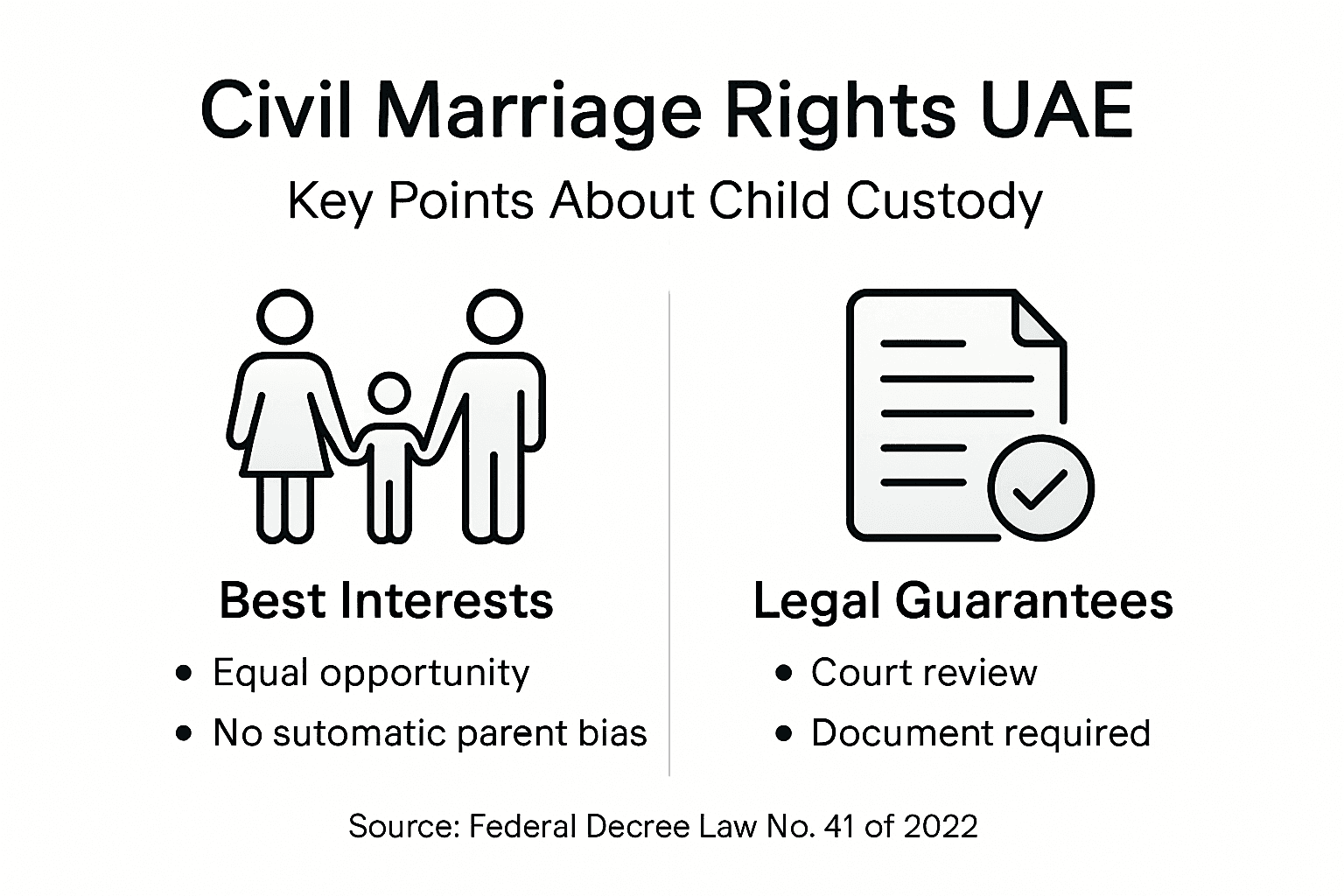
Civil law prioritizes the best interests of the child in custody decisions and doesn’t automatically favor one parent based on gender. Both parents have equal standing in custody matters, and courts make decisions based on what benefits the child most. This differs from traditional Islamic law, where custody typically follows gender based preferences at different child ages. You have flexibility to arrange custody according to your family’s specific needs and the child’s welfare.
International Recognition and Validity
Your civil marriage certificate carries weight far beyond the UAE. Because it’s issued by a government authority under secular law, other countries recognize it without question. If you relocate to another country, you can register your UAE marriage certificate with your new country’s vital records office. This is particularly valuable if you later apply for residency, citizenship, or family reunification in another nation. Your marriage remains legally valid across borders, which matters immensely for expat couples who may move multiple times during their careers.
The certificate is written in both Arabic and English, making it acceptable for international use without translation in English speaking countries. If you need certified translations for non English speaking countries, official translators can provide them quickly.
Post-Marriage Documentation Steps
After receiving your marriage certificate, several practical steps strengthen your legal position:
Update Your Home Country Records
Contact your home country’s vital records office or embassy in the UAE to register your marriage. This updates your official marital status in your country of origin, affecting your legal status there. The process varies by country, but most accept UAE marriage certificates with apostille certification. Some countries automatically recognize UAE marriage certificates without additional paperwork, while others require official notification. Check your country’s specific requirements at your embassy’s website.
Notify Relevant Authorities and Organizations
Inform your employer, health insurance provider, and any financial institutions of your marriage. Update your beneficiary designations on insurance policies, retirement accounts, and wills. This ensures your spouse is recognized in emergency situations and that your assets pass to them as intended. Many organizations allow you to make these updates online.
Consider a Marriage Contract with Property Terms
While your civil marriage provides basic property rights, you can create an additional marriage contract specifying how you’ll manage joint finances, property ownership, and inheritance. This written agreement clarifies expectations and prevents misunderstandings. A family law attorney can help you draft terms that align with your circumstances.
Obtain Certified Copies of Your Certificate
Request multiple certified copies of your marriage certificate from the court. Keep originals in a safe place and use certified copies for official submissions. Government offices and embassies often need certified copies, so having several prevents repeated trips to the court.
What Happens if Your Marriage Dissolves
If you and your spouse later decide to divorce, legal implications of marriage under UAE law determine how your assets, custody, and financial obligations get handled. Civil law divorce procedures are generally faster and more straightforward than religious divorce. Courts divide property fairly based on contribution and need rather than predetermined religious allocations. Child custody decisions focus on the child’s welfare without gender bias. Both parties have relatively equal legal standing in divorce proceedings, and either spouse can initiate divorce without needing grounds or permission from the other party.
Maintaining Your Marriage’s Validity
Your civil marriage remains valid indefinitely once registered. You don’t need to renew it or file periodic paperwork to keep it active. Your marriage certificate never expires. However, if you change your name, residency status, or nationality, you may need to update your official records. If you relocate to another country, that country may require you to register your marriage locally, but your UAE marriage remains valid regardless.
Pro tip: Keep your original marriage certificate in a secure location like a safe deposit box, and maintain at least three certified copies in separate safe places for major life changes such as citizenship applications, inheritance matters, or visa sponsorships.
Mistakes Expats Make and How to Avoid Them
Expats planning civil marriages in the UAE often stumble on preventable errors that delay their applications, require resubmission, or worse, result in rejected cases. Many of these mistakes stem from misunderstanding the process, making assumptions based on experience in other countries, or simply not knowing the specific UAE legal requirements. Learning from others’ missteps saves you time, money, and stress. The good news is that every common mistake has a straightforward solution.
Mistake 1: Assuming Civil Marriage Works Like Religious Marriage
One of the biggest conceptual errors expats make is treating civil marriage procedures as similar to Islamic or religious marriage. They are fundamentally different processes with different requirements, paperwork, and legal outcomes. Religious marriage ceremonies emphasize spiritual elements, family involvement, and traditional rituals. Civil marriage is purely a legal contract focused on consent and documentation. You might think that because your home country has religious marriage, the UAE civil marriage process mirrors it. That assumption leads to missing critical procedural steps.
The solution is straightforward: understand that civil marriage under Federal Decree Law No. 41 of 2022 operates as a completely separate legal pathway. You’re not obtaining religious approval or following traditional marriage customs. You’re signing a secular legal contract. This mindset shift helps you focus on what the court actually needs: proper identification, proof of eligibility, explicit consent declarations, and signed disclosure forms. Don’t bring assumptions from other marriage traditions; instead, follow the specific civil marriage checklist the court provides.
Mistake 2: Failing to Meet All Five Legal Criteria
The UAE has five essential legal criteria for civil marriage, and missing even one causes automatic rejection. These criteria include meeting age requirements, completing disclosure forms accurately, demonstrating explicit consent in front of the authentication judge, proving no legal impediments exist, and confirming that the marriage doesn’t violate prohibited relationships. Expats often overlook one criterion and discover the problem only after submitting their application.
For example, some couples complete their disclosure forms but fail to appear before the judge in person to give explicit consent. They submit paperwork assuming it’s sufficient. The court rejects the application because the law requires oral consent directly to the authentication judge, not just written consent on forms. Another common gap is assuming your documents are sufficient when they actually need official authentication or apostille certification if issued outside the UAE.
Avoid this by creating a checklist of all five criteria and verifying that you meet each one before submitting anything. Contact your local court and ask them to confirm the five criteria and whether your specific documents satisfy them. Don’t guess; ask directly. The court staff will tell you exactly what you need.
Mistake 3: Submitting Incomplete or Unverified Documents
Incomplete applications are the number one reason for rejection and resubmission delays. Expats bring photocopies instead of original documents, forget to include proof of residence, or fail to obtain apostille certification for foreign documents. Courts need originals for verification, not copies. If your passport expires before your court date, you must renew it before applying.
Foreign documents are particularly problematic. Your divorce decree from your home country likely needs an apostille stamp from the court that issued it. Your birth certificate might need official authentication. Your university diploma proving your age might need certification. Many expats don’t realize these requirements until their application gets rejected with a note requesting authenticated documents. This creates a 4-6 week delay while you obtain apostilles from overseas.
Solve this problem by contacting your court one month before you plan to apply and requesting a complete list of documents they need. Ask specifically whether each document needs apostille certification or official authentication. If it does, start the authentication process immediately. For documents from overseas, contact your country’s relevant office (vital records, courts, etc.) and request apostille certification. Most can process requests by mail or email.
Mistake 4: Misunderstanding Eligibility and Exclusions
Many expats don’t realize that certain groups cannot marry under the non-Muslim civil marriage law. Muslim nationals of the UAE cannot use the civil marriage process, regardless of how modern they are or what they prefer. If either party is a UAE national Muslim, civil marriage is not available to you. You must use Islamic marriage procedures. This catches some couples after weeks of document preparation.
Other expats misunderstand age requirements, thinking that parental consent allows marriage below 21 years old. It doesn’t. The 21-year-old minimum is absolute with no exceptions. Some couples also misunderstand prohibited relationships, thinking they can marry a first cousin because it’s allowed in their home country. Under UAE law, certain close relationships are prohibited regardless of your country’s rules.
Verify your eligibility immediately. If either party is a UAE national Muslim, stop planning a civil marriage and consult with a family lawyer about Islamic marriage options. Confirm that both parties are at least 21 years old. Check whether your relationship falls into prohibited categories. Ask your court directly whether your specific circumstances qualify for civil marriage.
Mistake 5: Not Understanding Property and Inheritance Implications
Expats often fail to consider how choosing a specific legal system affects property division, inheritance, and divorce procedures. When you elect to follow your home country’s laws, you’re agreeing that all family matters will be governed by that country’s rules. If you’re American and you elect American law, then American divorce law determines asset division if you later divorce. American inheritance law determines what happens to your property if you die.
Some couples don’t realize that certain legal systems might disadvantage them. They choose their spouse’s home country’s law without understanding that country’s divorce provisions or inheritance rules. They later discover that the laws they agreed to follow don’t protect their interests the way they expected.
Before you sign your marriage contract, review the specific family law system you’re electing. Understand how that legal system handles divorce, property division, child custody, and inheritance. Consult a family law attorney who specializes in the legal system you’re choosing. Ask specific questions about what happens if your marriage dissolves or if one spouse dies. Make an informed decision rather than assuming all legal systems treat these matters similarly.
Mistake 6: Delaying Document Preparation and Application
Many expats wait until close to their planned wedding date to start gathering documents. Then they discover that apostille certification takes 6 weeks, or that their passport expires before their court date, or that the court has no available appointments for two months. Starting the process at the last minute guarantees stress and often forces you to reschedule your wedding.
Begin your document preparation at least three months before your intended wedding date. This gives you time to obtain apostilles, renew expired documents, schedule court appointments, and handle unexpected delays. Three months sounds like a long time, but international document authentication easily consumes that timeframe.
Mistake 7: Not Consulting Legal Professionals
Expats often assume the civil marriage process is simple enough to navigate alone. Then they encounter a specific situation their documents don’t clearly address, or they’re unsure whether their marital status documentation from their home country qualifies, or they need to elect a legal system and want expert guidance. By then they’ve already started the process and need to backtrack.
Consult a family law attorney before you begin your application. A 30-minute consultation costs far less than fixing mistakes after rejection. An attorney can review your specific situation, confirm your eligibility, advise which legal system best protects your interests, and identify any documents that might cause problems. They can also handle document authentication on your behalf, saving you significant time and stress.
Common Procedural Mistakes
Expats also make specific procedural errors:
Missing the court interview: The court schedules a hearing, but expats don’t treat it as mandatory or skip it thinking paperwork is sufficient. The interview is required, and missing it results in rejection.
Incomplete consent declarations: You appear before the judge but don’t clearly state your consent or appear confused about what you’re consenting to. The judge must hear explicit, clear consent from both parties.
Wrong application form: Different emirates use slightly different application forms. Using Dubai’s form in Abu Dhabi courts causes rejection. Confirm which form your specific court requires.
Outdated information in applications: Couples fill out applications months in advance, then circumstances change (new job, moved residence, name change). They submit outdated applications without updating them. Courts reject applications with inconsistent information.
Pro tip: Create a dedicated folder with all your documents, a completed checklist, contact information for your local court, and appointment confirmations, then share access with your partner so you’re both tracking progress and nothing falls through the cracks.
Simplify Your Non-Muslim Marriage Journey in the UAE with Harris & Charms
Navigating the complex legal pathways of non-Muslim marriage in the UAE can be overwhelming. From understanding your eligibility and legal rights to managing detailed documentation and selecting the appropriate civil law framework, the challenges require expert guidance. You deserve a smooth, stress-free experience that respects your unique situation and protects your future. Harris & Charms specializes in helping expat couples overcome these pain points by offering tailored assistance with marriage registration, document authentication, and legal compliance ensuring your marriage is recognized both locally and internationally.
Our personalized approach helps you avoid common pitfalls like incomplete paperwork or misunderstanding the civil marriage process outlined under Federal Decree Law No. 41 of 2022. Whether you want clear guidance on legal rights regarding property and inheritance or seamless coordination of your wedding day, Harris & Charms stands with you every step of the way. Discover how our trusted expertise turns complexity into clarity and excitement.
Take control now and let us help you open the door to your new shared life. Visit Harris & Charms to explore our comprehensive marriage assistance services including legal documentation support and event planning. Explore resources that simplify your path like our civil marriage step-by-step guide.

Ready to make your UAE non-Muslim marriage legally sound and beautifully memorable Choose Harris & Charms today and start your effortless journey towards a legally protected and happily celebrated union. Contact us now to schedule your personalized consultation.
Frequently Asked Questions
What are the legal requirements for a non-Muslim marriage in the UAE?
To marry as a non-Muslim in the UAE, both parties must be at least 21 years old, be free from legal impediments to marriage, and provide necessary documents such as passports, proof of marital status, residency verification, and completed consent forms.
How does civil marriage differ from religious marriage in the UAE?
Civil marriage operates under secular law, focusing primarily on the legal contract between two consenting adults, while religious marriage follows specific faith traditions, such as Islamic Sharia law, which involves additional requirements like guardian consent and religious officiants.
What documents are needed to register a non-Muslim civil marriage?
Essential documents include valid passports, a residence permit or visa, proof of marital status, and consent and disclosure forms. Foreign documents may require authentication or apostille certification to be accepted in the UAE.
What rights do non-Muslims have under civil marriage in the UAE?
Non-Muslims married under civil law have equal rights regarding property ownership, inheritance, custody of children, and divorce procedures, promoting gender equality and protecting the legal interests of both spouses.
Recommended
Comments