
Muslim marriage ceremony steps in UAE: full guide
- haris haneef
- Apr 16
- 8 min read

TL;DR:
Registering the marriage with the Sharia court is legally essential in the UAE.
Proper documentation and following legal steps ensure the marriage’s validity and protection.
Balancing spiritual sincerity with legal compliance leads to a meaningful and secure marriage.
Muslim Marriage Ceremony Steps: Planning a Muslim marriage in the UAE is one of the most meaningful things you and your partner will do together. Yet many couples arrive at the process feeling genuinely lost, unsure whether their ceremony will be spiritually valid, legally recognized, or both. A Muslim marriage (Nikah) in the UAE requires registration with the Sharia Court for legal validity, which means the religious ceremony alone is not enough. This guide explains the Muslim marriage ceremony steps, from gathering the required documents to completing your Sharia Court registration, so you can focus on what matters most: starting your marriage the right way.
Table of Contents
Key Takeaways of Muslim Marriage Ceremony Steps
Point | Details |
Legal registration is crucial | Registering your marriage in the Sharia court is mandatory for legal recognition and rights protection in the UAE. |
Know the ceremony steps | The Nikah includes Ijab (offer), Qabul (acceptance), witnesses, the bride’s wali, and mahr. |
Preparation prevents problems | Having the right documents and parties present prevents delays and legal complications. |
Simplicity is encouraged | Islamic teachings favor a ceremony that is simple, spiritually meaningful, and compliant with Sunnah. |
Expert help is available | Specialist marriage services in the UAE can help you navigate both religious and legal requirements. |
Documents and prerequisites for a Muslim marriage in the UAE
With the context set, let’s look at what you absolutely need before the ceremony itself. Showing up unprepared is one of the most common reasons couples face delays or complications. Getting your paperwork right from the start saves you time, stress, and potential heartache later.
The essential elements include Ijab, Qabul, two Muslim male witnesses, the bride’s wali, and an agreed mahr. These are not optional formalities. Each one plays a specific legal and religious role in making your marriage valid under UAE law and Islamic tradition.
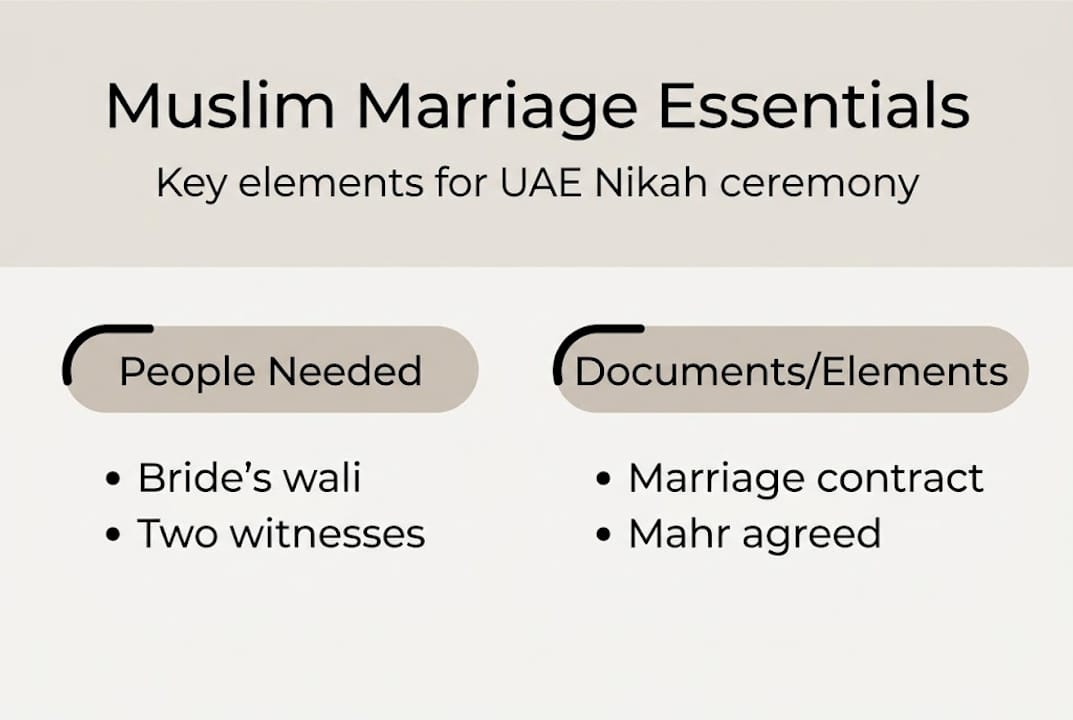
Here is a quick overview of the required documents:
Document | Who provides it | Notes |
Valid passport or Emirates ID | Both bride and groom | Must be current and unexpired |
Proof of divorce or death certificate | Applicable party only | Required if either was previously married |
Wali’s valid ID | Bride’s guardian | Father or closest male relative |
Witness IDs | Two adult Muslim men | Must be present at the ceremony |
Mahr agreement | Both parties | Amount agreed before ceremony |
Beyond the documents, here are the key prerequisites you must have in place:
Valid passports or residency IDs for both parties
Bride’s wali (father or closest male guardian) present in person
Two adult Muslim male witnesses who are not immediate family members in some jurisdictions
Agreed mahr amount discussed and confirmed before the ceremony begins
Proof of previous marriage dissolution if either party was married before
The ceremony emphasizes simplicity per Sunnah, and legal registration protects the rights of both parties. This means you do not need an elaborate setup to have a meaningful and valid Nikah. A focused, well-prepared ceremony is far more powerful than a complicated one.
Pro Tip: Use an Islamic marriage checklist to verify every document before your ceremony date. Missing even one item can delay the entire process.
For a deeper look at how the paperwork fits together, the Islamic marriage registration guide breaks down each requirement with practical context.
The main steps of the Nikah ceremony
Once you have your documents and support in order, the Nikah ceremony itself follows these traditional and legal steps. Understanding the sequence helps both families participate meaningfully and ensures nothing is skipped.
The Ijab and Qabul, role of witnesses, wali, and mahr are central to the Nikah’s validity. Each step builds on the previous one, so the order matters.
Opening recitation The ceremony typically begins with recitation of Quranic verses and blessings, setting the spiritual tone.
Ijab (the offer) The bride’s wali formally offers her hand in marriage, usually by stating the offer clearly in Arabic or a mutually understood language.
Qabul (the acceptance) The groom accepts the offer verbally and clearly, in the presence of witnesses. This exchange must be unambiguous.
Witness confirmation The two adult Muslim male witnesses confirm they heard and understood the Ijab and Qabul. Their presence makes the contract legally and religiously binding.
Mahr agreement and handover The agreed mahr is formally presented or its deferred payment is acknowledged. This is the bride’s right and cannot be waived.
Signing the Aqd-Nikah (marriage contract) Both parties, the wali, and witnesses sign the official marriage contract. This document is essential for Sharia court registration.
Duas and blessings The ceremony closes with prayers for the couple’s happiness, health, and a blessed life together.
Here is how the key roles compare during the ceremony:
Role | Person | Responsibility |
Wali | Bride’s guardian | Offers the bride in marriage (Ijab) |
Groom | Groom | Accepts the offer (Qabul) |
Witnesses | Two adult Muslim men | Confirm the exchange is valid |
Officiant | Imam or authorized person | Guides the ceremony and recitations |
Pro Tip: Review the full Nikah process steps before your ceremony so every participant knows their role in advance. Confusion during the ceremony can create doubt about validity.
Registering your marriage in the UAE Sharia court
After the ceremony, proper legal registration ensures your marriage is fully protected and officially recognized. Many couples assume the Nikah alone is sufficient. It is not. Without Sharia court registration, your marriage has no legal standing in the UAE.

Legal registration is required; unregistered marriages risk court invalidity and can create serious problems for inheritance, residency, and child custody. This step is not bureaucratic red tape. It is how the state recognizes your union and protects your rights.
Here are the steps to register your marriage:
Gather all required documents including the signed Aqd-Nikah, IDs for both parties, witness IDs, and mahr documentation.
File your application at the relevant Sharia court or Personal Status Court in your emirate.
Attend the court appointment where a judge reviews the marriage contract and verifies all parties and documents.
Judge review and verification The judge confirms the ceremony met all legal and religious requirements.
Receive your marriage certificate Once approved, you are issued an official UAE marriage certificate.
Here is a summary of what you need for registration:
Requirement | Detail |
Signed marriage contract (Aqd-Nikah) | Original, signed by all parties |
Bride and groom IDs | Passport and/or Emirates ID |
Witness IDs | Both witnesses must be identifiable |
Mahr documentation | Written proof of agreed amount |
Application form | Obtained from the Sharia court |
Skipping registration is a risk no couple should take. Courts in the UAE will not recognize an unregistered marriage, which means you could face complications in everything from visa sponsorship to property rights. For a complete breakdown, read this guide on UAE legal marriage registration and the registration step-by-step process.
Common mistakes and how to avoid them
Even with the best intentions, mistakes can happen. Here is how to spot them before they affect your marriage’s validity.
The most frequent errors couples make are surprisingly avoidable. Most come down to rushing the process or not understanding which steps are non-negotiable.
“Missing legal steps or proper documentation can invalidate the marriage in UAE courts. Preparation is not optional.”
Here are the most common mistakes and how to avoid each one:
Missing a required document Always use a checklist. One missing paper can delay or void the process entirely.
Wali not present The bride’s wali must be physically present. A phone call or written note is not a substitute under UAE law.
Improper witness signatures Witnesses must sign in person and their IDs must match the names on the contract. Photocopies or unsigned forms are rejected.
Skipping Sharia court registration As covered above, this is the most consequential mistake. The ceremony alone does not create a legally valid marriage.
Overcomplicating the ceremony Couples sometimes add so many elements that the core legal steps get rushed or overlooked. Simplicity protects validity.
Not confirming the mahr in writing Verbal agreements on mahr can be disputed later. Always document it before the ceremony.
Pro Tip: Review the Muslim marriage rules UAE guide at least two weeks before your ceremony. This gives you time to fix any gaps without pressure.
If you are unsure about any of these points, consulting a professional who specializes in UAE Islamic marriages is always worth it.
Our perspective: The underestimated importance of legal and spiritual balance
After working with many couples across the UAE, we have noticed a pattern worth talking about honestly. Some couples focus almost entirely on the celebration, the venue, the guests, and the photos. Others rush through the process to get the paperwork done as quickly as possible. Both approaches miss something important.
The most meaningful and problem-free marriages we have seen are the ones where couples treated the legal and spiritual steps with equal seriousness. The Nikah is not just a formality before the party. It is the foundation. When you approach it that way, something shifts. The ceremony feels more intentional, and the registration feels like a natural extension of your commitment rather than a chore.
We also believe that the marriage documents checklist is one of the most underused tools available to couples. It takes minutes to review and can prevent weeks of delays. The couples who come to us most stressed are almost always the ones who skipped the preparation phase.
Balance is not complicated. Prepare thoroughly, keep the ceremony focused, and complete your registration without shortcuts. That combination is what actually protects your marriage long term.
Expert help for your Muslim marriage in the UAE
Navigating the legal and religious steps of a Muslim marriage in the UAE is manageable, but it is genuinely easier with the right support. From document preparation to Sharia court coordination, having a knowledgeable team in your corner means fewer surprises and faster results.

At Harris & Charms, we support couples through every stage of the process. Our Islamic marriage service packages cover paperwork, translations, legal coordination, and ceremony planning so nothing falls through the cracks. Whether you need full support or just help with a specific step, we are here. Explore our marriage services Dubai options and reach out to start your journey with confidence.
Frequently asked questions
What is the role of the wali in a Muslim marriage in the UAE?
The wali, typically the bride’s father or closest male guardian, must be present to offer consent and represent the bride during the ceremony. Under UAE law, the wali must attend the Nikah for the marriage to be valid at Sharia court registration.
Is registration with the Sharia court mandatory for a Muslim marriage in the UAE?
Yes, registration is mandatory for legal validity. Unregistered marriages are not recognized by UAE courts, which can affect inheritance, residency, and family rights.
What is mahr in a Muslim marriage ceremony?
Mahr is a mandatory dowry agreed between the bride and groom, which the groom gives to the bride as part of the Nikah. The mahr must be agreed and granted during the ceremony and should be documented in writing.
Can expats have an Islamic marriage in the UAE?
Yes, expats can marry under Islamic law in the UAE if they meet all legal and religious requirements. Marriage registration applies to Muslims resident in the UAE, including expatriates, through the Sharia court system.
What happens if required documents or steps are missed?
Missing documents or skipping required steps can invalidate the marriage, preventing recognition in UAE courts. Missing legal steps risks invalidity and can complicate future rights related to property, children, and residency.
Recommended
Comments