
Marriage Certificate Definition – Why It Matters UAE

Starting your journey to marriage in the United Arab Emirates means more than hosting a memorable celebration. For expats and foreign nationals, understanding the marriage certificate definition is crucial, as this document provides official proof of your union, protects your rights, and is required for everything from residency applications to legal recognition in the UAE. This guide explains what a marriage certificate means under UAE law and what steps you need to secure your legal status with confidence.
Table of Contents
Key Takeaways of Marriage Certificate Definition
Point | Details |
Marriage Certificate Importance | The marriage certificate in the UAE officially validates the marital union, establishing legal rights and responsibilities for both spouses. |
Types of Certificates for Expats | Expatriates should be aware of different marriage certificate types (Islamic, Civil, International, Consular) to ensure legal recognition based on their circumstances. |
Legal Requirements | Couples must meet specific legal criteria, such as minimum age and proof of consent, for obtaining a valid marriage certificate in the UAE. |
Administrative Uses | The marriage certificate is essential for various administrative functions, including residency applications, healthcare access, and legal identification. |
What Is a Marriage Certificate in UAE Law
A marriage certificate in the United Arab Emirates represents a critical legal document that officially recognizes and validates the matrimonial union between two individuals. Within UAE legal frameworks, this document serves as definitive proof of a legally sanctioned marriage, establishing the rights, responsibilities, and legal standing of both spouses under civil marriage regulations.
Under Federal Decree Law No. 41 of 2022, a marriage certificate in the UAE specifically confirms several essential legal aspects:
Official recognition of the marriage contract
Legal documentation of spousal rights
Proof of mutual consent between partners
Verification of both parties’ legal capacity to marry
The certificate holds significant importance for non-Muslim expatriates and UAE nationals alike, functioning as a fundamental legal instrument that validates the marriage’s legitimacy. It must be issued by authorized government entities and contains comprehensive details about the marital union, including names, nationalities, marriage date, and registration information.
Key requirements for obtaining a valid marriage certificate in the UAE include:
Mutual legal consent
Meeting minimum age requirements
Proving legal capacity to marry
Demonstrating no existing marital impediments
Completing required documentation
Legal recognition extends beyond the ceremony itself, transforming the marriage from a personal commitment into a legally binding contract with specific rights and obligations. The certificate becomes crucial for subsequent legal processes such as residency applications, visa sponsorships, and establishing family legal frameworks.
A marriage certificate in the UAE is more than a document - it’s a legal gateway that defines your marital status and rights within the country’s comprehensive legal system.
Pro tip: Always ensure your marriage certificate is properly authenticated and translated if issued outside the UAE to guarantee its legal validity in government proceedings.
Types of Marriage Certificates for Expats
Expats in the United Arab Emirates encounter multiple marriage certificate types, each designed to accommodate different legal and cultural requirements. Understanding these variations is crucial for navigating the complex matrimonial landscape of the UAE, where marriage document types can significantly impact legal recognition and personal status.
The primary marriage certificate categories for expatriates in the UAE include:
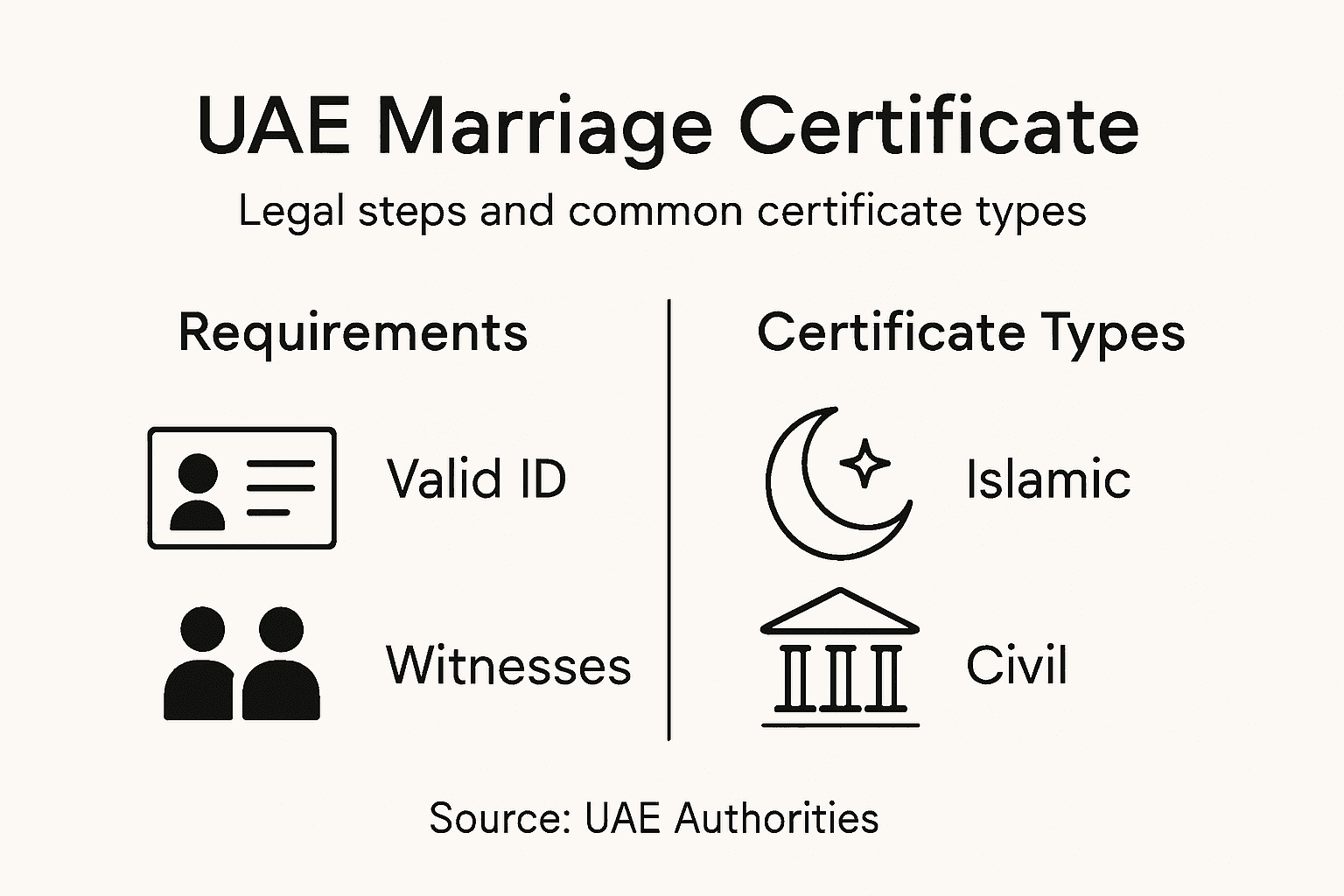
Islamic Marriage Certificate: Issued for Muslim couples or marriages involving a Muslim partner
Civil Marriage Certificate: Designed for non-Muslim expatriates without religious ceremony requirements
International Marriage Certificate: Recognized for cross-border legal validations
Consular Marriage Certificate: Issued for marriages conducted through diplomatic channels
Each certificate type serves specific legal purposes and follows distinct registration protocols. Islamic marriage certificates, governed by Sharia law, are typically processed through Islamic courts and require specific religious documentation. Civil marriage certificates, established under Federal Decree Law No. 41 of 2022, provide a secular framework for non-Muslim couples to legally formalize their union.
Key distinctions among these marriage certificates involve:
Religious vs. secular legal frameworks
Documentation requirements
Registration procedures
Jurisdictional authority
International recognition standards
Expatriate couples must carefully select the appropriate marriage certificate type based on their nationality, religious background, and legal requirements. The choice impacts residency applications, visa sponsorships, and overall legal standing within the UAE’s comprehensive administrative system.

Here’s a summary comparing the main types of marriage certificates for expatriates in the UAE:
Certificate Type | Legal Framework | Typical Use Case | Issuing Authority |
Islamic Marriage Certificate | Sharia Law | Muslim couples | Islamic Court |
Civil Marriage Certificate | Secular Law | Non-Muslim expatriates | Civil Courts/Ministry of Justice |
International Certificate | Cross-Border Law | Overseas legal validity | Home/Foreign Authorities |
Consular Certificate | Diplomatic | Marriages via embassies | Respective Embassy/Consulate |
Marriage certificates in the UAE are not just documents - they are legal bridges connecting personal commitments with official recognition.
Pro tip: Consult official UAE authorities or legal experts to determine the most appropriate marriage certificate type for your specific expatriate circumstances.
Legal Requirements and Issuance Process
Obtaining a marriage certificate in the UAE involves navigating a comprehensive set of legal requirements that vary depending on the couple’s nationality, religious background, and type of marriage. Marriage document processing demands careful attention to detail and strict adherence to local regulations.
The fundamental legal requirements for marriage certificate issuance in the UAE include:
Minimum age of 18 for both partners
Proof of legal capacity to marry
Valid identification documents
Medical fitness certificates
No existing marriage to another person
Consent from both parties
Proof of relationship status
The issuance process typically involves multiple steps, which differ slightly between Muslim and non-Muslim couples. For non-Muslim expatriates, the civil marriage process requires:
Online application submission
Document verification
Payment of required fees
Medical screening
Official marriage ceremony
Certificate registration
Expatriate couples must prepare comprehensive documentation, including valid passports, residency permits, birth certificates, and single status certificates. These documents often require official translation and authentication from the home country’s embassy and UAE authorities.
Legal marriage registration in the UAE is not merely a bureaucratic process, but a carefully structured system designed to protect the rights of both partners.
Pro tip: Always verify document requirements with official UAE authorities at least three months before your intended marriage date to ensure smooth processing.
Key Uses and Applications for Couples
A marriage certificate in the United Arab Emirates serves far more than a symbolic document, functioning as a critical legal instrument that enables numerous essential personal and administrative processes. Marriage document applications play a pivotal role in establishing legal rights and accessing critical services for expatriate couples.
The primary uses of a marriage certificate in the UAE encompass several key areas:
Residency and Visa Processing
Healthcare Service Access
School Enrollment for Children
Property and Financial Transactions
Insurance Policy Management
Legal Identification and Status Verification
Government Service Eligibility
Couples can leverage their marriage certificate for multiple critical administrative functions, including:
Applying for spouse residency visas
Adding spouse to health insurance plans
Registering children’s birth certificates
Accessing family sponsorship programs
Initiating inheritance and property rights
Pursuing legal proceedings
Expatriate couples must recognize that the marriage certificate acts as a foundational document for establishing their legal and social standing within the UAE’s comprehensive administrative framework. Each government and private sector interaction typically requires this critical documentation for verification and processing.
The following table highlights common administrative uses of a UAE marriage certificate and the impact for expatriate couples:
Application Area | Purpose | Outcome for Couples |
Residency/Visas | Sponsoring spouse | Enables family reunification |
Health Insurance | Adding partner to plan | Access to medical coverage |
Children’s Schooling | Registering dependents | Ensures educational access |
Property Transactions | Joint ownership documentation | Allows co-ownership and inheritance |
Legal Identification | Official marital status proof | Streamlines government interactions |
A marriage certificate is not just a piece of paper, but a passport to legal recognition and administrative rights in the UAE.
Pro tip: Always maintain multiple certified copies of your marriage certificate and store digital backups to streamline administrative processes.
Rights, Attestation, and Common Pitfalls
Navigating the legal landscape of marriage certificates in the UAE requires comprehensive understanding of rights, attestation processes, and potential challenges. Marriage document verification is a critical step that can significantly impact a couple’s legal standing and administrative interactions.
The key rights associated with a properly attested marriage certificate include:
Family sponsorship eligibility
Inheritance and property rights
Healthcare and insurance benefits
Dependent visa applications
Legal recognition of marital status
Access to government services
Educational enrollment privileges
The attestation process typically involves multiple crucial steps:
Notarization in the home country
Authentication by home country authorities
Embassy or consulate verification
Final attestation by UAE diplomatic missions
Registration with UAE authorities
Common pitfalls that couples must carefully avoid include incomplete documentation, missed authentication stages, and failure to meet specific national or religious requirements. These errors can lead to significant delays, application rejections, and potential legal complications.
Attestation is not just a bureaucratic formality, but a critical process that validates the legal authenticity of your marriage in the UAE.
Pro tip: Maintain a comprehensive checklist of attestation requirements specific to your nationality and consult official sources to ensure complete and accurate documentation.
Secure Your Legal Marriage Journey with Expert Support
Understanding the importance of your marriage certificate in the UAE means navigating complex legal requirements and ensuring your rights are fully protected. Whether you are securing your residency visa, managing family sponsorship, or preparing vital attestation documents, missing even one detail can cause delays and stress. Key challenges such as proper documentation, certificate attestation, and selecting the right marriage certificate type require personalized guidance and trusted assistance.
Harris & Charms specializes in making your marriage documentation seamless and stress-free. Our comprehensive services cover civil and Islamic marriages, legal document processing, and event planning with heartfelt attention to your unique story. We stand ready to help you with every step including certifying your marriage certificate, handling visa-related paperwork, and ensuring your marriage is fully recognized under UAE law. Explore how we simplify this journey at Harris & Charms.
Ready to turn your marriage documentation challenges into a smooth process? Start today with personalized support tailored to expatriate couples navigating the UAE legal landscape.

Secure your peace of mind now by visiting Harris & Charms and discover how our expert team can help you obtain and legalize your marriage certificate efficiently. Don’t wait for complications to arise act now and ensure your marital rights and future plans are fully protected.
Frequently Asked Questions
What is a marriage certificate?
A marriage certificate is a legal document that officially recognizes and validates the union between two individuals, serving as proof of marriage and outlining the rights and responsibilities of both spouses.
Why is a marriage certificate important in legal terms?
A marriage certificate is essential for establishing official recognition of a marriage, which is necessary for various legal processes, including residency applications, visa sponsorships, and accessing family rights and benefits.
What are the types of marriage certificates available for expatriates?
Expatriates may encounter different types of marriage certificates, including Islamic marriage certificates for Muslim couples, civil marriage certificates for non-Muslim expatriates, and international marriage certificates for legal validation across borders.
What are the key requirements for obtaining a marriage certificate?
To obtain a marriage certificate, couples typically need to provide mutual legal consent, meet minimum age requirements, prove legal capacity to marry, demonstrate no existing marital impediments, and complete essential documentation.
Recommended
Comments