
Philippine embassy Dubai marriage: Complete 2026 guide


TL;DR:
Getting married at the Philippine embassy in Dubai involves several requirements, document authentication, and a reporting process for legal recognition. Failure to properly authenticate documents or submit reports promptly can delay your marriage registration and legal benefits in both countries. Expert assistance ensures a smooth process, providing couples with accurate guidance from document preparation to attestation and reporting steps.
Many Filipino couples living in Dubai assume that getting married at the Philippine embassy is just a matter of showing up with a few papers, signing some forms, and walking out legally wed. That assumption leads to real problems. The truth is that embassy marriage involves layers of requirements, specific document formats, appointment scheduling, and a post-marriage reporting process that must be completed for your union to be fully recognized in both the UAE and the Philippines. This guide walks you through every step, from understanding what type of marriage applies to you, to getting your certificate attested and reporting your marriage back home.
Table of Contents
Key Takeaways
Point | Details |
Embassy marriage requirements | Filipino couples must follow both civil and Islamic procedures with precise documentation. |
Registration steps matter | Understanding and completing every step avoids costly delays or rejection at the embassy. |
Attestation is essential | Legal authentication of your marriage is crucial for recognition in both the UAE and the Philippines. |
Reporting ensures benefits | Timely reporting of marriage protects your legal rights and family status back home. |
Expert help simplifies process | Professional guidance can make embassy marriage stress-free, avoiding common pitfalls. |
Understanding marriage at the Philippine embassy in Dubai
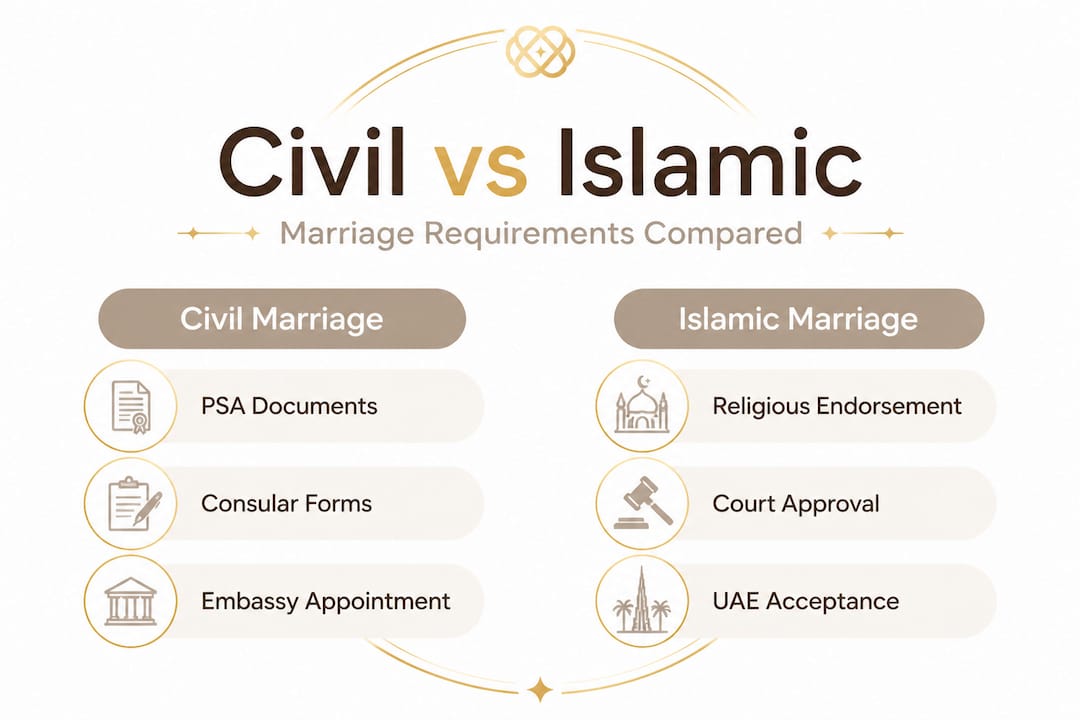
Marriage at the Philippine embassy in Dubai is not a one-size-fits-all process. The embassy handles two main types of marriages relevant to Filipino couples: civil marriages and Islamic marriages. Civil marriages follow a secular legal procedure, while Islamic marriages are conducted under Sharia law and require additional documentation tied to religious requirements. The type of marriage you pursue affects everything from the paperwork you submit to the legal framework that governs your union afterward.
To qualify for marriage registration at the embassy, at least one party must be a Filipino citizen. Mixed-nationality couples are welcome, but non-Filipino partners will face additional requirements, including translated documents, country-specific clearances, and sometimes proof of single status from their home country. Both parties must be of legal age, which is 18 years old, and must not currently be in a legal marriage with someone else. Widowed individuals need to present a death certificate of their former spouse, while annulled individuals must present the final court decree.
Here is a quick overview of core documents you will need regardless of marriage type:
Valid passports (both parties)
Certificate of No Marriage (CENOMAR) or Advisory on Marriages from the Philippine Statistics Authority (PSA)
PSA-issued birth certificates
Completed application forms from the embassy
Proof of UAE residency (valid visas or Emirates IDs)
For non-Filipinos: equivalent documents from their home country
The report of marriage process is also a major component of this journey, and understanding it early helps you plan your timeline better. Couples who also want to understand the legal implications for UAE marriage should review what happens when a marriage is not properly registered in either country.
Pro Tip: Always get your PSA documents authenticated or apostilled before you travel to the UAE. Embassy staff commonly flag unauthenticated documents, and this alone can delay your process by weeks.
Complete marriage requirements checklist
With an understanding of what embassy marriage entails, let’s break down the exact requirements you’ll need for your application.
The official documentation required at the embassy differs slightly depending on whether you are filing for a civil or Islamic marriage. Knowing this distinction saves you from submitting incomplete packets.
Documents required for civil marriage:
Accomplished Marriage License Application Form (from the embassy)
PSA birth certificates (both parties, authenticated)
CENOMAR or Advisory on Marriages (PSA-issued, not older than 6 months)
Valid passports (originals and photocopies)
Two passport-size photos each
Proof of UAE residency (Emirates ID or valid residence visa page)
Certificate of Legal Capacity to Contract Marriage (for non-Filipino partners, issued by their country’s embassy)
Documents required for Islamic marriage (additional to the above):
Nikah contract or Muslim marriage contract (certified copy)
Proof of Islamic faith (for Muslim parties)
Wali (guardian) documentation if required by the groom’s country or faith requirements
Sharia court approval in some cases
Comparison table: Civil vs. Islamic marriage requirements
Requirement | Civil marriage | Islamic marriage |
PSA birth certificate | Required | Required |
CENOMAR | Required | Required |
Nikah contract | Not applicable | Required |
Certificate of Legal Capacity | For non-Filipinos | For non-Filipinos |
Sharia court approval | Not required | Sometimes required |
Proof of faith | Not required | Required for Muslim parties |
Witnesses | 2 witnesses | 2 male Muslim witnesses |
Common eligibility requirements:
Minimum age: 18 years old (parental consent required for those under 21 in the Philippines)
No existing legal marriage (bigamy is a criminal offense in the Philippines)
Mental capacity to consent
No prohibited degree of relationship (e.g., blood relatives)
One of the most frequent mistakes couples make is submitting expired documents. Your CENOMAR must be issued within six months of your application date. Many couples also confuse a Local Civil Registrar-issued document with a PSA-issued one. The embassy specifically requires PSA-certified copies.
The civil marriage requirements UAE page goes deeper into document formats and endorsements, while the legal marriage steps for UAE expats guide explains how expat-specific rules apply to your situation.
Pro Tip: Create two sets of photocopies for every document before your appointment. Embassy staff often retain originals temporarily, and having backups prevents panic.
Step-by-step process to register your marriage in Dubai
Once your requirements are ready, here’s how to go through the registration process without hassle.
The marriage certificate process involves more sequential steps than most couples expect. Skipping or mishandling even one phase can restart your timeline entirely.
Registration process, step by step:
Gather all required documents. Use the checklist above as your baseline. Verify each document’s validity date, especially your CENOMAR and PSA certificates.
Authenticate or apostille Philippine documents. Documents from the Philippines must carry a PSA seal and in some cases an apostille from the Department of Foreign Affairs (DFA). Do this before you arrive in the UAE.
Translate non-English documents. Any documents in Arabic or another language must be officially translated into English or Filipino by a certified translator.
Book an appointment at the Philippine Consulate General in Dubai. Use the official online appointment system. Walk-in appointments are rarely accommodated.
Submit your documents. Arrive early. Bring originals and copies. An embassy officer will review your papers and flag any missing items.
Pay the required fees. Fees vary depending on the service and are subject to change. Confirm the current rates during your appointment booking.
Attend the marriage ceremony at the embassy. The solemnizing officer will officiate your civil ceremony on the scheduled date.
Receive your Marriage Certificate. This is issued by the embassy and must then be attested and registered to be fully valid.
Sample timeline for the full process:
Phase | Estimated duration |
Document gathering and authentication | 2 to 6 weeks |
Embassy appointment scheduling | 1 to 3 weeks |
Document submission and review | 1 to 2 weeks |
Marriage ceremony at embassy | Same day as appointment |
Issuance of marriage certificate | 1 to 4 weeks |
Attestation of certificate | 1 to 3 weeks |
Report of Marriage to Philippines | 1 to 2 months |
Total timeline from start to full legal recognition: roughly 3 to 5 months if everything goes smoothly. This surprises most couples who expected a two-week process.
The marriage registration steps guide breaks this down even further for couples dealing with unique situations like prior marriages or dual citizenship.
Pro Tip: Schedule your embassy appointment at least 4 weeks in advance. Embassy slots fill up fast, especially around Philippine holidays and long weekends.
Attestation and legal recognition of your marriage
After registration, it’s critical to make sure your union is legally recognized in both countries through attestation and authentication.
Attestation is the process of verifying that your marriage certificate is genuine and has been issued by a legitimate authority. In the UAE context, attestation involves getting your document certified by the UAE Ministry of Foreign Affairs and, in some cases, the Department of Legal Affairs. Without marriage certificate attestation, your marriage may not be recognized for legal purposes in the UAE, such as sponsoring your spouse’s residency visa or updating your family book.
Why is attestation so important? Here’s what it unlocks:
Spouse visa sponsorship in the UAE
Joint property and financial account ownership
Legal standing in UAE courts for family matters
Recognition by Philippine government agencies for overseas workers’ benefits
Access to spousal benefits through insurance and employer HR policies
The Philippine embassy in Dubai has provided clear guidance on this:
“All marriages performed or recorded outside the Philippines must be reported to the Philippine Statistics Authority through the nearest Philippine embassy or consulate general. Failure to do so may affect the legal status and benefits of the parties involved.”
The authentication process works in layers. Your embassy-issued marriage certificate is first certified by the DFA representative at the Philippine Consulate in Dubai, then presented to the UAE Ministry of Foreign Affairs and International Cooperation (MOFAIC) for attestation. Some situations may also require notarization before attestation.
The legal benefits for expats are significant, particularly for overseas Filipino workers who depend on proper documentation to access government benefits and legal protections.
Pro Tip: Keep a certified copy of your attested marriage certificate separate from your original. Many couples have been stuck when they submitted their only original to a government office and could not get it back quickly.
After marriage: Reporting, benefits, and common pitfalls
Once your marriage is registered and attested, reporting it and understanding ongoing benefits and obligations is just as essential.
The Report of Marriage is a formal submission to the Philippine Statistics Authority, done through the embassy. This step converts your overseas marriage record into one that the PSA officially recognizes and can issue a certified copy of on demand. It is a required step, not an optional one.
Critical follow-up tasks after your embassy marriage:
File your Report of Marriage at the Philippine Consulate in Dubai within one year of the marriage date.
Submit the notarized and attested marriage certificate along with your application form.
Pay the required filing fees.
Wait for confirmation from the PSA (this can take several months).
Request a PSA-certified copy of your marriage certificate once it is recorded.
Update your marital status with your employer, bank, and insurance provider in the UAE.
Update your Philippine government records, including SSS, PhilHealth, and Pag-IBIG, if applicable.
Not reporting your marriage carries real consequences. If you apply for a spouse visa and your marriage is not in the PSA system, UAE immigration authorities may flag inconsistencies. Your spouse may also be unable to claim benefits under your SSS or PhilHealth contributions as a legal dependent.
The legal implications for marriage are broader than most couples realize. Your marital status affects your tax filing in the Philippines, your eligibility for joint property ownership, and even how inheritance is handled if something happens to either spouse.
Pro Tip: File your Report of Marriage as soon as your certificate is fully attested. Do not wait until the one-year deadline approaches. Embassy queues grow longer near deadlines, and you could miss it entirely.
The surprising challenges and opportunities for Filipino couples in Dubai
Most couples we work with come to us after already getting confused or stuck somewhere in the process. And honestly, that experience has shaped how we think about embassy marriage. It is not just a bureaucratic formality. It is a legal foundation that affects your life together in both the UAE and back home.
The biggest myth is that “the embassy handles everything.” The embassy solemnizes your marriage and records it, but the burden of gathering, authenticating, translating, attesting, and reporting falls squarely on you. No one will follow up if your CENOMAR expires or if you forget to submit your Report of Marriage.
There is also a quiet opportunity that couples miss: when you do the process right, fully and carefully, you create a legal paper trail that protects you in ways you may not need today but will absolutely value later. Proper documentation means your children can inherit, your spouse can be sponsored without issue, and your Philippine-based family benefits are updated accurately.
We also see couples who were previously married and either have a pending annulment or have completed one but did not update their PSA records. This creates a legal conflict that can delay a new marriage registration by months or even years. Consulting with a specialist before you start the process, rather than after a rejection, saves enormous stress.
The expat marriage guide UAE explains how these issues affect expats specifically, and it is worth reading before you even book your embassy appointment.
Getting embassy marriage right is not about being overly cautious. It is about giving your relationship the legal grounding it deserves so you can focus on building your life together rather than untangling paperwork problems years from now.
Get expert help for your Philippine embassy marriage in Dubai
Knowing the complexities and advantages of embassy marriage, here’s how expert help can make your journey seamless.
Navigating the Philippine embassy marriage process on your own is absolutely possible, but it is also time-consuming and easy to get wrong. That’s where Harris & Charms comes in.

We specialize in helping Filipino couples in the UAE prepare every document correctly, schedule appointments efficiently, and follow through on attestation and reporting with zero missed steps. Whether you’re planning a civil ceremony or an Islamic wedding, our civil marriage Dubai packages are built to take the stress off your plate. Our Dubai marriage services also cover venue arrangements, photoshoots, and coordination with our sister companies for visa and attestation needs. Check out our full range of comprehensive UAE wedding services to see how we support couples from the first document to the final attested certificate. Reach out today and let us make your legal journey as beautiful as your love story.
Frequently asked questions
What documents are required for a civil wedding at the Philippine embassy Dubai?
You will need your passports, a PSA-issued Certificate of No Marriage (CENOMAR), PSA birth certificates, completed embassy application forms, and proof of UAE residency. Non-Filipino partners must also present a Certificate of Legal Capacity from their home country embassy, as noted in the official marriage registration requirements.
How long does the marriage registration process take at the Philippine embassy Dubai?
The full process typically takes 3 to 5 months from document gathering to complete legal recognition. Delays are common when documents are incomplete or expired, as outlined in the step-by-step marriage certificate guide.
Do both partners have to be Filipino for marriage registration at the embassy?
At least one partner must be a Filipino citizen for the Philippine embassy in Dubai to have jurisdiction. Mixed-nationality couples face additional requirements including legal capacity certificates and translated documents, which are covered in the official report of marriage guidelines.
Is attestation of the marriage certificate necessary after marriage at the embassy?
Yes, attestation is legally required to have your marriage recognized in the UAE for purposes like spouse visa sponsorship, property ownership, and court proceedings. The full attestation process is detailed in the marriage certificate attestation guide.
What are common mistakes Filipino couples make when marrying at the Philippine embassy Dubai?
The most common mistakes are submitting expired PSA documents, forgetting to authenticate papers before arriving in the UAE, and failing to file the Report of Marriage within the one-year deadline. Missing any of these steps can delay legal recognition significantly, as outlined in the official Report of Marriage process.
Recommended
Comments