
Marriage Registration Tools for Expats: U.S. Guide

Updated: Aug 31

The United States does not maintain a federal marriage registry for foreign marriages. What it does instead is recognize them. If your marriage was legally valid where it took place, U.S. federal agencies, including USCIS, the Social Security Administration, and the State Department, will generally treat it as valid here too. State agencies follow their own rules, which vary, but the core principle holds nationwide.
Your first move is straightforward: obtain a certified copy of your foreign marriage certificate, authenticate it (either through an apostille or consular legalization, depending on the issuing country), and get a certified English translation if the document is not already in English. Those three steps cover the majority of what every U.S. agency will ask for.
Quick next-steps checklist:
Contact the civil registry office where your marriage was recorded and request a certified copy of the marriage certificate.
Confirm whether the issuing country is a member of the Hague Apostille Convention. If yes, apply for an apostille. If not, contact the nearest U.S. embassy or consulate for consular legalization guidance.
Hire a certified translator for an English translation with a signed translator’s affidavit if the document is not in English.
Call your county clerk or state Secretary of State office to ask whether local recording or additional filings are required for your specific purpose (name change, benefits enrollment, driver’s license update).
Table of Contents for Marriage registration for expats
How to authenticate a foreign marriage certificate: apostille vs consular legalization
When certified English translations are required and how to get them accepted
How foreign marriage certificates are used for immigration, name changes, and benefits
Can you get a U.S. marriage certificate if you married abroad?
If you live in the U.S. and plan to marry abroad: what to do before you leave
Who to contact for help: official offices, translators, and paid services
Example walkthrough: preparing documents for a USCIS marriage-based petition
What most expats get wrong about foreign marriage recognition
Documents to gather before you start authentication
Getting your packet together before you touch the authentication process saves you weeks. Missing one item mid-process means restarting the queue.
Core identity and marriage documents:
Original or certified copy of the foreign marriage certificate (not a photocopy of the original, but a certified copy issued by the civil registry)
Valid passports for both partners
Birth certificates for both partners (some agencies, particularly USCIS, request these)
Divorce decrees or death certificates if either partner was previously married
Authentication documents:
Apostille certificate from the issuing country’s competent authority (typically the Secretary of State equivalent or a national notary authority), if the country is a Hague Convention member
For non-Hague countries: legalization stamps from the home country’s foreign ministry and the U.S. embassy or consulate in that country
Embassy-issued affidavit of freedom to marry, if you married abroad and the host country required one before the ceremony
Translation and notarization:
Certified English translation with a signed translator’s affidavit
At least three certified copies of the translated document (one for USCIS, one for Social Security, one for your records)
Pro Tip: Order at least four certified copies of your marriage certificate from the issuing registry before you begin authentication. Apostille offices and consular sections often retain one copy, and USCIS keeps originals during processing. Ordering extras upfront costs a few dollars more but avoids a 4–8 week wait to re-request from a foreign registry.
When assembling your first envelope for a U.S. office or legal representative, place documents in this order: certified marriage certificate, apostille or legalization, certified English translation, supporting identity documents. Label each section with a sticky tab. Clerks process organized packets faster, and immigration attorneys charge less time reviewing them.
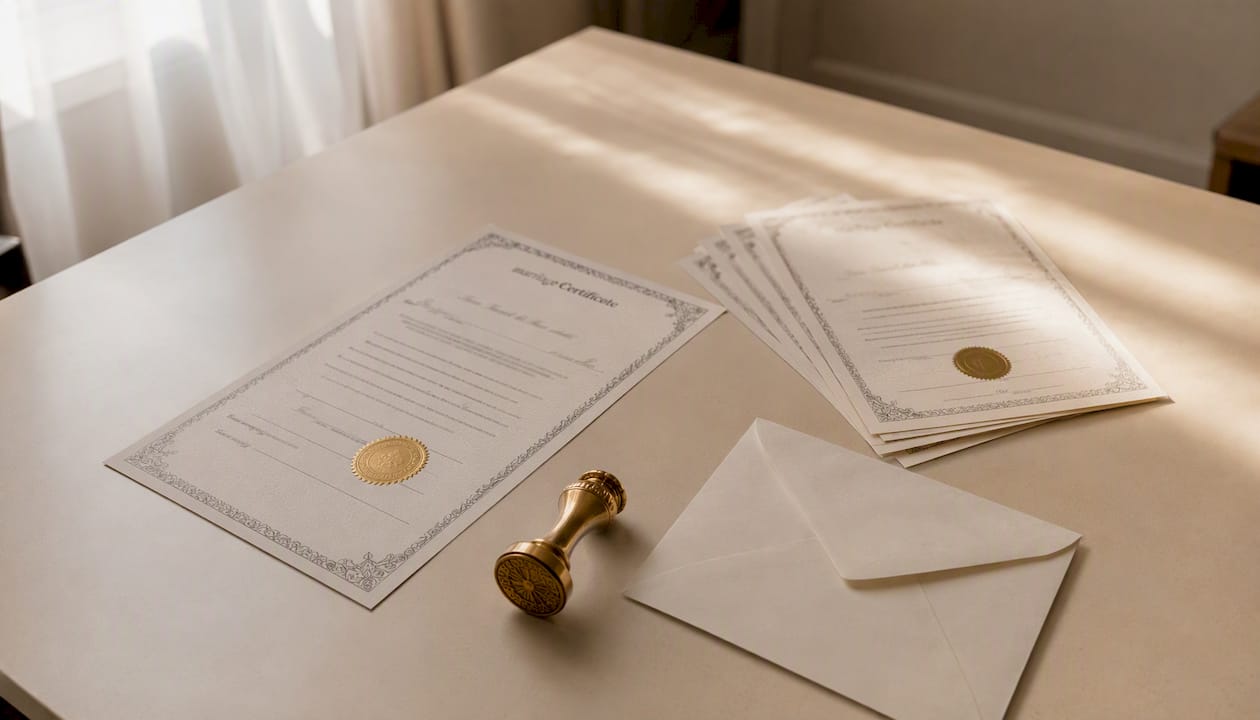
Does the U.S. require you to register a foreign marriage?
No federal registration is required. The U.S. government recognizes foreign marriages that were legally valid in the country where they occurred. There is no federal office where you file a foreign marriage certificate to “activate” recognition. USA.gov confirms this directly: the U.S. does not issue a domestic marriage certificate for marriages performed abroad.
That said, state and agency-level requirements add layers. Here is how each major contact point fits into the recognition flow:
U.S. Department of State (travel.state.gov): Provides guidance on marrying abroad and on what U.S. embassies can do for citizens. The State Department does not register your marriage but can direct you to the right embassy resources and country-specific requirements.
U.S. embassy or consulate (in the country where the marriage occurred): Can notarize documents, issue affidavits of eligibility to marry, and provide guidance on local civil registry requirements. The embassy cannot determine your marital status or issue a U.S. marriage certificate, but it is often your first call when you need a document notarized abroad.
Secretary of State (state-level apostille authority): In the U.S. context, your state’s Secretary of State office issues apostilles for U.S.-origin documents. For foreign documents, the equivalent authority is in the issuing country. Contact your state’s Secretary of State when you need a U.S. document apostilled for use abroad, or when you need guidance on what your state accepts for local recording.
County clerk office: The county clerk is where name changes, local record filings, and some benefit-related verifications happen. Some counties will record a foreign marriage certificate for local administrative purposes; others require only that you present the authenticated document when needed. Call your county clerk early to ask what they accept.
USCIS: For immigration petitions (marriage-based green cards, spousal visas), USCIS requires authenticated foreign marriage certificates, certified English translations, and supporting evidence of a bona fide marriage. Missing apostilles and improper translator affidavits are among the most common reasons USCIS issues a Request for Evidence (RFE).
How to authenticate a foreign marriage certificate: apostille vs consular legalization
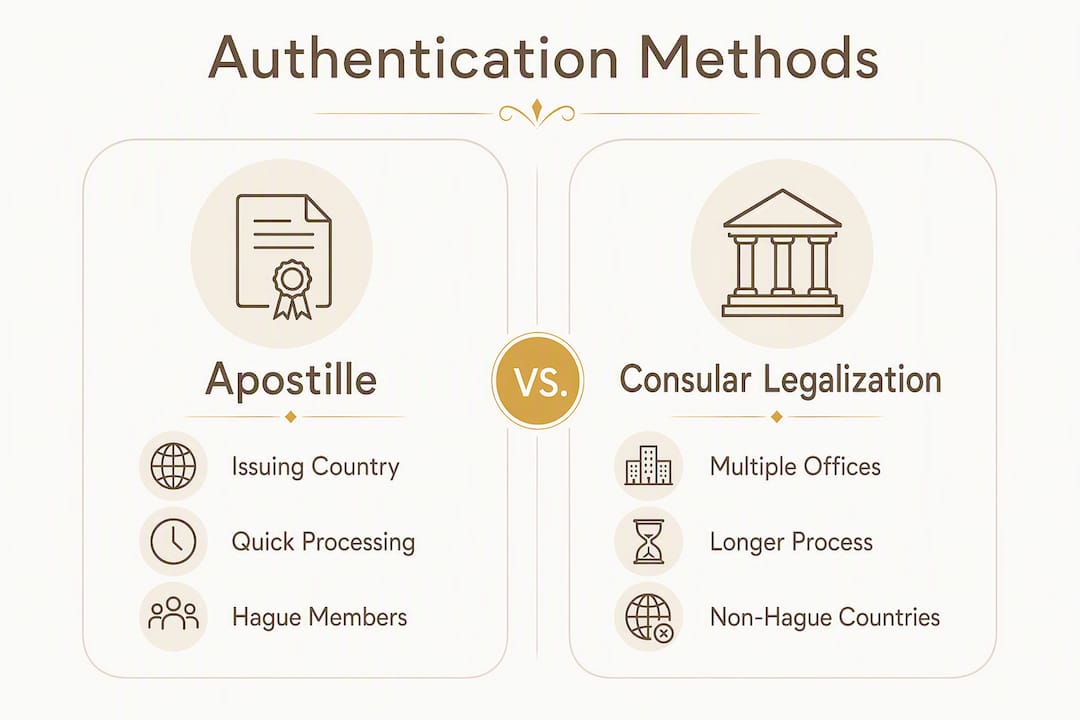
The deciding factor is simple: is the country where your marriage was registered a member of the Hague Apostille Convention? If yes, use an apostille. If not, use consular legalization.
Apostille process (Hague member countries)
Obtain a certified copy of your marriage certificate from the issuing civil registry.
Identify the competent authority in the issuing country. This is usually the national notary authority, the Ministry of Justice, or a regional Secretary of State equivalent.
Submit the certified copy to that authority with the required application form and fee.
Receive the apostille certificate, which is attached to or stamped on the document.
Confirm the apostille is valid: it should carry the issuing authority’s seal, a reference number, and the date of issuance.
Processing times vary widely. Some countries issue apostilles same-day at a walk-in office; others take 2–4 weeks by mail.
Consular legalization process (non-Hague countries)
Obtain a certified copy of the marriage certificate from the issuing civil registry.
Submit the document to the issuing country’s Ministry of Foreign Affairs (or equivalent) for authentication.
After the home-country foreign ministry stamps the document, submit it to the U.S. embassy or consulate in that country for consular legalization.
The embassy verifies the foreign ministry’s seal and stamps the document.
Retrieve the legalized document and proceed to translation.
This process typically takes longer than an apostille because it involves two separate government offices, each with their own queue.
Step | Apostille (Hague member) | Consular legalization (non-Hague) |
Who issues | Issuing country’s competent authority | U.S. embassy/consulate + home-country foreign ministry |
Authentication type | Apostille stamp/certificate | Multi-step legalization chain |
Translation required | Yes, if not in English | Yes, if not in English |
Typical processing time | Same day to 4 weeks | 2–8 weeks |
Typical cost | Varies by country; often $10–$100 equivalent | Embassy fees plus foreign ministry fees |
Pro Tip: U.S. embassy consular sections in high-demand countries often book notarization appointments 2–4 weeks out. Check the embassy’s appointment portal the moment you know you need legalization. Waiting until you have all documents in hand can add a month to your timeline.
For UAE-issued documents specifically, the UAE marriage attestation process follows its own attestation chain before U.S. authentication.
When certified English translations are required and how to get them accepted
Any document not originally in English requires a certified English translation before a U.S. agency will accept it. USCIS is explicit about this: every foreign-language document submitted must be accompanied by a full English translation that the translator certifies as complete and accurate.
What makes a translation “certified” for U.S. purposes:
A professional translator (individual or company) provides the translation.
The translator signs a written statement certifying that the translation is accurate and complete, and that they are competent to translate between the two languages.
The statement includes the translator’s name, contact information, and the date.
Notarization of the translator’s signature is not universally required but some county offices and state agencies ask for it. Confirm with the receiving agency before you pay for notarization.
What to include in your translation packet:
The full translated text of the marriage certificate
A copy of the original foreign-language document attached to the translation
The translator’s signed certification statement
Translator’s contact details (name, address, phone or email)
Translation companies like certified document translation services can provide this format as a standard deliverable. If you use a freelance translator, make sure they understand the USCIS affidavit format specifically.
Pro Tip: Keep your original foreign-language marriage certificate, at least two photocopies of it, and at least three certified translations in separate physical folders. If USCIS retains your original during processing, you still have copies for Social Security, your employer’s HR department, and the DMV. Replacing a certified translation costs $50–$150 and takes days; replacing a foreign-language original can take months.
How foreign marriage certificates are used for immigration, name changes, and benefits
USCIS and other federal agencies accept valid foreign marriages, but they do not take your word for it. Authenticated documents and certified translations are the baseline. Here is what each major use case requires:
USCIS (immigration petitions):
Certified copy of the foreign marriage certificate with apostille or consular legalization
Certified English translation with translator affidavit
Supporting evidence of a bona fide marriage: joint bank account statements, lease agreements, photos together, correspondence
Marriage alone does not change immigration status. Even after a valid foreign marriage, the foreign spouse must apply for the appropriate visa or adjustment of status separately.
Social Security Administration (name change):
Certified copy of the foreign marriage certificate (authenticated)
Certified English translation
Your current Social Security card and government-issued photo ID
SSA processes name changes at local field offices; call ahead to confirm what they accept for foreign documents.
Employer HR (benefits enrollment):
Most employers accept a certified copy of the marriage certificate with translation for adding a spouse to health insurance or other benefits.
Some HR departments also ask for a government-issued photo ID for the spouse.
State DMV (driver’s license name change):
Requirements vary by state. Most accept an authenticated foreign marriage certificate with certified translation.
Contact your state DMV directly before visiting; some states require additional affidavits.
Agencies to contact for clarifications:
USCIS (uscis.gov) for immigration-related questions
Social Security Administration (ssa.gov) for name changes and benefit records
Your state DMV for license updates
Your county clerk for local record filings
The issuing country’s U.S. embassy or consulate for document-specific questions
Can you get a U.S. marriage certificate if you married abroad?
No. The U.S. does not issue a domestic marriage certificate for a marriage that took place in another country. Your foreign marriage certificate, properly authenticated, is the document you use. There is no federal re-registration process.
What you can do at the local level:
Contact your county clerk and ask whether they accept a foreign marriage certificate for local administrative purposes (name change filings, local benefit records). Some counties will record the document; others simply accept it as presented when needed.
Ask the right questions on your first call: Does the county require an apostille? A certified translation? An additional affidavit? Will they accept a foreign civil registry copy as proof for a local license or permit?
File an affidavit of marriage with a notarized translation if your county requires a local record but does not have a formal foreign-marriage recording process.
Check state-specific options: A small number of states allow court-based domestic registration of foreign marriages for specific purposes (certain benefit programs, state-issued licenses). Your state’s Secretary of State website is the starting point.
Do not attempt to re-register a foreign marriage at the federal level. No such process exists, and pursuing one wastes time. The authenticated foreign certificate is legally sufficient for every federal agency.
For a deeper look at why registering a marriage abroad matters for your legal standing in the U.S., that resource walks through the practical consequences in detail.
If you live in the U.S. and plan to marry abroad: what to do before you leave
U.S.-based citizens and residents marrying in another country need to prepare before the trip, not after. Many countries require proof that you are legally free to marry before they will register the ceremony.
Before you travel:
Check the host country’s specific requirements for foreign nationals marrying there. The U.S. Department of State’s country-specific pages at travel.state.gov are the most reliable starting point.
Determine whether the host country requires a “certificate of no impediment,” a “single-status affidavit,” or an “affidavit of eligibility to marry.” These are different names for essentially the same document: proof that you are not already married.
Contact the nearest U.S. embassy or consulate in the host country to schedule a notarization appointment for the affidavit. The embassy can notarize the document but cannot determine your marital status for you.
Checklist for U.S.-based planners:
Order certified copies of your U.S. birth certificate (apostilled if the host country requires it)
Obtain a certified copy of any divorce decree if previously married
Prepare translator-ready copies of all documents (some countries require translations into the local language before the civil registry will accept them)
Schedule your embassy appointment at least 2–3 weeks before the ceremony date. Embassy notarization slots fill quickly, and some embassies offer notarization services only on specific days of the week.
Confirm whether the host country’s civil registry requires the affidavit to be translated and certified in the local language before submission.
The affidavit process in citizenship and migration contexts follows similar principles: the document must be current, properly notarized, and matched to the receiving authority’s format.
Who to contact for help: official offices, translators, and paid services
Official contacts (start here):
Issuing country’s civil registry: The office where your marriage was recorded. This is where you request certified copies and, in many countries, where you initiate the apostille process.
Nearest U.S. embassy or consulate: For notarizations, affidavits, and consular legalization. The embassy can also clarify what local authorities require from U.S. citizens. Note that embassy staff cannot confirm your marital status or issue a U.S. marriage certificate.
State Secretary of State office: For apostilles on U.S.-origin documents and for guidance on what your state accepts for local recording of foreign marriages.
County clerk: For name changes, local record filings, and benefit-related verifications. Call before visiting.
Private professionals:
Certified translators: Use a professional who provides a signed translator’s affidavit in the USCIS-accepted format. Translation companies that specialize in legal documents typically know the format each agency requires.
Immigration attorneys: Worth hiring when you are filing a marriage-based green card petition, when the issuing country has a complex legalization chain, or when you have received an RFE from USCIS. The cost of an attorney is usually far less than the cost of a denied petition.
Document attestation services: These services manage the apostille or legalization chain on your behalf, which is useful when the issuing country’s process requires in-person submissions or local-language correspondence.
What to ask on your first call to any office:
What certified documents do you accept for a foreign marriage?
Do you require an apostille or consular legalization?
Do you require a certified English translation, and must the translator’s signature be notarized?
What is your current processing time?
Pro Tip: Prepare a one-page summary sheet listing your marriage date, the issuing country and city, the civil registry name, and both partners’ full legal names as they appear on the certificate. Hand this to every office or professional you contact. It eliminates the back-and-forth of basic questions and speeds up every interaction.
Typical timeline and cost expectations
Authentication, translation, and filing timelines vary significantly by country and agency. Processing times and costs vary significantly by country and agency, with some steps taking from days to several months and costs ranging from low to moderate expense.
Practical scheduling advice:
Order your certified marriage certificate copy the moment you know you need it. Foreign civil registries in some countries take 3–4 weeks to process requests.
Book embassy appointments immediately. In countries like Thailand, embassy affidavit appointments for popular nationalities can be booked out 2–3 weeks.
For USCIS filings, complete authentication and translation at least 4–8 weeks before your target filing date. USCIS processing times are measured in months; your document preparation should not add unnecessary delay at the front end.
Germany’s civil registration fees (Standesamt) run roughly €100–€400 for the registration itself, with additional costs for translations, apostilles, and extra appointments. Thailand’s process, when all documents are prepared, can be completed in 1–2 weeks at the district office (amphur). These country examples illustrate how much variation exists: always verify with the specific issuing country’s civil registry.
Example walkthrough: preparing documents for a USCIS marriage-based petition
The minimal USCIS-ready packet for a marriage-based green card petition includes a certified and authenticated marriage certificate, a certified English translation with translator affidavit, and supporting evidence that the marriage is genuine.
Step-by-step sequence:
Request a certified copy from the foreign civil registry where the marriage was recorded. Ask for at least two certified copies.
Determine authentication method: Check whether the issuing country is a Hague Convention member. If yes, apply for an apostille from the country’s competent authority. If not, begin the consular legalization chain (home-country foreign ministry, then U.S. embassy).
Obtain certified English translation: Hire a professional translator who provides a signed affidavit of accuracy. Confirm the format matches USCIS requirements (full translation, translator’s name and contact, signed certification statement).
Assemble the USCIS folder:
Authenticated marriage certificate (original or certified copy with apostille/legalization attached)
Certified English translation with translator affidavit
Copies of both partners’ passports (photo page)
Supporting evidence of bona fide marriage: joint bank statements, lease or mortgage documents, photos together across multiple dates and locations, correspondence
Suggested timing estimates:
Certified copy from civil registry: 1–4 weeks
Apostille or consular legalization: 1–8 weeks depending on country
Certified translation: 3–7 business days
Total document preparation before filing: budget 6–10 weeks minimum
Common USCIS mistakes and how to avoid them:
Missing apostille or legalization: USCIS will issue an RFE and your case stalls. Authenticate before you file, not after.
Unsigned or incomplete translator affidavit: The translator must sign a statement that includes their name, contact information, and a declaration of competency. A translation without this is rejected.
Out-of-date single-status letter: If you obtained an affidavit of freedom to marry before the ceremony, USCIS may ask for it. Make sure it was current at the time of marriage.
Unlabeled translated documents: Label each translated document clearly (e.g., “Certified English Translation of [Country] Marriage Certificate, [Date]”). Unlabeled documents slow review.
For a civil marriage checklist that maps the full document sequence, that resource covers the preparation steps in detail.
Key Takeaways
The U.S. recognizes valid foreign marriages without federal registration, but every agency that matters, from USCIS to the county clerk, requires an authenticated certificate, a certified English translation, and sometimes additional evidence before they will act on it.
Point | Details |
No federal registration needed | The U.S. recognizes valid foreign marriages; no federal office registers them. |
Authentication is mandatory | Use an apostille (Hague countries) or consular legalization (non-Hague) before filing with any U.S. agency. |
Certified translation required | Every non-English document needs a signed translator affidavit; USCIS rejects incomplete translations. |
Budget 6–10 weeks minimum | Authentication plus translation plus agency processing adds up fast; start early. |
Harrisandcharms handles it | For couples who need apostille coordination, certified translations, and embassy document support, Harrisandcharms offers hands-on marriage documentation services. |
What most expats get wrong about foreign marriage recognition
The single biggest misconception I see is that couples treat “the U.S. recognizes foreign marriages” as a finish line. It is not. Recognition is the legal principle. Acceptance by a specific agency is the practical reality, and those are two different things.
USCIS can recognize your marriage as valid and still issue an RFE because your apostille was missing, your translator forgot to sign the affidavit, or your single-status letter was three months old when you married. The legal principle does not protect you from procedural rejection. The paperwork does.
The second mistake is underestimating country-specific variation. Germany treats civil registration as the only legally binding form of marriage, which means a religious ceremony alone produces nothing USCIS will accept. Thailand requires an embassy-issued freedom-to-marry affidavit before the district office will register the marriage at all. These are not edge cases; they are standard requirements that catch expats off guard because they assumed the process would mirror what they knew from home.
The practical fix is to treat the issuing country’s civil registry checklist as your single source of truth, not travel blogs or secondhand advice. Call the registry directly. Ask what they need from a foreign national. Then work backward from that list to what you need to prepare before you arrive.
One more thing worth saying plainly: hiring an immigration attorney for a marriage-based green card petition is not a luxury. If your country of marriage has a complex legalization chain, a rare-language translation requirement, or if you have received even one RFE, the cost of professional help is a fraction of the cost of a delayed or denied petition.
Authoritative sources and where to read more
These are the official pages to consult for country-specific rules, current fees, and procedural updates. Rules change; always verify directly with the source before filing.
U.S. Department of State (travel.state.gov): — The starting point for marriage abroad guidance, country-specific requirements, and what U.S. embassies can do for citizens. Use it for affidavit guidance and embassy contact information.
USA.gov marriage certificate guidance: — Confirms the federal recognition principle and explains how to obtain certified copies of U.S. marriage records. Use it to understand what local county clerks typically require.
USCIS (uscis.gov): — The authoritative source for immigration petition requirements, including what constitutes acceptable evidence of a valid foreign marriage and the current I-130 filing fee.
The U.S. embassy or consulate in the country where you married: — For consular legalization steps, notarization appointments, and country-specific affidavit requirements.
Local county clerk rules vary more than any other part of this process. Confirm your county’s specific requirements directly before submitting any documents.
Harrisandcharms makes the documentation process manageable
Getting a foreign marriage recognized by U.S. agencies means navigating civil registries, apostille offices, embassy queues, and certified translators, often across multiple countries and time zones. Most couples underestimate how many moving parts are involved until they are already mid-process.

Harrisandcharms specializes in exactly this: the documentation side of international marriages, including civil marriage packages that cover the full attestation chain, certified translations, and embassy coordination. For couples who married in the UAE or are planning a UAE ceremony, Harrisandcharms manages the local attestation process and prepares documents to the standard U.S. agencies expect. You get an organized, agency-ready packet without spending weeks tracking down the right office in the right country.
If you need hands-on support with apostilles, certified translations, or embassy document coordination, contact Harrisandcharms directly to discuss your specific situation and get a clear picture of what your documentation process will require.
Recommended
Comments