
Islamic Wedding Registration Process in the UAE: 2026 Guide

Updated: Jul 27
TL;DR:
A valid Islamic marriage in the UAE requires both a religious Nikah ceremony and official court registration for legal recognition. Registering involves verifying mutual consent, licensed officiants, proper documents, and emirate-specific procedures; skipping the court registration renders the marriage legally invalid in the UAE. Official registration ensures spouses can access visa sponsorship, inheritance rights, and family court protections.
The Islamic wedding registration process in the UAE is defined as the completion of both a religious Nikah ceremony and official court registration with the UAE Sharia Courts to obtain a legally recognized marriage certificate. A Nikah performed without subsequent court registration carries religious validity but holds no legal standing under UAE law. That distinction matters enormously for visa applications, inheritance claims, and family law proceedings. This guide covers every step, document, and requirement Muslim couples need to complete their marriage registration correctly in 2026.
What are the key legal and religious prerequisites for Islamic marriage registration?
A valid Islamic marriage in the UAE requires mutual consent from both the bride and groom as a non-negotiable condition under both Islamic and UAE Sharia law. Consent is not a formality. It is a legal and religious requirement that courts verify during registration.
Beyond consent, the Nikah requires the presence of a Wali (the bride’s male guardian), at least two Muslim witnesses, and a licensed officiant known as a Mazoon. The Mazoon must hold a court-issued license. An unlicensed officiant cannot produce a registration-ready ceremony, regardless of how the ceremony is conducted.
The document checklist for Islamic marriage varies slightly by emirate, but the core requirements are consistent:
Valid passports for both parties
Emirates ID (for UAE residents)
Single status certificate (certificate of no impediment to marriage)
Attested birth certificates where required
Proof of religion (for converts, a certificate of reversion to Islam)
No-objection letter from the embassy for expat nationals
Pro Tip: Expat couples should contact their home country’s embassy in the UAE at least six weeks before the ceremony. Embassy-specific requirements for Islamic marriage registration can add weeks to the process if not addressed early.
Emirate-specific rules also apply. Dubai, Abu Dhabi, and Sharjah each operate their own Sharia Court systems with slightly different portals and submission procedures. Couples registering in Dubai use the Dubai Courts platform, while Abu Dhabi residents use the Abu Dhabi Judicial Department. Knowing which system applies to your emirate before you start saves significant time.
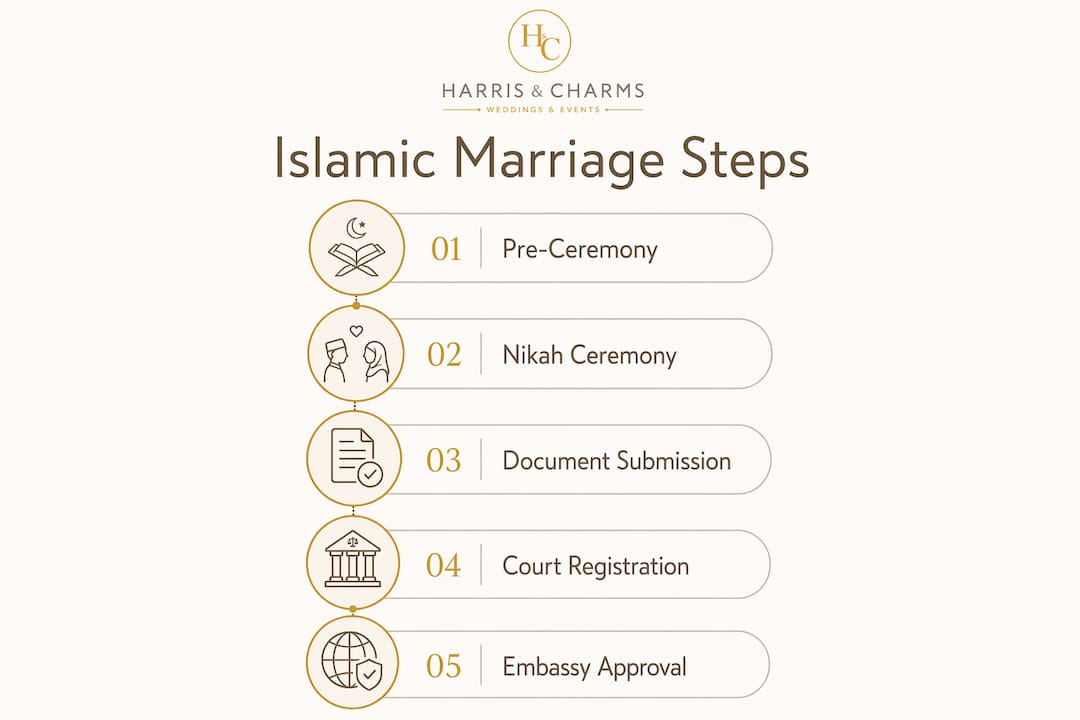
How to complete the Nikah ceremony and register your marriage with the UAE Sharia Courts
The Nikah ceremony follows a defined sequence that must be completed correctly for the registration to proceed. Here is the step-by-step process:
Confirm eligibility. Both parties must meet the age requirements under UAE law and have no existing marriage that would prohibit the union.
Gather all documents. Compile passports, Emirates IDs, single status certificates, and any embassy-required paperwork before booking the ceremony.
Book a licensed Mazoon. Verify the officiant’s credentials through the relevant emirate’s Sharia Court registry. Licensed Mazoons reduce administrative delays and produce court-ready documentation.
Conduct the Ijab and Qabul. The Ijab (offer) is made by the Wali or bride’s representative, and the Qabul (acceptance) is made by the groom. Both must occur in the presence of the two witnesses and the Mazoon.
Confirm the Mahr. The Mahr (dowry) amount is agreed upon and stated during the ceremony. It becomes part of the marriage contract.
Submit registration documents. After the ceremony, submit the signed marriage contract and all supporting documents to the Sharia Court in the emirate where the ceremony took place.
Receive the official marriage certificate. The court reviews the submission and issues the official certificate, which carries full legal recognition.
Pro Tip: Some emirates now allow online submission of post-ceremony registration documents. Check your emirate’s Sharia Court portal before scheduling an in-person visit, as online processing can be faster.
The table below outlines the core documents required at each stage:
Stage | Required Documents |
Pre-ceremony | Passports, Emirates IDs, single status certificates |
During ceremony | Signed marriage contract, Wali and witness details |
Post-ceremony registration | Completed contract, passport copies, court application form |
Certificate issuance | Court-verified submission confirmation |
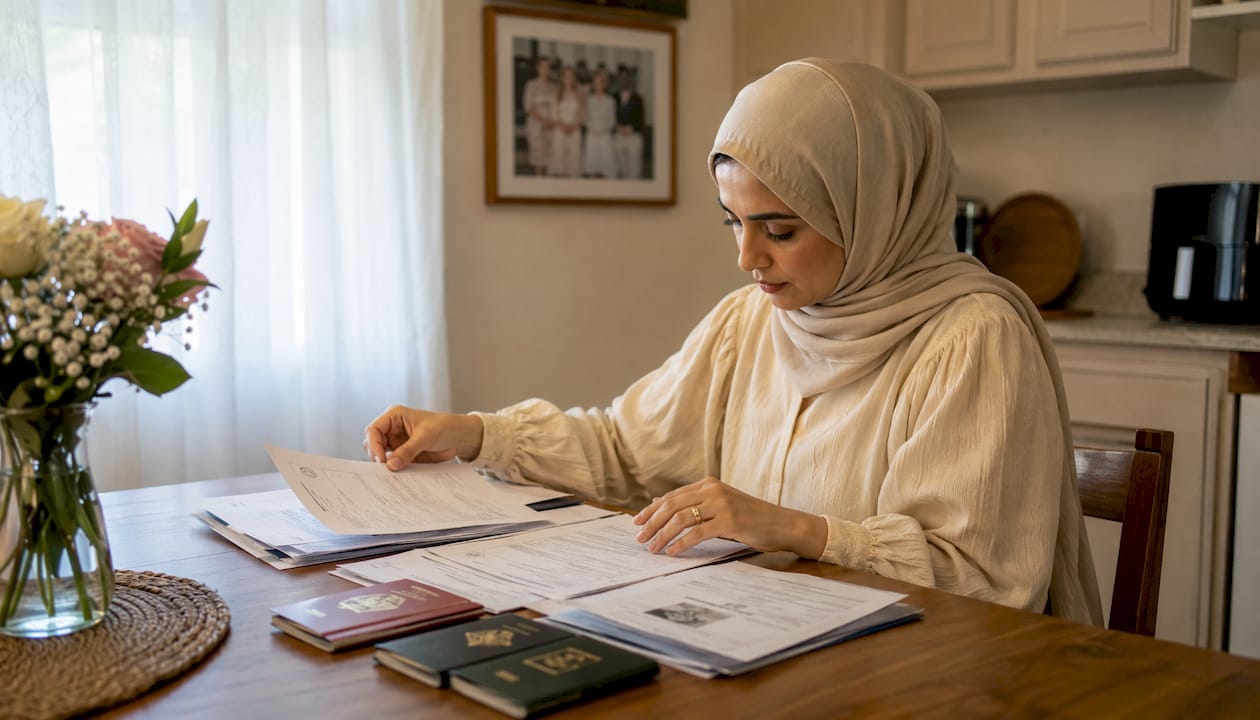
Registration must occur in the emirate where the Nikah ceremony took place. Submitting to the wrong emirate’s court is a common error that causes delays and requires resubmission. The step-by-step registration guide from Harrisandcharms covers emirate-specific portals in detail.
What are common challenges couples face during Islamic wedding registration?
The single most costly mistake couples make is treating the Nikah as legally complete without court registration. An unregistered Nikah has no standing in UAE courts for visa sponsorship, inheritance, or custody disputes. Religious validity and legal validity are two separate outcomes that require two separate steps.
Other frequent problems include:
Choosing an uncertified officiant. An unlicensed Mazoon cannot produce documents the court will accept. Always verify credentials before booking.
Incomplete documentation. Incorrect or missing documents are the leading cause of registration delays. A missing single status certificate or unattested foreign document can stall the process by weeks.
Registering in the wrong emirate. The registration must happen where the ceremony occurred, not where the couple lives or works.
Leaving attestation too late. Foreign documents must be attested by the issuing country’s authorities and then by the UAE Ministry of Foreign Affairs. This process takes time and cannot be rushed.
Couples who treat Islamic marriage registration as a single event rather than a two-part process consistently run into legal problems later. The religious ceremony opens the marriage. The court registration protects it. Skipping the second step is not a minor oversight. It leaves both spouses without legal recourse in any UAE court proceeding.
Expat couples face an additional layer of complexity. Embassy rules and nationality directly affect which documents are required and how they must be attested. Some nationalities require pre-approval from their embassy before the Nikah can proceed. Checking these requirements early is the single most effective way to avoid delays. The Islamic marriage guide for expats from Harrisandcharms breaks down nationality-specific requirements in practical terms.
What legal benefits does Islamic marriage registration provide in the UAE?
Official registration produces a court-issued marriage certificate that functions as legal proof of the union across all UAE government systems. Courts rely exclusively on this certificate for any legal matter involving the marriage. Without it, neither spouse can assert legal rights in a UAE court.
The practical benefits of registration are direct and significant:
Visa sponsorship. A registered spouse qualifies for a UAE residency visa sponsored by their partner. An unregistered Nikah does not meet the visa authority’s requirements.
Inheritance rights. UAE inheritance law recognizes only court-registered marriages. A surviving spouse without a registered marriage certificate may lose inheritance entitlements entirely.
Custody and maintenance. Family courts require a registered marriage certificate before ruling on child custody or spousal maintenance claims.
International recognition. Registered Nikah certificates can be attested for use abroad, supporting immigration and legal processes in other countries.
Legal registration is a safeguard for both spouses, not a bureaucratic formality. The advantages of Islamic marriage registration extend beyond the UAE, particularly for couples who plan to relocate or apply for residency in other countries. Golden visa holders in the UAE also benefit directly, as a registered marriage certificate supports dependent visa applications and family residency status under the Golden Visa program.
Key Takeaways
The Islamic wedding registration process in the UAE requires completing both a valid Nikah ceremony and official Sharia Court registration to produce a legally recognized marriage certificate that protects both spouses’ rights.
Point | Details |
Two-step requirement | A Nikah ceremony alone is not legally sufficient. Court registration is mandatory for legal recognition. |
Licensed Mazoon | Only court-approved officiants can produce registration-ready documentation. Verify credentials before booking. |
Document preparation | Gather passports, Emirates IDs, single status certificates, and attested foreign documents before the ceremony. |
Emirate jurisdiction | Registration must occur in the emirate where the Nikah took place, not where the couple resides. |
Legal protections | A registered marriage certificate is required for visa sponsorship, inheritance claims, and custody proceedings in UAE courts. |
What I’ve learned from helping couples through this process
Most couples who come to me have already completed the Nikah. A surprising number have not registered it. They assume the ceremony was enough, and they only discover the gap when they apply for a spouse visa or face a legal matter that requires proof of marriage. That moment is stressful and avoidable.
The part that catches expat couples off guard most often is the embassy step. They focus on the UAE court requirements and overlook the fact that their home country’s embassy has its own approval process. I’ve seen couples delay their ceremony by a month because they didn’t account for embassy processing time. Starting that step six to eight weeks early is not excessive. It’s realistic.
My honest recommendation is to engage a licensed Mazoon and verify their credentials through the Sharia Court registry before you commit to a date. The documents required for registration should be fully assembled before the ceremony, not after. Chasing paperwork post-ceremony while also managing a new marriage is genuinely difficult. Getting it right the first time is always the better path.
The legal protections that come from registration are real and consequential. Inheritance rights, visa sponsorship, and custody protections all depend on that court-issued certificate. Treat registration as part of the wedding, not as an afterthought.
— Harris
How Harrisandcharms supports your Islamic wedding registration in the UAE
Harrisandcharms offers end-to-end support for Muslim couples completing their Islamic marriage in the UAE, covering both the religious ceremony and the legal registration process.

The team at Harrisandcharms verifies Mazoon credentials, prepares and reviews your full document checklist, and guides you through the correct Sharia Court submission process for your emirate. For expat couples, Harrisandcharms coordinates embassy requirements and document attestation so nothing falls through the gaps. Whether you are a UAE resident or a visitor planning a destination Nikah, the Islamic and civil marriage packages cover every step from ceremony planning to certificate issuance. Reach out to Harrisandcharms before you book your date to make sure your registration is handled correctly from the start.
FAQ
What is the difference between a Nikah and a registered marriage in the UAE?
A Nikah is the Islamic religious marriage ceremony. A registered marriage is the official court record recognized by UAE law. Both are required for full legal validity.
How long does Islamic marriage registration take in the UAE?
Processing time varies by emirate and document completeness. Couples with all documents ready typically receive their certificate within a few days to two weeks after submission.
Can expats register an Islamic marriage in the UAE?
Yes. Expat Muslim couples can register their Nikah in the UAE, but embassy approval and additional documentation are often required based on nationality. Starting the process early is critical.
What documents are needed for Islamic marriage registration?
The core document checklist includes valid passports, Emirates IDs, single status certificates, and attested foreign documents. Additional items may apply depending on nationality and emirate.
Does an Islamic marriage certificate work for UAE visa applications?
Yes. A court-registered marriage certificate is the required proof for spouse visa sponsorship and residency applications in the UAE. An unregistered Nikah does not qualify.
Recommended
Comments